
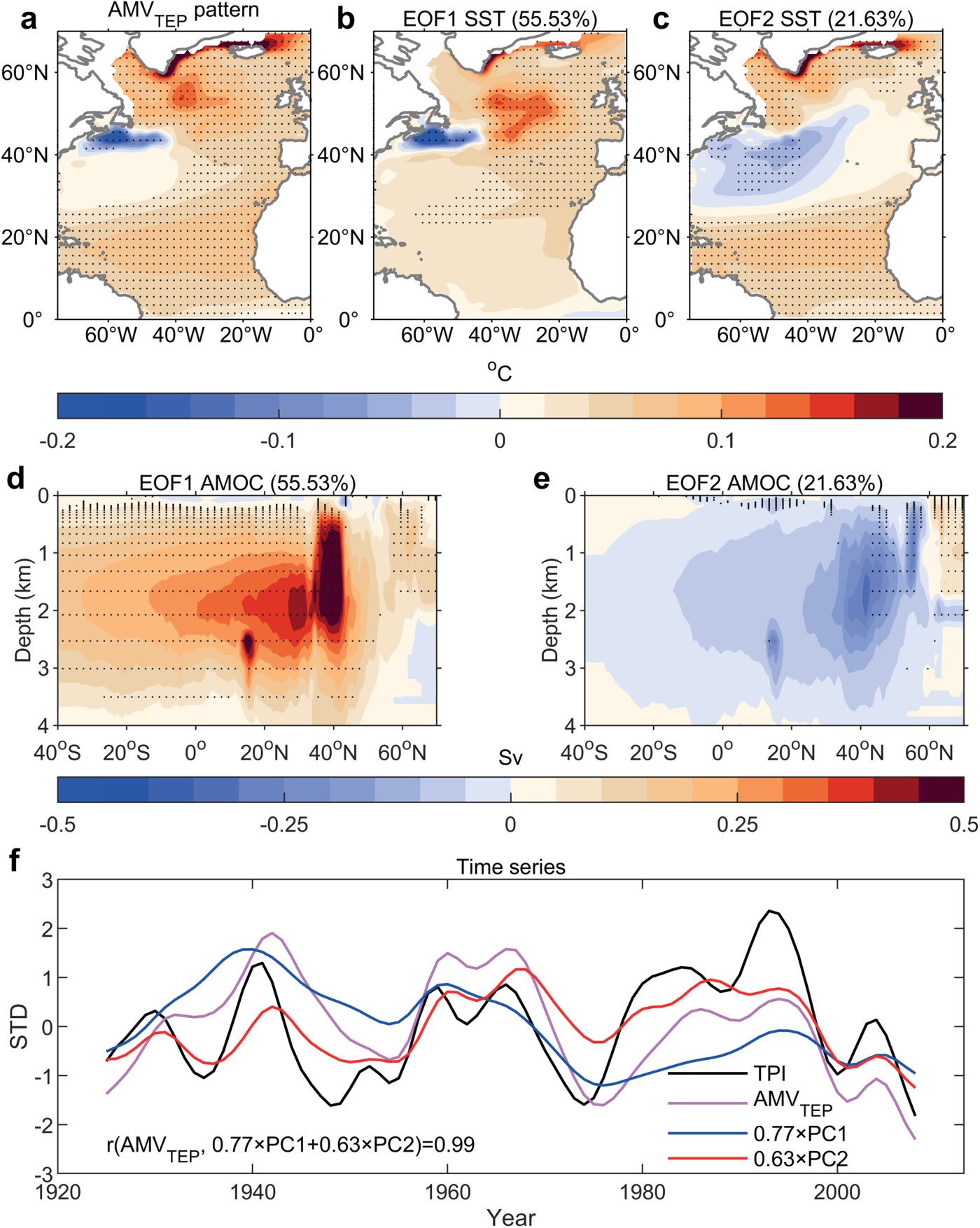
Figure 1 from Yang et al. (2026): The two leading joint EOF modes and their PCs of North Atlantic SST and AMOC decadal variability. (a) Decadal SST anomalies regressed onto the AMVTEP. Decadal SST (b) and AMOC (d) anomalies regressed onto the PC1. In panels (c, e) Same as (b, d) but for the PC2. Stipplings in (a–e) denote regression coefficients exceeding the 90% confidence level. (f) Time series of the TPI (black), AMVTEP (purple), and the normalized PC1 (blue) and PC2 (red) multiplied by their respective correlations with the AMVTEP. Tropical Pacific index (TPI) is decadal SST anomalies averaged in the TEP (180°W–90°W, 15°S–15°N), representing TEP decadal SST variability. AMVTEP is model-estimated TEP-forced decadal SST anomalies averaged in the North Atlantic (75°W–0°W, 0°N–70°N), tracking the TEP-forced AMV. AMVOBS is observed AMV (North Atlantic average) from linearly detrended ERSSTv3b SST. AMVLE is radiatively forced AMV computed as linearly detrended LE ensemble-mean AMV.
This blog post and the “Deep Dive” podcast, created by Google Notebook, are based on “Tropical Eastern Pacific Decadal Variability Drives Atlantic Multidecadal Variability: Two Distinct Pathways” by Yang et al. (2026).
This study demonstrates how decadal temperature shifts in the tropical eastern Pacific act as a primary driver for Atlantic Multidecadal Variability (AMV). Through climate model experiments, the authors identify two distinct pathways that explain how the Pacific influences the Atlantic across different timescales. The first is a rapid atmospheric teleconnection that creates a tripole temperature pattern in the North Atlantic by altering surface heat exchange. Roughly a decade later, a second response emerges as these surface changes modify deep-water formation and slow down the large-scale oceanic overturning circulation. Ultimately, these Pacific-driven processes account for about one-third of historical Atlantic variability, significantly impacting the timing and strength of regional climate phases. These findings suggest that monitoring the Pacific could drastically improve our ability to predict long-term climate trends and extreme weather in the Atlantic basin.
In the study of Earth’s climate, the “butterfly effect” is a common metaphor for how small, localized changes can ripple into massive, unpredictable consequences. However, emerging research suggests that some of the planet’s most significant climate shifts are far less accidental than they appear. The world’s oceans are engaged in a constant, structured conversation, and it appears the Pacific Ocean has been holding the conductor’s baton for the Atlantic’s most significant climate cycles for decades.
For years, scientists have focused on the Atlantic Multidecadal Variability (AMV)—a massive, long-term fluctuation in Sea Surface Temperatures (SST) across the North Atlantic. This phenomenon acts as a global “climate pacemaker,” dictating the frequency of Atlantic hurricanes, the intensity of rainfall in the African Sahel, and seasonal temperature swings across Europe and North America. But a persistent question has haunted climatologists: Is the internal rhythm of the Atlantic truly its own, or is it being driven by a distant drummer?
New research has identified a startling answer. By tracing the “trans-basin” signals between oceans, scientists have discovered that changes in the Tropical Eastern Pacific (TEP) can dictate the climate of the North Atlantic years, or even a full decade, later. This influence travels through two distinct pathways—one a rapid atmospheric “echo” and the other a slow-moving oceanic conveyor—that effectively rewrite the Atlantic’s climate script.
The Pacific is the Atlantic’s Secret “Pacemaker”
To uncover this link, researchers utilized a “pacemaker experiment” using the Community Earth System Model. In this setup, SST anomalies in the Tropical Eastern Pacific were “nudged” to match historical observations while the rest of the global ocean was allowed to evolve naturally. This allowed scientists to isolate exactly how much of the Atlantic’s behavior is forced by the Pacific versus how much is generated internally by the Atlantic’s own local physics.
The results challenge the traditional view of the Atlantic as an isolated system. The TEP was found to account for approximately 30% of the variance in the internal AMV. This suggests that nearly one-third of the Atlantic’s multidecadal rhythm is actually a response to a distant signal from the Pacific, forcing a reconsideration of what we define as “internal” variability.
“The tropical eastern Pacific (TEP) decadal sea surface temperature variability is a crucial forcing of the AMV… we find a two-step AMV response to the TEP forcing involving rapid surface changes and slow ocean circulation adjustments.” — Plain Language Summary, Yang et al.
The Fast Track: An Atmospheric “Echo” One Year Later
The first pathway is an “atmospheric bridge” that delivers a rapid response, accounting for 40% of the TEP-forced signal. When decadal temperatures shift in the Pacific, they excite tropospheric Rossby wave trains—massive planetary waves that propagate through the atmosphere to the North Atlantic.
This atmospheric shift leads to a pressure pattern that resembles the North Atlantic Oscillation (NAO), a major fluctuations in air pressure. However, this TEP-forced pattern is shifted farther north than the standard NAO, meaning it influences the subpolar regions more than the tropics. This pressure shift alters surface winds and heat exchange, creating a Tripole Response in SSTs that peaks just one year after the Pacific trigger:
- Subpolar and Tropical Regions: Experience positive temperature anomalies (warming).
- Midlatitudes: Experience negative temperature anomalies (cooling), specifically centered near 65°W, 40°N.
This signal persists through a “reemergence process.” During the winter and spring, these temperature anomalies penetrate into deeper layers of the ocean. They “hide” beneath the surface during the summer, only to reemerge the following winter when the ocean’s mixed layer deepens again, reinforcing the initial atmospheric impact.
The Slow Burn: The Decade-Long Deep Ocean Conveyor
While the atmospheric bridge is fast, it actually seeds a second, much slower pathway that relies on the deep-ocean conveyor belt. This oceanic response eventually creates a Monopole Response—a basin-wide warming or cooling that accounts for 59% of the total TEP-forced signal.
The transition from the “Fast” to the “Slow” pathway is a masterpiece of geophysical linking. The subpolar warming generated during the initial Tripole phase acts as the trigger for a complex causal chain:
- Buoyancy Shifts: The surface warming in the subpolar North Atlantic outweighs freshening effects, driving negative surface buoyancy fluxes.
- Shoaling the Mixed Layer: Because the surface water is more buoyant (warmer and less dense), the ocean’s mixed layer “shoals,” or becomes shallower.
- Inhibition of Deep Water: This shallow mixed layer inhibits the formation of North Atlantic Deep Water, the engine of global circulation.
- Slowing the AMOC: Consequently, the Atlantic Meridional Overturning Circulation (AMOC)—the massive “conveyor belt” that moves heat northward—slows down.
The most dramatic aspect of this process is the time-lag. Because ocean circulation moves at a glacial pace compared to the atmosphere, the resulting monopole temperature shift lags the initial Pacific trigger by approximately 12 years. This “oceanic memory” is a game-changer for decadal forecasting; it suggests the Pacific conditions of today are a preview of the Atlantic climate in the 2030s.
Shifting the Historical Timeline
The influence of the Pacific is not merely theoretical; it has actively shaped the historical timeline of the AMV. The TEP does not just “influence” the Atlantic; it can actively accelerate, stall, or weaken its natural cycles through a two-way trans-basin conversation.
Specific historical data points illustrate this power:
- The Early 1960s: A peak in Pacific forcing during this era effectively stalled the Atlantic’s internal rhythm, delaying a major phase transition in the North Atlantic by five years.
- The Late 1990s and 2000s: Pacific conditions during the 1997–2008 mean acted as a significant brake on the Atlantic, weakening its positive temperature phase by an estimated 33%.
These insights suggest that the Pacific and Atlantic are not soloists, but participants in a synchronized duet. While the Atlantic has its own internal physics, the Pacific has the power to override the script, modulating both the intensity and the timing of the Atlantic’s phase changes.
Conclusion: A New Frontier for Climate Prediction
The discovery of these two distinct pathways—the rapid atmospheric tripole and the decade-delayed oceanic monopole—clarifies why the North Atlantic has remained so notoriously difficult to predict. We are seeing that the Atlantic’s future is often written in the Pacific’s past.
Consequently, improving our ability to simulate Tropical Eastern Pacific variability is now a non-negotiable requirement for the next generation of climate models. If we cannot accurately capture the Pacific’s “pacemaker” effect, our long-term predictions for European heatwaves, Sahelian droughts, and Atlantic hurricane seasons will remain fundamentally incomplete.
As we move forward, a critical question remains: If the Pacific holds the key to 30% of the Atlantic’s variability, what other trans-basin “conversations” have we yet to overhear? Ignoring these global connections may be the greatest remaining limit to our predictive capabilities in a changing world.
Yang, J.-C., Lin, X., Li, J., Zhang, Y., Xu, W.-Y., & Lv, Z. (2026). Tropical eastern Pacific decadal variability drives Atlantic multidecadal variability: Two distinct pathways. Geophysical Research Letters, 53, e2026GL124187. https://doi.org/10.1029/2026GL124187


Leave a comment