North Atlantic Temperature Regimes Increase Long-Range Weather Predictability
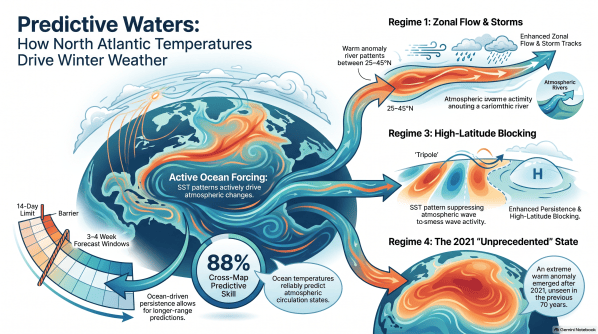
This infographic was generated by Google Notebook. This blog post and the “Deep Dive” podcast, created by Google Notebook, are based on a preprint article “North Atlantic SST Drives Sub-seasonal Variability and Predictability of the Large-Scale Circulation” by Murphy et al. (2026). A preprint article by Murphy et al. (2026) investigates the causal relationship between North... Continue Reading →

Think Twice Before Using NAO Time Series in Your Next Climate Study

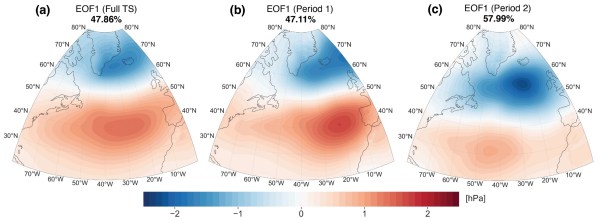
Figure 6 from Ender et al. (2026). EOFs 1 of monthly ERA5 sea level pressure over the North Atlantic (20°- 80°N, 90°W-0) for full record [(a); 1993–01 to 2023-12], Period 1 [(b); 1997–06 to 2001-10], and Period 2 [(c); 2004–02 to 2008-06]. Percent variance explained by each EOF is expressed in subplot titles. This blog... Continue Reading →

SST Anomalies in the Tropical Eastern Pacific can dictate the climate of the North Atlantic a decade later

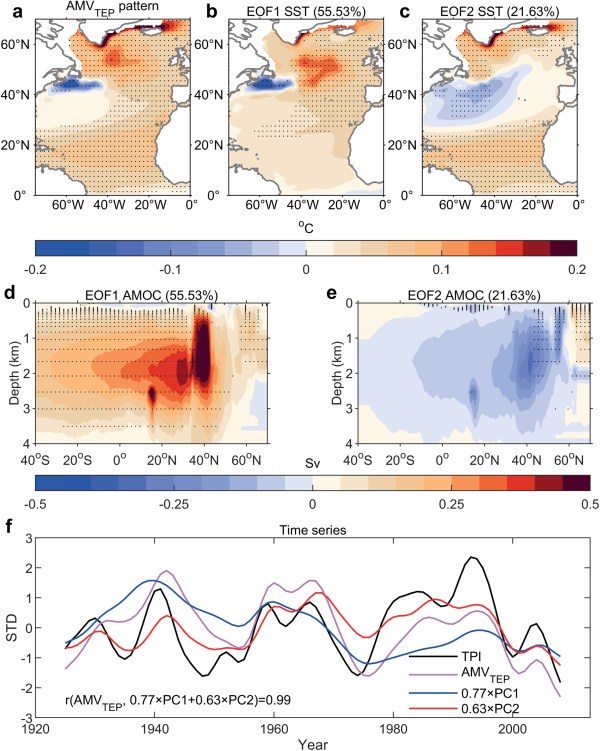
Figure 1 from Yang et al. (2026): The two leading joint EOF modes and their PCs of North Atlantic SST and AMOC decadal variability. (a) Decadal SST anomalies regressed onto the AMVTEP. Decadal SST (b) and AMOC (d) anomalies regressed onto the PC1. In panels (c, e) Same as (b, d) but for the PC2. Stipplings in (a–e) denote... Continue Reading →

New Study Reveals Key Local Blind Spots in Climate Model Projections

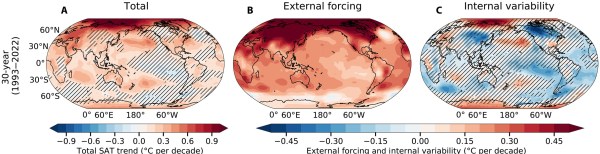
Fig. 2 from Aru et al. (2026): Partitioning of observed SAT trend patterns into external forcing and internal variability. (A) Total, (B) external forcing, and (C) internal variability observed SAT trend patterns for the most recent (D to F) 30-year (1993–2022) periods, respectively, by regressing observed local anomalies against the 1850–2022 MMLE GSAT time series. Hatched regions... Continue Reading →

Strengthening of the Indonesian Throughflow Accelerated Indian Ocean Warming Contrary to Climate Model Projections

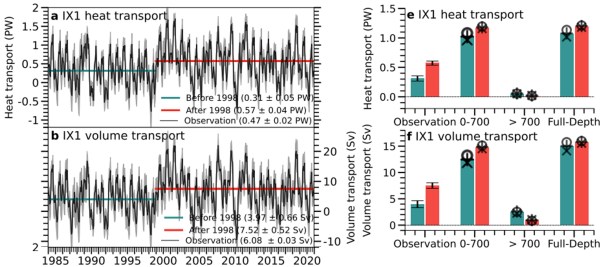
Figure 1 from Guo et al. (2026): Heat and volume transports across the IX1 section and within Makassar Strait. a, b Heat (a) and volume (b) transports of the upper 700 m across the IX1 section, based on relative geostrophic currents estimated with observational data of ocean temperature and salinity. The grey shading represents the... Continue Reading →

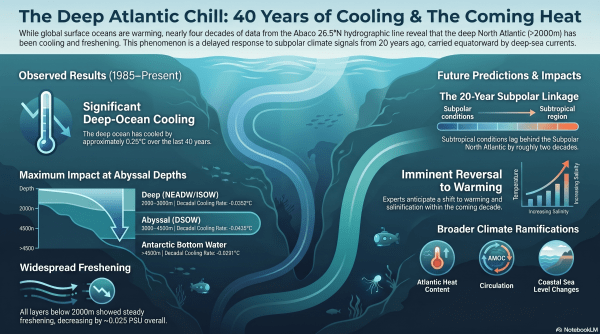
The Atlantic’s Deep-Sea Time Capsule: Why the Depths are Cooling in a Warming World

This blog post and the “Deep Dive” podcast, created by NotebookLM, are based on “Deep ocean cooling and freshening from Subpolar North Atlantic reaches Subtropics at 26.5°N” by Chomiak et al. (2025). Chomiak et al. (2025) identifies a surprising cooling and freshening trend in the deep waters of the Subtropical North Atlantic, specifically at the... Continue Reading →

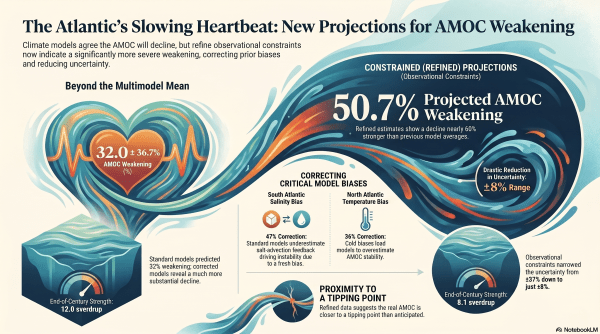
The Atlantic’s ‘Conveyor Belt’ is Weakening Faster Than Predicted Once Model Biases Are Corrected

This blog post and the “Deep Dive” podcast, created by NotebookLM, are based on “Observational constraints project a ~50% AMOC weakening by the end of this century” by Portmann et al. (2026). Portmann et al. (2026) published in Science Advances utilizes observational constraint methods to refine future projections of the Atlantic Meridional Overturning Circulation (AMOC), a critical system of ocean... Continue Reading →

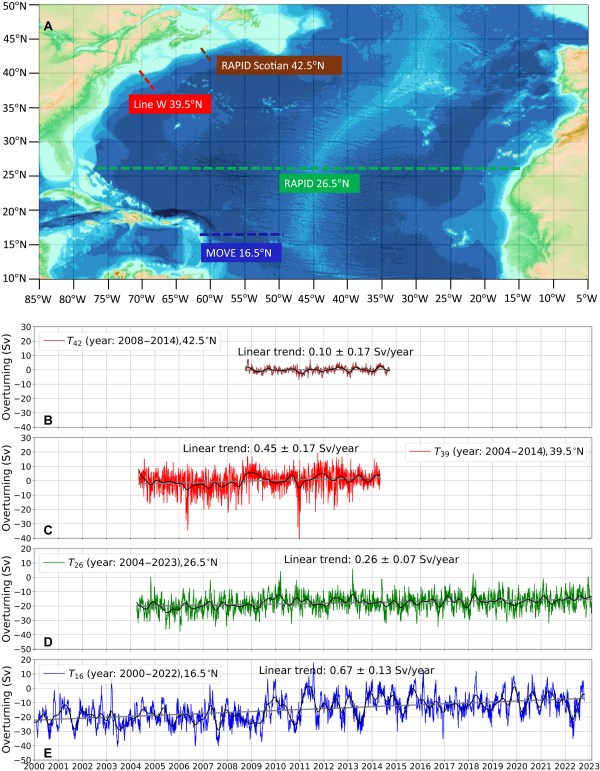
The North Atlantic Deep Western Boundary Current is Faltering

This blog post and the “Deep Dive” podcast, created by NotebookLM, are based on “Meridionally consistent decline in the observed western boundary contribution to the Atlantic Meridional Overturning Circulation” by Xing et al. (2026). Xing et al. (2026) analyzes long-term observational data from four major mooring arrays to evaluate the Atlantic Meridional Overturning Circulation (AMOC). By... Continue Reading →

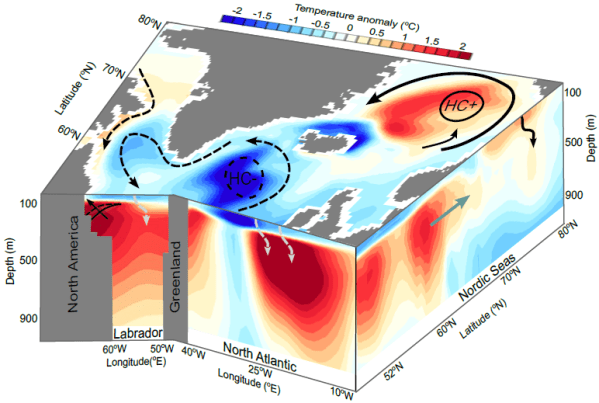
Melting of the Arctic and Greenland ice sheets triggers rapid subsurface warming in the North Atlantic and Nordic Seas

This blog post and the “Deep Dive” podcast, created by NotebookLM, are based on “Rapid subsurface warming in the subpolar North Atlantic from freshening" by Menviel et al. (2026). Menzviel et al. (2026) study explores how increased freshwater from melting Arctic ice and the Greenland Ice Sheet triggers rapid subsurface warming in the subpolar North Atlantic.... Continue Reading →

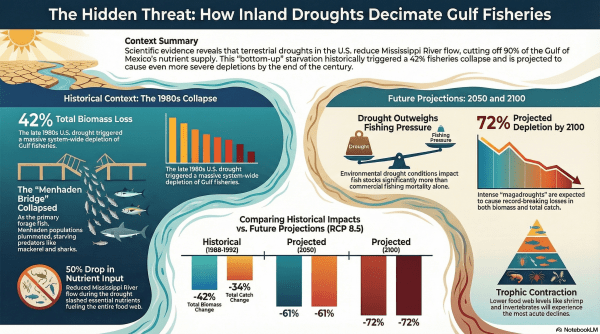
U.S. Drought in the Late 1980s Triggered a Major Depletion of Gulf Fisheries

This blog post and the “Deep Dive” podcast, created by NotebookLM, are based on “Historical depletion and future drought-driven risks to Gulf of Mexico fisheries production” by Berenshtein et al. (2026). This research examines how terrestrial droughts in the United States drastically reduce fisheries production in the Gulf of Mexico by decreasing Mississippi River nutrient... Continue Reading →

Website Powered by WordPress.com.

Up ↑