
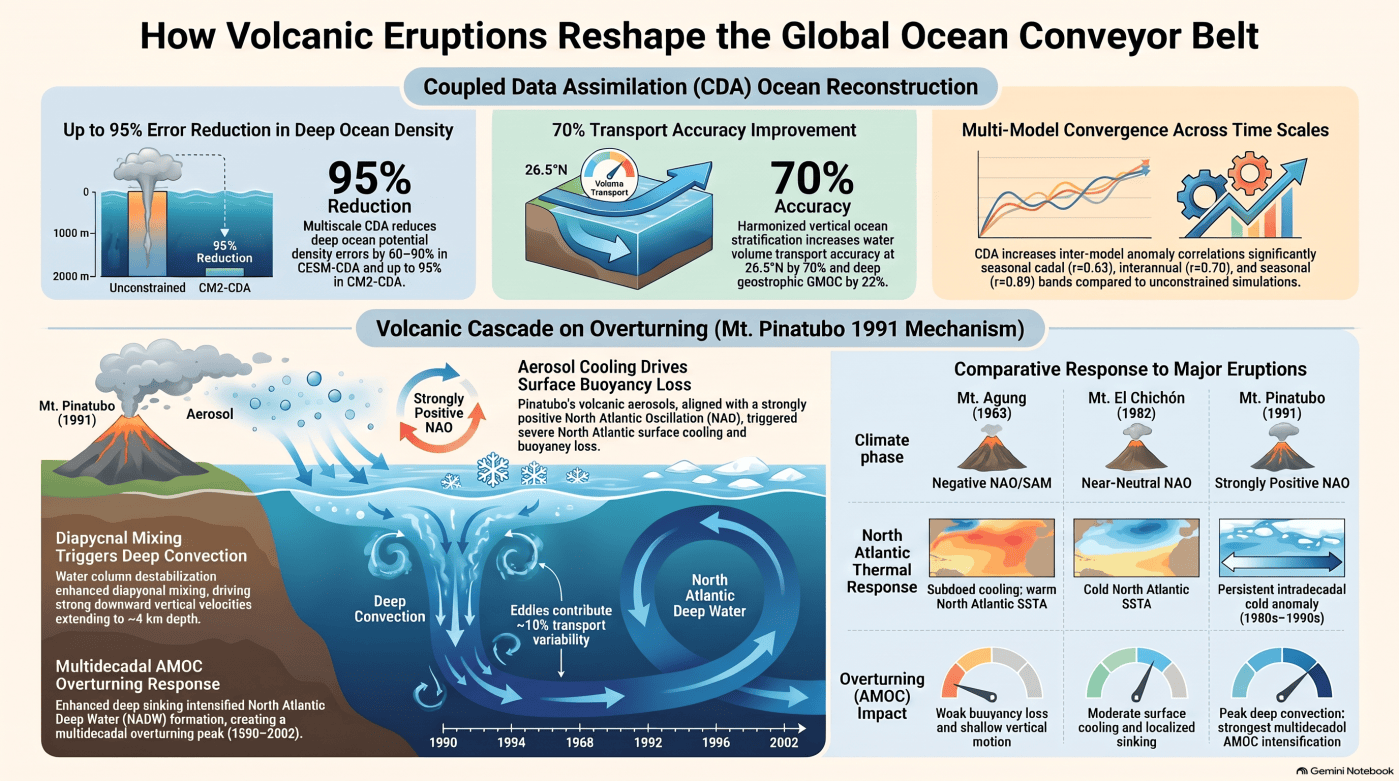
This blog post and the “Deep Dive” podcast, created by Google Notebook, are based on “The coupled reanalysis global meridional overturning circulation imprinted by historic volcanic eruptions” by Jiang et al. (2026).
A new research published in Nature Communications successfully reconstructed the past eighty years of the global ocean meridional overturning circulation by applying advanced coupled data assimilation systems to harmonize atmospheric and oceanic observations. This methodology significantly minimized model biases and enhanced the representation of deep-ocean stratification to accurately capture historical ocean dynamics. The resulting data revealed that major historic volcanic eruptions, particularly the 1991 Mt. Pinatubo event, left distinct footprints on ocean variability by triggering surface cooling and buoyancy loss. These eruptions intensified diapycnal mixing and deep convection through a chain of reactions heavily mediated by eddy activities. Ultimately, the study demonstrates how integrating observational data into climate models improves our understanding of multiscale ocean processes and circulation responses to major natural events.
1. Introduction: Uncovering the Hidden Pulse of the Oceans
The Global Meridional Overturning Circulation (GMOC) acts as Earth’s planetary conveyor belt, redistributing vast quantities of heat, freshwater, carbon, and nutrients between ocean basins. This immense liquid system regulates regional weather patterns and maintains global climate equilibrium. Yet, for decades, Earth system scientists faced a intriguing climate mystery: how explosive volcanic eruptions—occurring thousands of miles away on land—can secretly re-engineer this deep ocean circulation system across multidecadal timescales.
Reconstructing an accurate 80-year history of the GMOC has long been stymied by a lack of deep-sea observational data prior to the modern Argo array and by persistent systematic biases in climate models. A breakthrough 2026 study published in Nature Communications by Jiang et al. has finally solved this puzzle. By fusing atmospheric and oceanic observations within two independent Earth system models using Coupled Data Assimilation (CDA), researchers constructed dynamically consistent 3D reconstructions of ocean transport from 1945 to the present. In doing so, they revealed that historical volcanic eruptions leave distinct, multidecadal “fingerprints” written deep into the ocean’s physical structure.
2. Takeaway 1: Giant Volcanic Eruptions Can Trigger Multidecadal Shifts in the Ocean’s Deep Conveyor Belt
When Mt. Pinatubo erupted in June 1991, it blasted massive quantities of sulfur dioxide aerosols into the stratosphere. While the immediate surface cooling effects were felt globally, the study reveals that Mt. Pinatubo initiated a deep oceanic chain reaction that altered global circulation for decades.
The eruption triggered severe surface cooling and a net surface buoyancy loss over the high-latitude North Atlantic. While net surface heat flux () dominated the initial buoyancy loss, the researchers found that a persistent decline in the freshwater flux component () through 2000 played a vital role in sustaining this negative buoyancy state over a multidecadal window.
Crucially, the ocean does not respond to atmospheric cooling instantly. The study identified a 2- to 3-year lag (quantified as a 28-month lag) between North Atlantic sea surface temperature (NASSTr) anomalies and changes in North Atlantic Deep Water (NADW) formation. In physical oceanography, NADW volume is measured by the layer thickness between specific potential density surfaces—specifically (potential density referenced to a depth of 1500 meters). Because surface cold water requires time to destabilize upper layers and mix downward into these specific density surfaces, the intra-decadal surface cold phase following Pinatubo (which reached its minimum in 1993–1994) drove a strong NADW formation phase from 1990 to 2002, peaking in transport around 1996–1997.
Volcanic surface cooling and sustained freshwater changes drive deep buoyancy loss, enhancing diapycnal mixing to trigger multidecadal shifts in global overturning.
“The Mt. Pinatubo (1991) volcanic eruption produces a multidecadal characteristic of the overturning evolution by the chain of enhancing diapycnal mixing – strengthening deep convection – mediated by eddy activities.“
3. Takeaway 2: Timing is Everything—Why Mt. Pinatubo Reshaped the Oceans While Other Eruptions Faltered
While Mt. Pinatubo left a lasting mark on deep ocean circulation, an intriguing finding of the study is that major volcanic eruptions do not produce identical overturning responses. The 1963 eruption of Mt. Agung and the 1982 eruption of Mt. El Chichón produced far weaker, shorter-lived ocean overturning responses.
Why did Mt. Pinatubo reshape global conveyor dynamics while Agung and El Chichón faltered? The answer lies in the state of background atmospheric climate modes at the moment the aerosols hit the stratosphere:
- Mt. Pinatubo (1991): Coincided with a strongly positive phase of the North Atlantic Oscillation (NAO). This atmospheric alignment strengthened the westerly jet stream and boosted poleward heat transport, creating the ideal background state for volcanic cooling to trigger deep oceanic convection.
- Mt. El Chichón (1982): Occurred during a near-neutral NAO phase, which generated much weaker surface buoyancy loss and resulted in a subdued NADW response.
- Mt. Agung (1963): Coincided with both a negative NAO phase and a negative Southern Annular Mode (SAM) phase. The negative SAM weakened Southern Ocean wind stress, reducing the Antarctic Circumpolar Current residual circulation (ACC-RC) transport. This attenuated the northward positive salinity anomaly flux through the South Atlantic, depriving the high-latitude North Atlantic of salt and suppressing local density-driven downwelling.
The background atmospheric state acts as a planetary gateway, dictating whether aerosol cooling gets translated into deep ocean circulation shifts or muted at the surface.
4. Takeaway 3: Ocean Eddies and Diapycnal Mixing Are the Hidden Elevators Driving 4 km Deep Sinking
To trace how high-altitude volcanic cooling reaches the abyssal ocean, researchers dissected the subsurface physical chain reaction:
Volcanic Cooling Surface Buoyancy Loss Enhanced Diapycnal Mixing Deep Sinking (Vertical Velocity)
Following Mt. Pinatubo, surface buoyancy loss destabilized the upper ocean, driving intense diapycnal mixing—the vertical movement of water across constant density surfaces (in contrast to isopycnal mixing, which is the horizontal or slanted movement along surfaces of equal density). While isopycnal mixing reshuffles water laterally, diapycnal mixing requires fluid turbulence and buoyancy loss to force surface signatures vertically across density layers.
Mesoscale ocean eddies act as the physical engine mediating this vertical transport. The study calculated that eddy-driven overturning accounts for approximately 19% of total Atlantic Meridional Overturning Circulation (AMOC) variability.
This eddy-mediated engine drove downward vertical velocity anomalies to extreme depths of ~4 kilometers following Mt. Pinatubo. In contrast, Mt. Agung and Mt. El Chichón produced shallow, muted vertical velocity profile anomalies, proving that vigorous diapycnal mixing and eddy transport are essential to propel volcanic signals into the deep ocean.
5. Takeaway 4: Fixing an 80-Year Data Puzzle—How “Coupled Data Assimilation” Solved Deep Ocean Bias
Connecting atmospheric forcing to deep ocean motion required solving an 80-year climate modeling challenge. Free-running historical climate models suffer from severe systematic model biases in the deep ocean due to accumulated errors, while direct subsurface observations before the Argo satellite era are sparse.
To bridge this observational gap, researchers developed Coupled Data Assimilation (CDA) systems across two Earth system models—the Community Earth System Model (CESM) and the 2nd generation Coupled Model (CM2)—reconstructing global ocean transport from 1945 to the present.
The technical breakthrough relied on an elegant atmospheric constraint: assimilating gridded surface pressure (P_s) from the ERA5 atmospheric reanalysis alongside ocean temperature and salinity profiles. Assimilating surface pressure alone for the atmosphere acts as a powerful engineering solution because surface pressure reflects whole-column atmospheric mass variations. This allows the model to constrain global wind systems accurately without over-constraining upper-air variables. When paired with deep-ocean climatological restoration to the World Ocean Atlas (WOA), the system eliminated deep model drift while preserving realistic upper-ocean variability.
The quantitative improvements achieved by CDA over traditional free-running model simulations highlight the power of this method:
| Metric / Feature | Simulation Comparison: Free Runs vs. Coupled Data Assimilation (CDA) |
| Deep Ocean Potential Density Error (Below 2000m) | Free runs exhibit high systematic model bias; CESM-CDA achieved a 60–90% error reduction, while CM2-CDA achieved up to a 95% reduction relative to free runs. |
| Inter-Model Decadal GMOC Correlation | Free historical runs diverged with a low correlation of 0.18; CDA forced convergence between independent models to 0.62. |
| Deep Ocean Geostrophic GMOC Accuracy (Below 2000m) | Baseline free model error was reduced by 32% in CDA estimates compared to free historical runs. |
| Water Volume Transport Accuracy at 26.5°N | Baseline free model representation improved by 70% in CDA reanalysis compared to free historical runs. |
6. Conclusion: The Future of Ocean Forecasting and AI Integration
The creation of dynamically consistent, 80-year 3D ocean reconstructions marks a pivotal milestone for Earth system science. By resolving deep-ocean systematic biases, these high-resolution coupled reanalyses provide an accurate observational foundation that unlocks deep-ocean memory. These datasets will serve as the baseline training ground for next-generation artificial intelligence and machine-learning climate models designed to predict multi-year climate oscillations and basin-scale shifts.
To advance ocean forecasting even further, future climate reanalysis will require ultra-high-resolution models capable of explicitly resolving ocean sub-mesoscales, tropical cyclones, cloud physics, and multiscale sea-ice dynamics. Sea-ice processes in particular demand multiscale modeling, spanning thermodynamic interactions and rheological dynamics from millimeters to thousands of kilometers.
As climate change continues to perturb global air-sea interactions, how will unlocking the historical memory encoded deep in the ocean’s conveyor belt improve our ability to anticipate extreme climate events in an warming world?
Jiang, Y., Zhang, S., Gao, Y. et al. The coupled reanalysis global meridional overturning circulation imprinted by historic volcanic eruptions. Nat Commun 17, 8703 (2026). https://doi.org/10.1038/s41467-026-75651-z


Leave a Reply