Beyond El Niño: The Kuroshio-Oyashio Extension as a Precursor to California Winter Extremes

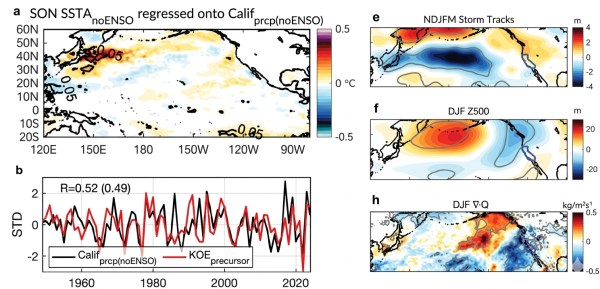
Reproduced from Figures 3 & 6 in Badezet-Delory (2026). (a) Regression of preceding September-November (SON) SST anomalies (°C), with tropical forcing removed, onto the ENSO-independent JFM California precipitation. (b) Comparison of the standardized timeseries of the ENSO-removed JFM California precipitation (black line) and the high-pass-filtered SON KOE precursor index (red line; cut off of 40... Continue Reading →

North Atlantic Temperature Regimes Increase Long-Range Weather Predictability

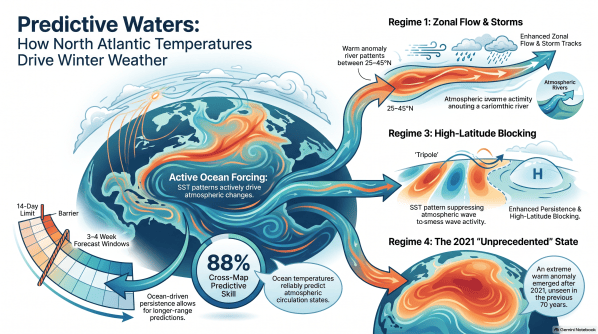
This infographic was generated by Google Notebook. This blog post and the “Deep Dive” podcast, created by Google Notebook, are based on a preprint article “North Atlantic SST Drives Sub-seasonal Variability and Predictability of the Large-Scale Circulation” by Murphy et al. (2026). A preprint article by Murphy et al. (2026) investigates the causal relationship between North... Continue Reading →

Why the Pacific is Cooling in a Warming World

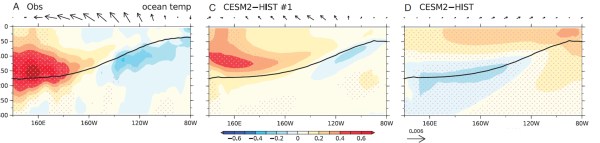
Derived from Figure 2 in Xie et al. (2026). Observed and simulated 1982–2024 trends in equatorial ocean temperature. Linear trend of equatorial (2.5°S to 2.5°N mean) ocean temperature trends (°C/decade) in (A) OISST, (C) a CESM2-HIST member run with the strongest La Nina-like trend, and (D) the CESM2-HIST ensemble mean. Stippling indicates 90% confidence. The... Continue Reading →

Is the Indian Ocean Flooding the U.S. East Coast?

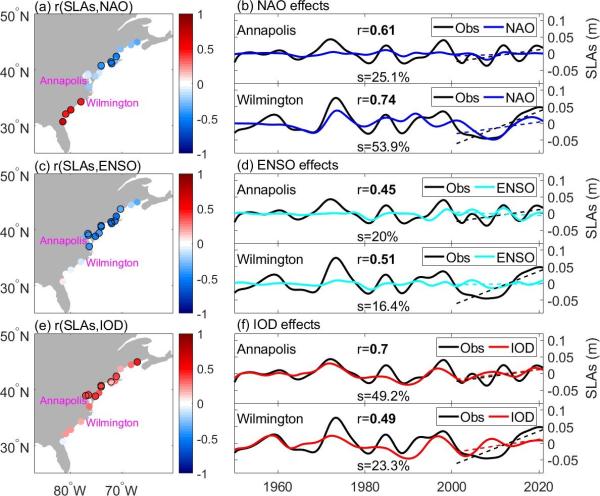
Figure 5 from Zhu et al. (2026). Relationships between decadal sea level anomalies (SLAs) and climate modes for the 1950-2020 period. (a) Correlation coefficients between decadal SLAs (with global mean sea level (GMSL) removed) from tide gauge data and the North Atlantic Oscillation (NAO) index. (b) Decadal SLAs from tide gauge observation (black line) and... Continue Reading →

A 330-Year Record of Ships’ Logbooks Reveal Strong Interplay Between the North Atlantic Oscillation (NAO) and East Atlantic (EA) patterns

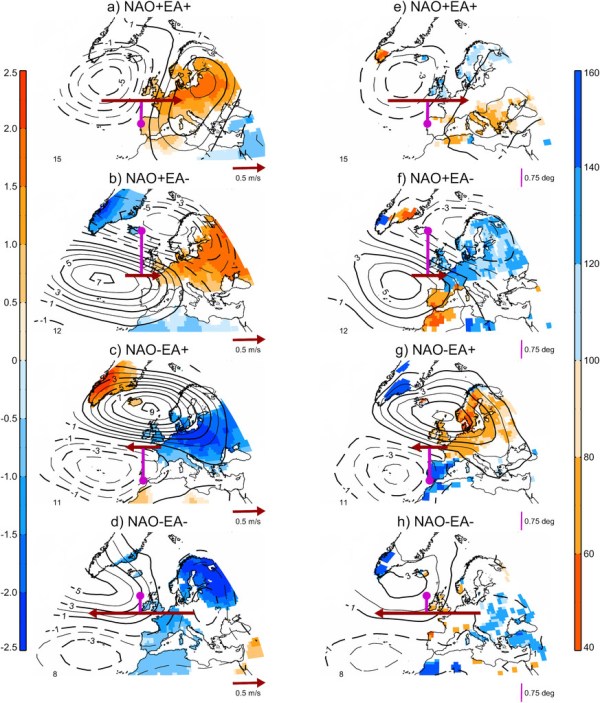
Figure 3 from Mellado-Cano et al. (2019). Winter composites of: (a)–(d) near-surface temperature (shading, in °C) and geopotential height at 500 hPa (contours, in dam) anomalies; (e)–(h) precipitation (shading, in percentage of normals) and SLP (contours, hPa) anomalies for different combinations of NAODI and EADI indices with absolute values larger than 0.5 standard deviations: (a) NAODI+/EADI+, (b)... Continue Reading →

Think Twice Before Using NAO Time Series in Your Next Climate Study

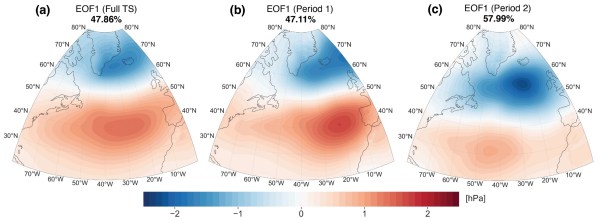
Figure 6 from Ender et al. (2026). EOFs 1 of monthly ERA5 sea level pressure over the North Atlantic (20°- 80°N, 90°W-0) for full record [(a); 1993–01 to 2023-12], Period 1 [(b); 1997–06 to 2001-10], and Period 2 [(c); 2004–02 to 2008-06]. Percent variance explained by each EOF is expressed in subplot titles. This blog... Continue Reading →

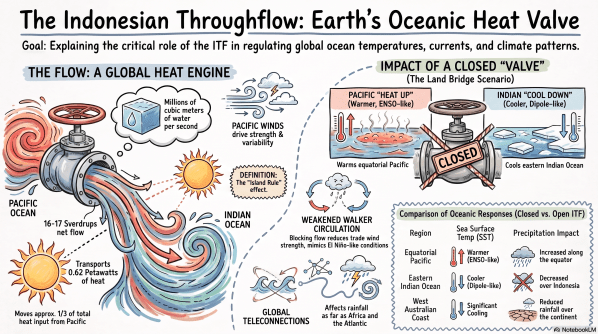
What Happens to the Planet if the Indonesian Throughflow Stops?

This blog post and the “Deep Dive” podcast, created by NotebookLM, are based on several studies, including "The Role of Indonesian Throughflow in a Global Ocean GCM." by Hirst and Godfrey (1993), "The Indonesian Throughflow’s Effect on Global Climate Determined from the COLA Coupled Climate System" by Wajsowicz and Schneider (2001), "Effects of the Indonesian... Continue Reading →

The warming hole has pushed the Atlantic summer jet stream southward

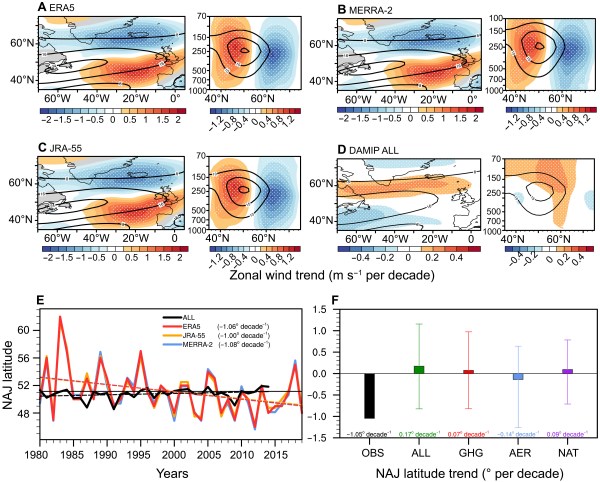
Fig. 1 from Sheng et al. (2026): Trend of the summer NAJ in the reanalyses and DAMIP simulations during 1980–2019. (A) ERA5 (the fifth generation European Centre for Medium Range Weather Forecasts atmospheric reanalysis of the global climate) trend (in meters per second per decade) of the zonal wind at 250 hPa and at the... Continue Reading →

U.S. Drought in the Late 1980s Triggered a Major Depletion of Gulf Fisheries

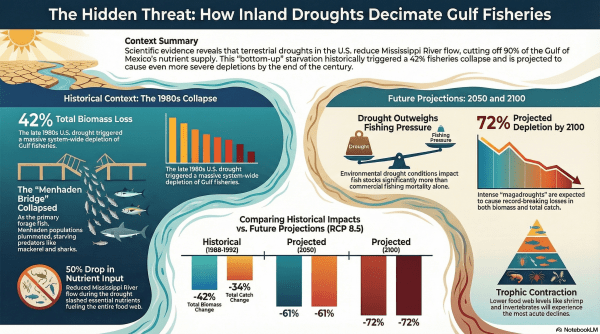
This blog post and the “Deep Dive” podcast, created by NotebookLM, are based on “Historical depletion and future drought-driven risks to Gulf of Mexico fisheries production” by Berenshtein et al. (2026). This research examines how terrestrial droughts in the United States drastically reduce fisheries production in the Gulf of Mexico by decreasing Mississippi River nutrient... Continue Reading →

The Stratospheric Metronome of Global Weather Is Fading Under Global Warming

This blog post and the “Deep Dive” podcast, created by NotebookLM, are based on “The disappearing quasi-biennial oscillation under sustained global warming” by Luo et al. (2026). Luo et al. (2026) examines the potential permanent disappearance of the Quasi-Biennial Oscillation (QBO), a major atmospheric cycle, due to prolonged global warming. Using CMIP6 climate models and high-emission scenarios, the study finds that... Continue Reading →

Website Powered by WordPress.com.

Up ↑