
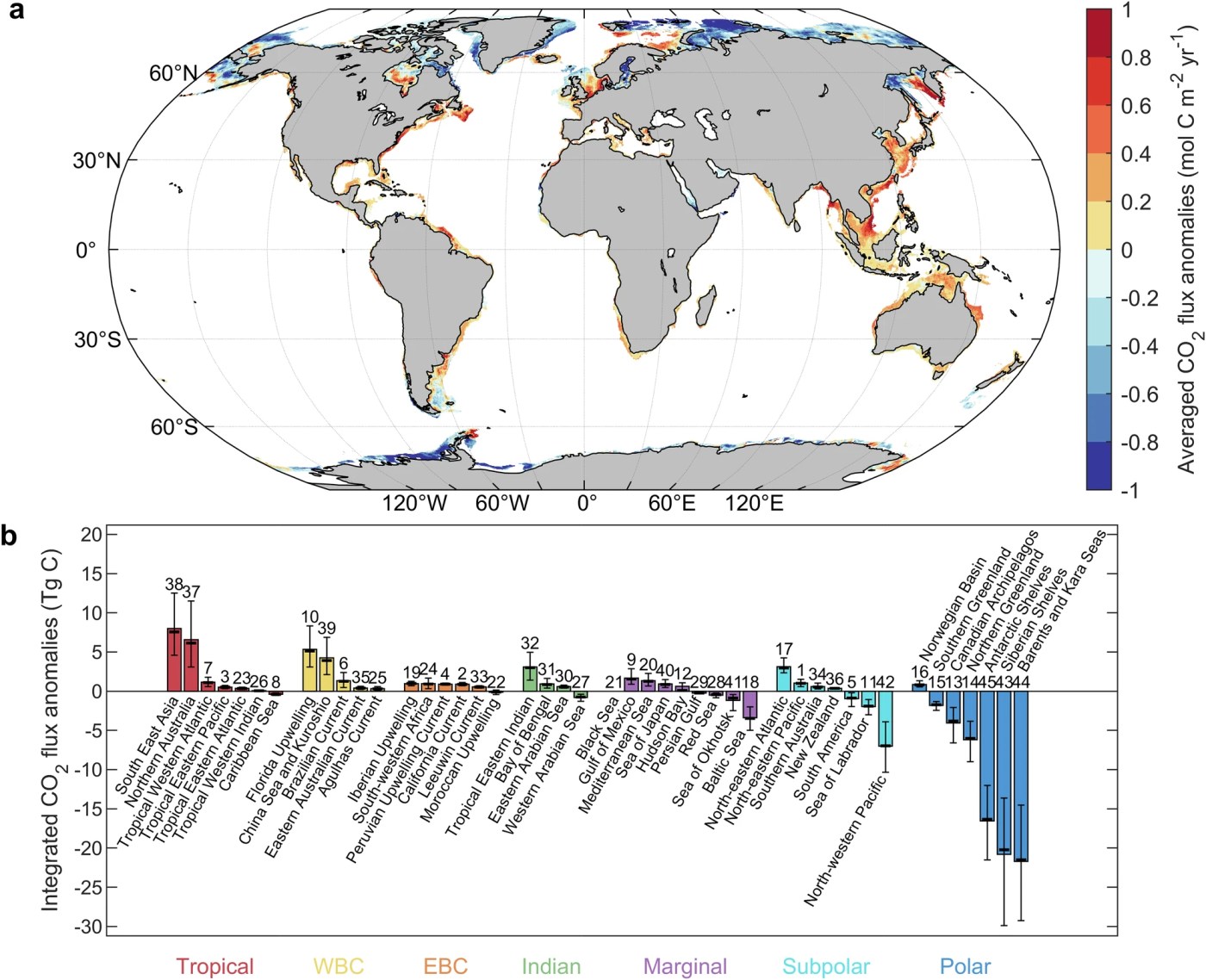
Figure 1 from Hu et al. (2026). a Spatial distribution of averaged air–sea CO2 flux anomalies (mol C m−2 yr−1) during MHW months across the global coastal ocean, derived from the observation-based ULB–SOM–FFN–coastalv2 dataset. Positive anomalies indicate enhanced CO2 outgassing or reduced uptake, whereas negative anomalies represent enhanced uptake or reduced outgassing. b Integrated CO2 flux anomalies (Tg C) across 45 coastal segments from 1985 to 2020 based on the same dataset. Each bar represents the mean anomaly from eleven sensitivity tests; error bars denote the full range of estimates. Bold horizontal lines indicate results obtained with a 15-day threshold for defining MHW months, which serves as the benchmark for class ranking. Classes are ordered by total integrated CO2 flux anomaly in descending order, with segments within each class further ordered by descending anomaly. WBC and EBC denote western and eastern boundary current regions, respectively. Tropical, Indian, Marginal, Subpolar and Polar denote the corresponding coastal regions. Segment names and their serial numbers are shown.
This blog post and the “Deep Dive” podcast, created by Google Notebook, are based on “Polar and subpolar shelf seas dominate enhanced coastal CO2 uptake during marine heatwaves” by Hu et al. (2026).
Hu et al. (2026) investigates the impact of marine heatwaves on the coastal carbon cycle using global observation datasets and biogeochemical modeling. While extreme heat typically reduces CO2 uptake in the open ocean, the researchers found that these events actually increased the net carbon sink in global shelf seas by approximately 11% between 1985 and 2020. This phenomenon is primarily driven by polar and subpolar regions, where rising temperatures cause significant sea-ice loss and stimulate biological carbon fixation. In contrast, lower-latitude coastal systems experience enhanced outgassing due to thermal changes that reduce gas solubility. The study highlights the vital role of high-latitude shelves in buffering the global carbon budget during climate extremes. Ultimately, the authors demonstrate that non-thermal processes in coastal waters can outweigh the standard warming-induced reduction of ocean carbon absorption.
The Hook: A Climate Paradox
Marine heatwaves (MHWs) are traditionally framed as the villains of the climate crisis. These periods of anomalously high sea surface temperatures are well-documented ecological disasters, responsible for mass coral bleaching, collapsing fisheries, and the decimation of vital foundation species. The standard narrative is grim: as the ocean heats up, its ecosystems—and its ability to regulate the climate—suffocate.
However, a surprising discovery in the journal Nature Communications is flipping this narrative on its head. While these “hot” water events generally stress the planet, they are simultaneously triggering a chemical and biological “tug of war” in the coastal carbon cycle. In a startling paradox, extreme heat is actually helping the coastal ocean “breathe in” more carbon dioxide. Under the right conditions, the very events we fear as climate stressors are supercharging the planet’s natural cooling mechanisms.
The Coastal Exception to the Global Rule
While the open ocean tends to lose its capacity to absorb CO2 during heatwaves, coastal shelf seas—the shallow, productive regions near land—behave as a distinct exception. The impact of MHWs is determined by a conflict between thermal drivers (which reduce gas solubility as water warms) and non-thermal drivers (biogeochemical shifts and ice dynamics). In the coastal realm, the non-thermal forces are winning.
Data from 1985 to 2020 reveals a stark contrast between these two marine environments:
- The Coastal Shelf: Experienced an 11.0 ± 1.6% enhancement in net CO2 uptake during MHW months.
- The Open Ocean: Generally saw a suppression of CO2 uptake by approximately 8% during similar events.
To maintain journalistic integrity, it is important to note the scale: while this 11% boost is significant during the heatwaves themselves, it represents about 0.62% of the total annual coastal carbon sink. Nevertheless, it marks a systematic and resilient response from what the researchers describe as a “highly dynamic and biologically productive interface between land and the open ocean.”
The Polar and Subpolar “Carbon Engine”
The global boost in carbon absorption is far from uniform. The heavy lifting for the global coastal carbon budget is performed almost entirely by high-latitude systems.
High-Latitude Dominance More than 90% of the total enhanced CO2 uptake during marine heatwaves is driven by polar and subpolar shelf seas. There is a profound geographical irony at play: the regions warming most rapidly are the ones doing the most work to offset carbon during extreme events. While the North-western Pacific has emerged as a major powerhouse of uptake, the Siberian Shelves and the Barents and Kara Seas are also acting as massive “carbon engines.”
When Melting Ice Becomes a Carbon Doorway
In these high-latitude regions, marine heatwaves are almost always accompanied by a dramatic reduction in sea-ice cover. While ice loss is typically viewed as a climate tragedy, in this specific context, it “opens the door” for atmospheric CO2 absorption.
A reduction in the sea-ice fraction expands the open-water area exposed to the atmosphere and freshens the surface waters. These physical changes facilitate a rapid drawdown of CO2. Without this ice-loss mechanism, the coastal response to heatwaves would likely mirror the open ocean’s decline in efficiency. In the poles, the heatwave essentially removes the physical lid that normally keeps the atmosphere and the ocean apart.
The “Biological Bloom” Effect
Beyond physical changes, the most critical factor in this carbon surge is a biological one: a massive reduction in Dissolved Inorganic Carbon (DIC). This non-thermal driver acts as the principal regulator of the coastal sink. Using the ICON-Coast model—which utilizes a sophisticated “telescoping grid” to seamlessly integrate coastal and open-ocean dynamics—researchers identified that MHWs trigger intense biological activity.
In the nutrient-rich waters of the poles, MHWs alter upper-ocean stratification. This physical shift increases the residence time of phytoplankton in the euphotic zone—the sunlit upper layer—giving them more time to grow and “inhale” carbon. In the Antarctic, the effect is further boosted as melting sea ice triggers an iron release, fertilizing waters that are otherwise chlorophyll-poor.
“Our findings reveal region-specific MHW impacts on coastal carbon dynamics, highlighting a critical role of high-latitude shelf systems in the global carbon budget under ongoing climate change.”
These gains are primarily sustained by improved light and thermal conditions rather than new nutrient inputs. Essentially, the heatwaves remove the cold and dark barriers that usually limit Arctic and Antarctic productivity.
The Latitudinal Great Divide
The story of MHWs as a “carbon gain” is strictly a high-latitude phenomenon. In lower latitudes, the traditional disaster narrative holds firm. Tropical shelf seas and Western Boundary Current (WBC) systems, such as the Florida Upwelling or the China Sea, show the opposite effect.
In these warmer, often oligotrophic (nutrient-poor) waters, MHWs increase CO2 outgassing. This is caused by a double-edged sword:
- Thermal Solubility: Warmer water naturally loses its ability to hold dissolved gases.
- Stratification Barriers: Unlike the nutrient-dense poles, heatwaves in the tropics increase stratification so severely that they cut off the supply of nutrients from below, suppressing biological growth and DIC drawdown.
This divide highlights the complexity of climate science: a single phenomenon—a heatwave—can have diametrically opposite effects on the carbon cycle depending on the latitude.
Conclusion: A Fragile Resilience
The discovery that marine heatwaves enhance coastal CO2 uptake adds a crucial layer to our understanding of the global carbon budget. The polar and subpolar shelf seas are currently providing a measurable, systematic response that offsets some of the climate damage seen in the open ocean.
However, this resilience may be a “fragile” gift. As we continue to hit record-high global temperatures, we must ask: Can we rely on these “accidental” carbon gains as the climate continue to destabilize? Are we witnessing a robust defense mechanism of the planet, or is this a temporary shift in a system that is rapidly reaching its limits? While the Arctic’s “breath” is currently helping to cool the planet, the long-term stability of this polar engine remains one of the most critical questions for our future climate.
Hu, Z., Mathis, M., Li, H. et al. Polar and subpolar shelf seas dominate enhanced coastal CO2 uptake during marine heatwaves. Nat Commun 17, 9346 (2026). https://doi.org/10.1038/s41467-026-77165-0


My experience in the tropics shows that this effect is much stronger at lower latitudes.