
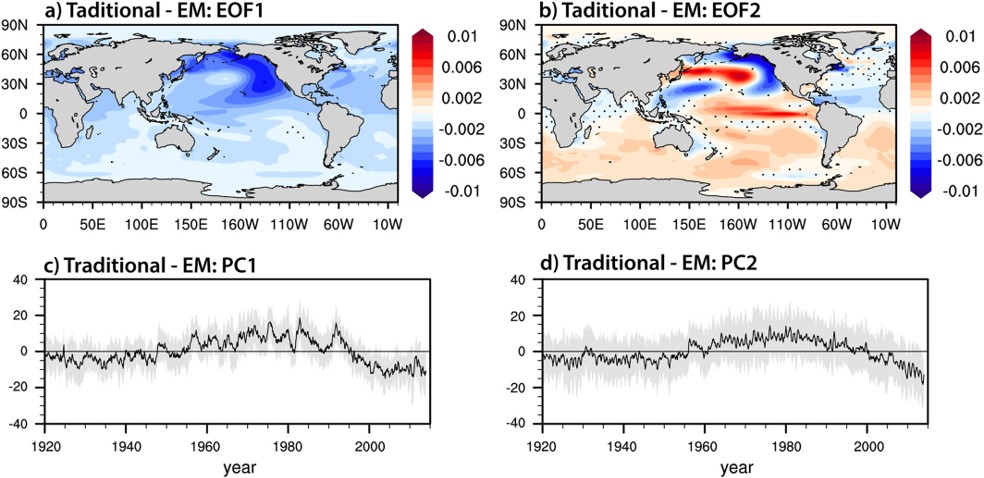
Figure 4 from Xing et al. (2025): Differences between the traditional and ensemble-mean removed methods (hereafter traditional-EM). (a) EOF1 and (b)) EOF2 spatial pattern; here differences are calculated between the ensemble mean of the traditional method applied to each ensemble member, and the ensemble mean of PDV calculated using the ensemble mean removed method. All calculations use the CESM2 full-forcing ensembles. Stippling indicates where responses are not significant at the 95% confidence level, according to the Student’s t test. (c), (d) Traditional-EM differences for PC1 and PC2; black lines denote ensemble mean and shading spans 2 standard deviations.
This blog post and the “Deep Dive” podcast, created by Google Notebook, are based on “Apparent Changes in Pacific Decadal Variability Caused by Anthropogenically Induced Mean State Modulations” by Xing et al. (2025).
This study utilizes large climate model ensembles to investigate how human activities influence Pacific decadal variability (PDV), focusing on the Pacific Decadal Oscillation (PDO) and the North Pacific Gyre Oscillation (NPGO). Researchers found that anthropogenic forcing creates long-term temperature trends that closely mimic these natural cycles, potentially leading to misleading observations of forced phase changes. When scientists used a specialized method to remove the forced mean-state trend, they discovered that the underlying nature of PDV remains largely unchanged by external emissions. However, greenhouse gases and aerosols do notably alter the spatial patterns of these oscillations, even if they do not shift their timing. The findings highlight the difficulty of separating internal climate fluctuations from human-induced warming in a single real-world timeline. Ultimately, the authors emphasize that accurately simulating background temperature trends is a vital prerequisite for understanding future changes in the Pacific Ocean.
For decades, the Pacific Ocean has functioned as the global climate’s primary metronome. This heartbeat, known as Pacific Decadal Variability (PDV), is a slow-moving pulse of sea surface temperatures that dictates the stakes of life on land and sea. Its rhythm determines the intensity of Northeast Pacific marine heatwaves, shifts the trajectory of North American rainfall, and modulates the very rate at which the planet’s average temperature climbs or plateaus.
Yet, as we move deeper into the Anthropocene, a profound “identity crisis” has emerged within the halls of geophysical research. Scientists have long observed shifts in these Pacific cycles that appeared to be direct responses to human interference. But a landmark study by Xing et al. (2025), published in Geophysical Research Letters, suggests we may have been the victims of a sophisticated oceanic masquerade.
The mystery is no longer just about if the ocean is changing, but whether the changes we think we see are real. Is the Pacific Ocean actually altering its natural temporal cycles, or is the fingerprint of human activity simply wearing a “costume” that looks identical to those cycles? The answer suggests that our current understanding of the Pacific’s future may be built on a legacy of mathematical oversimplification.
The “Copycat” Effect: The Danger of Spatiotemporal Convolution
The core finding of the Xing et al. study reveals a startling “copycat” effect: human-induced sea surface temperature (SST) trends are not merely a uniform warming blanket. Instead, they possess distinct spatial patterns that “project” onto natural modes like the Pacific Decadal Oscillation (PDO) and the North Pacific Gyre Oscillation (NPGO).
In essence, because the warming caused by greenhouse gases and the cooling caused by aerosols occupy the same geographic space as the ocean’s natural oscillations, the two signals become “convolved”—tangled so tightly that they are easily confused. This convolution is not just a scientific curiosity; it is a systemic blind spot that risks rendering our climate predictions obsolete. As the study’s abstract warns:
“This suggests that observed PDV responses to anthropogenic forcing may be erroneously convolved with the background trend pattern.”
When human activity mimics a natural cycle, the background trend of a warming world effectively “aliases” itself onto the ocean’s internal variability, creating a ghost signal that scientists have mistaken for a fundamental shift in the Pacific’s heart rate.
The Aerosol Era vs. The Greenhouse Era
The investigative team at Xing et al. successfully decoupled the “costumes” worn by the two primary human drivers of climate change. Their research details a specific, bifurcated timeline of interference:
- Anthropogenic Aerosols (AAER): Between 1950 and 1980, aerosol pollution was the dominant actor. By driving heterogeneous hemispheric cooling, aerosols created a spatial signature that perfectly mimicked a positive PDO phase. This created an illusion of natural variability that was, in fact, a product of industrial pollution.
- Greenhouse Gases (GHGs): From 1980 through 2014, the influence shifted as GHG concentrations surged. This era induced a negative shift in Pacific patterns, driven by enhanced thermodynamic coupling and increased ocean stratification.
The complexity deepens with the “nonlinear GHG–aerosol interplay.” For example, the study notes that the full-forcing PDO-like trend turned downward after the year 2000—a shift not found in single-forcing models. This was likely the result of warming-induced high-latitude albedo feedbacks weakening the shortwave cooling effects of aerosols. Furthermore, the NPGO-like mode in models shows a “slightly colder” tropical bias compared to reality, a nuance that suggests our current simulations may still be struggling to separate the human mask from the oceanic face.
The Legacy of Mathematical Oversimplification
Why did we miss this for so long? The answer lies in a failure of traditional mathematics. For years, the “Traditional Method” of cleaning climate data involved simply subtracting the Global Mean Sea Surface Temperature (GMSST). The logic was simple: remove the average global warming, and what remains must be natural.
The Xing et al. study exposes this as a fallacy. Because human-induced warming is “spatially heterogeneous”—meaning it doesn’t happen evenly—removing a global average effectively “smears” a complex human fingerprint across the entire dataset. This process injects false signals and leaves human-driven changes embedded in the variability.
To solve this, researchers utilized “Large Ensembles”—hundreds of simulations of a single model. By averaging these simulations, they could finally “see” the true ensemble mean (the human signal) and subtract it with surgical precision. When they finally “cleaned” the data this way, the results were staggering: the supposed “forced change” in the Pacific’s timing and frequency—the temporal “beat”—completely vanished.
Changing the Map, Not the Beat
The discovery forces a vital distinction in the climate narrative: humans are changing the map, but not the beat.
When the researchers analyzed the data after removing the ensemble mean, they found that the temporal nature of these modes—their “red noise signals”—remained consistent with pre-industrial conditions. This is the scientific proof that the nature of the Pacific’s internal variability has not fundamentally changed. However, the spatial characteristics of these pulses now bear permanent human fingerprints:
- A Warmer Global Pattern: Greenhouse gas forcing has altered the “look” of internal PDV modes, resulting in a warmer geographic baseline even when the background trend is removed.
- Tropical Cooling Shifts: The second major mode (NPGO-like) now exhibits a significant “La Niña-like pattern” in the tropical Pacific that is absent in the natural state.
The investigative conclusion is clear: we aren’t changing how fast the ocean’s heart beats, but we are fundamentally reshaping the geography of the heart itself.
The “Single Realization” Problem: A Warning for the Real World
The most sobering limitation of this research is what scientists call the “Single Realization” problem. In a computer model, we can run the Earth 100 times, average the results, and isolate the human signal. In the real world, we only have one Earth and one history.
We are living in a single realization where we cannot “subtract the mean” because we are part of the mean. This makes it almost impossible to remove a “background trend” from our actual observations without a control Earth for comparison. If we continue to misread the Pacific’s “costume,” we are likely miscalculating the timing of the next “Big Dry” in North America or the onset of the next Super El Niño. As the researchers conclude:
“Correctly determining the mean-state trend is a necessary precursor for identifying possible forced changes to PDV.”
Conclusion: Beyond the Illusion
The Xing et al. (2025) study serves as a masterclass in scientific skepticism, revealing that many of our “observed” changes in the Pacific are likely the background noise of a warming world masquerading as a natural cycle.
It leaves us with a haunting question for the future of climate prediction: How can we trust our observations of “natural” shifts when the human footprint is so perfectly designed to mimic them? Until we can strip away the masquerade and perfectly map the background trend of our changing climate, the Pacific’s true rhythm may remain an enigma, hidden behind a human-made illusion.
Xing, C., Stevenson, S., Di Lorenzo, E., Newman, M., Capotondi, A., Fasullo, J., & Maher, N. (2025). Apparent changes in Pacific decadal variability caused by anthropogenically induced mean state modulations. Geophysical Research Letters, 52, e2025GL116499. https://doi.org/10.1029/2025GL116499


Leave a comment