
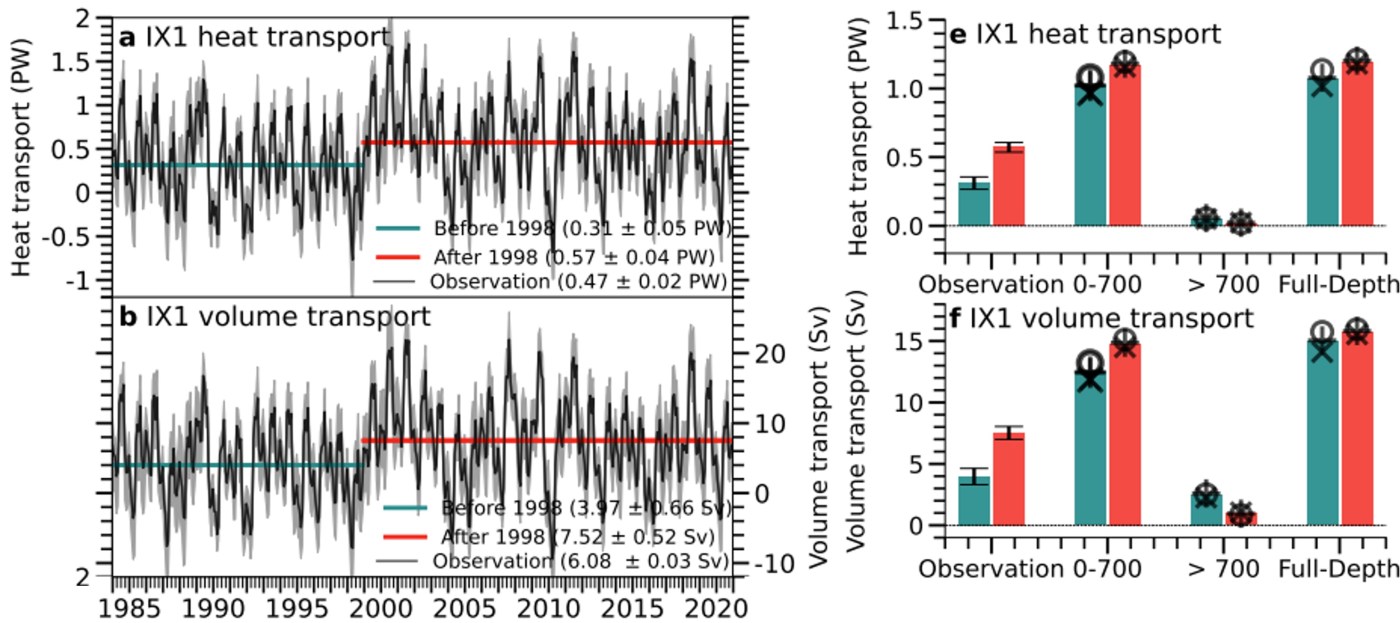
Figure 1 from Guo et al. (2026): Heat and volume transports across the IX1 section and within Makassar Strait. a, b Heat (a) and volume (b) transports of the upper 700 m across the IX1 section, based on relative geostrophic currents estimated with observational data of ocean temperature and salinity. The grey shading represents the 90% confidence interval based on Monte Carlo simulations, while the blue and red lines indicate the average values of 1984 1997 and 1998 2020, respectively. e, f Mean ITF heat (e) and volume (f) transports across the IX1 line over the 1984 1997 (blue) and 1998 2020 (red) periods. The “Observation” is based on relative geostrophic current estimates of 0 700 m, and the error bar indicates the 90% confidence interval. In all panels, positive values represent transports into the IO.
This blog post and the “Deep Dive” podcast, created by NotebookLM, are based on “Increased heat transport of the Indonesian Throughflow linked to the spin-up of Southern-Hemisphere circulation gyres” by Guo et al. (2026)
Guo et al. (2026) examines the recent intensification of the Indonesian Throughflow (ITF), a critical ocean current that transports warm water from the Pacific to the Indian Ocean. While previous climate models suggested that greenhouse warming would weaken this flow, observational data reveals that heat transport in the upper 700 meters has significantly increased since 1998. This surge is primarily attributed to internal climate variability, such as more frequent La Niña events and the positive phase of the Southern Annular Mode, rather than human-induced climate change. Specifically, the study identifies the Lifamatola Passage as the main source of this increased heat, linked to the strengthening of ocean circulation gyres in the Southern Hemisphere. These findings help reconcile the differences between theoretical model projections and real-world observations regarding the Indonesian Throughflow’s role in global heat distribution. Ultimately, the research emphasizes that natural atmospheric shifts currently dominate the behavior of this vital current system.
The “Broken” Forecast: An Introduction to the Indonesian Throughflow
For decades, the consensus among global climate models has been clear: as greenhouse gases trap more heat in our atmosphere, the planet’s great oceanic arteries should respond by slowing down. Specifically, scientists predicted a steady weakening of the Indonesian Throughflow (ITF)—a massive underwater current that serves as the “heat and material budget” manager for two of the world’s largest oceans. This current acts as a vital gateway, funneling warm, fresh water from the Pacific into the Indian Ocean.
Yet, as the data trickles in from the field, a startling mystery has emerged. The ITF is not slowing down; it is surging. This defiance of modern forecasting suggests that while human-induced climate change is a formidable force, the ocean’s internal “mood swings”—natural cycles of climate variability—are currently winning a tug-of-war against long-term trends. This unexpected acceleration is creating a “secret highway” for heat, fundamentally shifting how energy is distributed across our blue planet.
The Data Defiance: An 84% Surge in Heat Transport
The scale of this defiance is best captured in a single, staggering statistic: between 1984 and 1997, the upper-layer heat transport into the Indian Ocean averaged roughly 0.31 Petawatts (PW). From 1998 to 2020, that figure leaped to 0.57 PW—an 84% surge in the energy being injected into the Indian Ocean’s upper 700 meters.
To grasp the magnitude of a Petawatt, imagine one quadrillion (10^{15}) Watts. The energy involved in this surge is equivalent to the power of hundreds of billions of microwave ovens running simultaneously, or several times the total energy consumption of the entire human race, being pumped into the sea every single second. Researchers noted the gravity of this trend:
“Observations from the ITF outflow region reveal a significant strengthening trend in the ITF transport into the IO from the 1980s through the 2010s… leading to accelerated warming of the upper IO since the late-1990s.”
However, this surge comes with a hidden catch. Scientists have discovered a “deep compensation” at play—a phenomenon known as a baroclinic adjustment. While the upper layer of the ocean (0–700m) is racing forward with newfound intensity, the volume of water moving in the deeper layers has actually slowed down. It is a massive “layer shift”: the top of the ocean is accelerating while the bottom drags its feet.
The Lifamatola Shift: Finding the Hidden Leak
When scientists went looking for the source of this extra heat, they expected to find it in the Makassar Strait. Historically, the Makassar Strait is the “main road” of the Indonesian Seas, carrying about 77% of the throughflow’s total volume. But the data showed that the traffic on this main highway has remained surprisingly stable.
Instead, the extra heat is rushing through a “back door”: the Lifamatola Passage. This deeper, eastern route has emerged as the primary source of the increased heat transport. While the Makassar Strait handles the busy, shallow surface traffic, the Lifamatola Passage has become the site of a cold, deep, and heavy surge that is doing the heavy lifting for the current’s recent expansion. It is a counter-intuitive discovery: the primary highway is sitting this one out, while a deep eastern leak is flooding the Indian Ocean with energy.
The Southern Spin-Up: Winds, Not Just Warming
This “Secret Highway” is being revved up by a different reservoir than scientists originally expected. While the Makassar Strait draws its water from the North Pacific (via the Mindanao Current), the Lifamatola Passage is fed by the South Pacific through the New Guinea Coastal Current-Undercurrent system.
The “engine” driving this surge is not just rising temperatures, but a massive “spin-up” of the Southern Hemisphere’s circular currents, or gyres. Two primary drivers are acting as a giant pump:
- Intensified Winds: A “positive phase of the Southern Annular Mode” and strengthened southeasterly trade winds are pushing water toward the Indonesian gateway with unprecedented force.
- Climate Engines: A higher frequency of La Niña events and a revved-up Pacific Walker Circulation have acted as the mechanical force behind these wind changes, specifically feeding the eastern “leak” at Lifamatola.
The “Hiatus” Connection: How the Ocean Hid Global Warming
The strengthening of the ITF helps solve one of the most controversial puzzles in recent climate history: the “slowdown” or “hiatus” of global surface warming during the 2000s. To the casual observer, surface temperatures seemed to plateau, leading some to wonder if global warming had paused.
The reality was a surface illusion. The heat hadn’t disappeared; it was being sequestered. The ITF acted as a massive heat sink, moving thermal energy away from the Pacific surface and burying it in the depths of the Indian Ocean, far from where land-based thermometers could see it. While this hidden highway masked the warming of our atmosphere, the regional consequences have been devastating:
“The consequences are profound, including increased marine heatwaves and climate extremes, and regional sea-level rise.”
Why Human Fingerprints Are Still Missing (For Now)
If every climate model predicts the current should be weakening, why do we see a surge? The answer lies in “internal variability”—the noise of nature’s own cycles. Currently, these natural rhythms are so loud they have drowned out the signal of human-induced (anthropogenic) change.
The discrepancy can be reconciled by looking at two competing forces:
- Internal Variability (The Current Winner): Natural shifts like the Pacific Decadal Oscillation (PDO), La Niña, and the Southern Annular Mode are currently driving a strengthening of winds and gyre spin-up.
- External Forcing (The Long-Term Trend): Human-induced warming is predicted to eventually slow the current down, primarily due to the weakening of the Atlantic Meridional Overturning Circulation (AMOC)—the Atlantic’s great conveyor belt.
For now, nature is in the driver’s seat, masking the long-term human impact.
Conclusion: The Tipping Point Ahead
The current state of the Indonesian Throughflow is a reminder of the ocean’s capacity for surprise. Natural wind cycles and southern gyres are pushing heat into the Indian Ocean at record rates, effectively “sequestering” the warming that would otherwise be felt on land.
But this surge is a borrowed time. The study warns that as greenhouse gas concentrations rise, the “human fingerprint” will eventually emerge. As the AMOC continues to slow, it will eventually “starve” the Indonesian Throughflow of its source water, leading to a “rapid decline” of the current.
If the ocean has been “masking” global warming by hiding heat in its depths for decades, what happens when this “secret highway” eventually slows down as predicted?
Guo, Y., Li, Y., Cheng, L. et al. Increased heat transport of the Indonesian Throughflow linked to the spin-up of Southern-Hemisphere circulation gyres. Commun. Earth Environ. (2026). https://doi.org/10.1038/s43247-026-03545-5
 Ocean to Climate
Leave a comment