
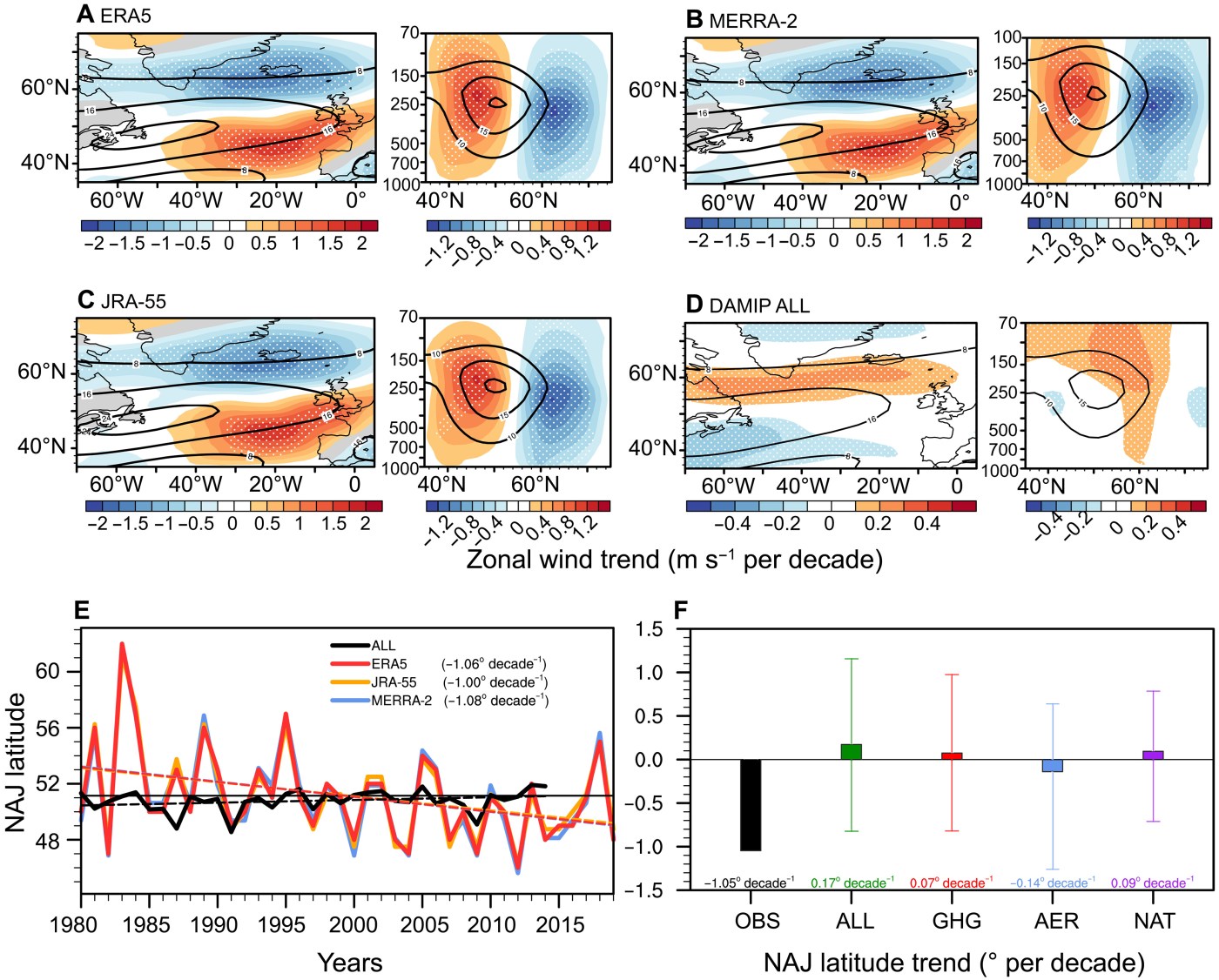
Fig. 1 from Sheng et al. (2026): Trend of the summer NAJ in the reanalyses and DAMIP simulations during 1980–2019. (A) ERA5 (the fifth generation European Centre for Medium Range Weather Forecasts atmospheric reanalysis of the global climate) trend (in meters per second per decade) of the zonal wind at 250 hPa and at the latitude-height cross section zonally averaged over the eastern North Atlantic sector (45°W to 0°). Contours indicate climatic mean of the zonal wind (in meters per second). White dots indicate significant trends at the 0.05 level using the Student’s t test. (B and C) As in (A) but for Modern-Era Retrospective analysis for Research and Applications, Version 2 (MERRA-2) and Japanese 55-year Reanalysis (JRA-55), respectively. (D) As in (A) but for the multimodel mean of the DAMIP ALL simulations (table S1). White dots indicate where more than half of DAMIP models agree with the same sign of trend. (E) Time series of the summer NAJ latitude (solid lines) and trends (dash lines) in the reanalyses (1980–2019) and multimodel mean of the DAMIP ALL simulations (1980–2014). (F) Trend (in ° per decade) of the summer NAJ latitude in the reanalyses observations (OBS) and the DAMIP ALL, GHG, AER, and natural (NAT) simulations. Bar indicates the average of the reanalyses and the ensemble mean of the DAMIP simulations. Error line denotes the 10th to 90th percentiles of the trend in the DAMIP ensemble members.
This blog post and the “Deep Dive” podcast, created by NotebookLM, are based on “Recent equatorward shift of the summer North Atlantic jet dominated by internal climate variability” by Sheng et al. (2026).
Sheng et al. (2026) explores why the summer North Atlantic jet has recently migrated toward the equator, a movement that contradicts the general poleward trend seen in other wind systems. The authors argue that this specific shift is primarily fueled by internal climate variability rather than human-induced greenhouse gases. The study highlights the North Atlantic warming hole as a critical driver, showing how its unique ocean temperatures alter the atmosphere’s thermal structure and influence wind patterns. While natural fluctuations have dominated recent decades, climate models suggest that anthropogenic forcing will likely take over by the 2050s. At that point, the jet is expected to reverse course and begin a consistent poleward shift. Understanding these shifting dynamics is essential for predicting future extreme weather and managing aviation risks across Europe.
1. Introduction: The Invisible Highway in the Sky
High above the North Atlantic, a powerful band of westerly winds known as the North Atlantic Jet (NAJ) acts as a primary architect of European life. This “invisible highway” in the upper troposphere does far more than influence the fuel efficiency and safety of commercial flights—specifically regarding clear-air turbulence—it serves as the steering mechanism for major storm systems and a regulator for the frequency of heatwaves, droughts, and wildfires. When the jet moves, the weather follows.
For years, climate models have suggested a clear global rulebook: as the planet warms, major wind patterns should shift toward the poles. However, a recent and counter-intuitive phenomenon has emerged. While global winds are generally migrating poleward, the summer NAJ has been doing the exact opposite. Understanding this southward drift is not merely a scientific curiosity; it is a matter of critical importance for European infrastructure and long-term climate adaptation.
2. The Great Southward Surprise: Defying Global Trends
While the annual average for global winds shows a steady poleward shift due to rising greenhouse gases, the summer NAJ over the eastern North Atlantic sector (45°W to 0°) has defied the script. Between 1980 and 2019, researchers observed a substantial “equatorward shift” that stands in sharp contrast to the annual mean poleward trends usually associated with global warming.
Analysis of this four-decade window reveals a robust southward movement of -1.05° per decade. This regional phenomenon has significant real-world consequences for Northern Europe and the United Kingdom, steering Atlantic storms directly into these regions and resulting in increasingly wet summers. The discrepancy between this localized southward drift and the global northward trend has presented scientists with a significant puzzle: why is the summer jet ignoring the anthropogenic “rulebook” in this specific sector?
3. The “Warming Hole” Mystery: Nature’s Internal Steering
The primary driver behind this movement is the North Atlantic Warming Hole (NAWH)—a persistent “cold patch” of sea surface temperatures (SST) in the North Atlantic surrounded by warmer waters. Crucially, it is the decadal component of the NAWH, rather than its centennial-scale trend, that has dominated the recent shift, accounting for approximately half of the observed trend since 1980.
While researchers analyzed other major climate indices—specifically the Interdecadal Pacific Oscillation (IPO) and the Atlantic Multidecadal Oscillation (AMO)—they found a limited influence and no robust coherent relationship between these indices and the summer NAJ’s latitudinal trend. Instead, the drift is currently a tug-of-war between competing forces. While greenhouse gases (GHG) push the jet poleward and anthropogenic aerosols (AER) influence regional jet strength, these external factors are currently being masked by internal climate variability.
“The recent equatorward shift of the summer NAJ was dominated by internal climate variability rather than anthropogenic forcing.”
4. The Physics of the Shift: Heat, Wind, and Feedback Loops
The mechanism by which an oceanic cold patch moves a massive wind current miles above the surface involves a complex chain reaction of heat and momentum:
- Meridional Temperature Gradients: The temperature difference between the NAWH cold patch and the surrounding warm water creates a distinct sea surface temperature gradient. Through turbulent heat release, the ocean “imprints” this temperature pattern onto the atmosphere, altering the meridional temperature gradient in the troposphere.
- Thermal Wind Response and Baroclinicity: This gradient triggers a “thermal wind response,” creating a dipole pattern in the westerlies—winds increase on the southern flank of the jet and decrease on the northern flank. This process is driven by changes in atmospheric baroclinicity (the potential for storm generation), which strengthens on the equatorward side.
- Eddy Feedback: Once the shift begins, “eddy feedback”—the interaction of swirling air currents and momentum flux—anchors the jet in its new southward position. Essentially, the ocean’s thermal signature forces the atmosphere into a stable, though temporary, weather regime.
5. The 2050 Turning Point: When Human Influence Takes the Wheel
This era of internal-variability dominance is temporary. Climate scientists use a concept called the “Time of Emergence” (ToE) to determine when the “signal” of human-caused climate change becomes loud enough to be distinguished from the “noise” (standard deviation) of natural cycles.
Projections under high-emission scenarios (SSP5-8.5) suggest that the 2050s will be the critical milestone where the anthropogenic signal finally pushes the summer jet poleward, overwhelming the natural cooling effect of the Warming Hole.
“As early as the 2050s, the latitudinal shift of the summer NAJ is projected to emerge beyond the range of internal climate variability.”
By this decade, the forced signal from greenhouse gases will likely cause the weather patterns European nations have adjusted to over the last forty years to undergo a dramatic reversal.
6. Conclusion: A Precarious Balance
The recent southward drift of the Atlantic jet stream is a product of natural cycles, but a forced northward shift is looming. This impending “flip” in the jet stream’s path poses a significant challenge for systemic risk assessment and infrastructure planning.
The current trend of wetter summers in Northern Europe may soon give way to a different regime as human-driven forces take the wheel. How should European nations prepare for a weather regime that is about to fundamentally change direction? The answer lies in recognizing that today’s natural cycles are merely the prelude to a much stronger, human-driven climate signal that will redefine the continent’s climate by mid-century.
Chen Sheng et al. ,Recent equatorward shift of the summer North Atlantic jet dominated by internal climate variability. Sci. Adv. 12, eaee8136 (2026). https://doi.org/10.1126/sciadv.aee8136


Leave a comment