
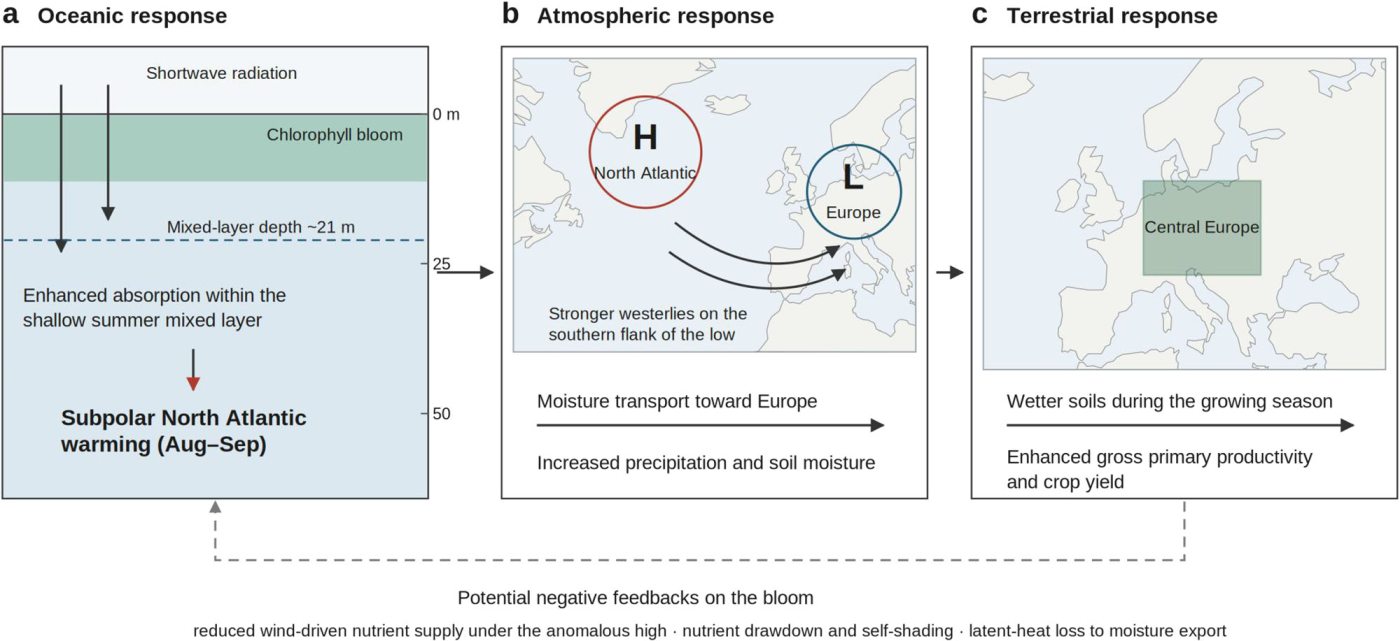
Figure 7 from Yang et al. (2026). The chlorophyll–climate–ecosystem teleconnection as a sequential ocean–atmosphere–land process. a Oceanic response: a North Atlantic chlorophyll bloom is associated with increased bio-optical absorption of shortwave radiation within the shallow late-summer mixed layer, potentially contributing to mixed-layer heating and sea-surface warming; the dashed line marks the climatological August–September mixed-layer depth of about 21 m. b Atmospheric response: this localized thermal anomaly is accompanied by an anomalous high-pressure response near the bloom region (H) and a low-pressure response over Europe (L), strengthening westerly flow on the southern flank of the low and enhancing moisture transport toward Europe. c Terrestrial response: increased moisture enhances precipitation, soil moisture and terrestrial gross primary productivity across central Europe (green box, 5°E–25°E, 45°N–55°N). Solid arrows denote the direction of the proposed pathway, and the dashed arrow denotes potential negative feedbacks that may constrain further chlorophyll growth. These feedbacks include reduced wind driven nutrient supply under the anomalous high-pressure system, nutrient depletion and self-shading within the bloom, and latent-heat loss from enhanced moisture export to Europe. The base maps in b, c were generated by the authors from the Natural Earth 1:1 10 m Admin-0 countries dataset, which is in the public domain. The schematic is illustrative and is not drawn to scale.
This blog post and the “Deep Dive” podcast, created by Google Notebook, are based on “North Atlantic chlorophyll blooms modulate European hydroclimate and terrestrial productivity” by Yang et al. (2026).
Yang et al. (2026) investigates how phytoplankton blooms in the North Atlantic remotely influence European hydroclimate and terrestrial productivity through ocean-atmosphere interactions. During high-chlorophyll years, pigments absorb more sunlight within a shallow mixed layer, which warms the sea surface and alters regional atmospheric pressure. This atmospheric response strengthens westerly winds that carry moisture inland, resulting in increased precipitation and a 15–20% rise in central European gross primary productivity. Earth system model experiments confirm this active bio-optical pathway, demonstrating that fixing chlorophyll removes the European productivity response. Ultimately, the findings establish that marine biological variability serves as a vital teleconnection pathway shaping ecosystem dynamics on land.
Introduction: The Invisible Bridge Between Ocean and Land
For decades, Earth system scientists have largely evaluated ocean biology and terrestrial plant growth as separate, parallel components of the global carbon cycle. Marine ecosystems were thought to operate exclusively within their oceanic realm, while forests and farm fields on land responded independently to continental climate drivers. However, groundbreaking research reveals that these systems are dynamically coupled across thousands of miles.
Microscopic organisms floating in the high-latitude North Atlantic Ocean—specifically microscopic algae known as phytoplankton—actively shape continental weather patterns and agricultural productivity across central Europe. Far from being isolated environments, the North Atlantic Ocean and the European continent are linked through an intricate ecological and atmospheric bridge, where ocean blooms directly influence regional rainfall, soil moisture, and crop yields thousands of miles away.
Takeaway 1: Microscopic Ocean Algae Act as Thermal Amplifiers for the Sea Surface
Phytoplankton contain chlorophyll pigments that absorb penetrating shortwave solar radiation. Rather than allowing sunlight to pass deeper into the ocean column, large phytoplankton blooms trap solar energy near the ocean surface through bio-optical absorption.
This heating mechanism is especially potent during late summer (August–September), when the subpolar North Atlantic mixed layer is remarkably shallow, averaging roughly 21 meters deep. Because the visible-band light attenuation depth () operates on this exact same spatial scale, solar radiation is trapped efficiently within this thin upper layer. Observational measurements confirm that high chlorophyll concentrations enhance upper 30-meter shortwave absorption by (MODIS-Aqua) to (ESA OC-CCI). Concurrently, reduced cloud cover during bloom periods adds an extra of incoming surface shortwave radiation to the ocean heat budget.
This thermal accumulation dramatically alters ocean temperatures. Observational data shows that during high-chlorophyll bloom years, subpolar sea surface temperatures (SST) experience a notable composite warming of compared to low-chlorophyll years. Direct bio-optical heating accounts for approximately 25% to 50% of this total observed temperature jump, with the remaining 50% to 75% driven by atmospheric feedbacks such as reduced cloud cover and reduced latent heat loss.
Idealized Earth system model experiments isolate the specific impact of chlorophyll on ocean physics: halving chlorophyll levels cools late-summer SST by , while doubling chlorophyll increases SST by and tripling it produces a warming anomaly.
Phytoplankton modify upper-ocean physics through the bio-optical absorption of penetrating shortwave radiation, efficiently heating the thin late-summer surface mixed layer.
It is deeply counter-intuitive that microscopic, single-celled biological organisms can physically manipulate the surface temperature of an entire oceanic basin. Yet, by altering how sunlight penetrates the sea, these tiny cells act as massive thermal amplifiers for the North Atlantic.
Takeaway 2: Ocean Blooms Launch a Three-Stage Climate Domino Effect
The link between marine biology and continental weather operates as a precise, three-stage atmospheric teleconnection:
- Oceanic Stage: In late summer (August–September), dense phytoplankton blooms in the high-latitude North Atlantic absorb incoming shortwave solar radiation, heating the shallow surface mixed layer.
- Atmospheric Stage: The resulting warm sea surface temperature anomaly reinforces a surface high-pressure system over the North Atlantic and a low-pressure anomaly over Europe. This pressure dipole strengthens prevailing westerly winds, which pump moist maritime air inland toward the European continent.
- Terrestrial Stage: The influx of ocean moisture increases rainfall and soil moisture across central Europe. Water-limited plants and crops absorb this extra moisture, spurring terrestrial gross primary productivity (GPP).
Why Central Europe Benefits Most
This marine teleconnection exhibits striking geographic specificity, selectively boosting growth in central Europe rather than across the entire continent. First, the quasi-stationary Atlantic high and European low dipole forms a preferred atmospheric transport corridor that channels maritime moisture directly into central Europe. Second, while northern European vegetation is primarily constrained by sunlight and temperature, and southern Europe experiences relative drying under this atmospheric dipole, central European ecosystems are strongly water-limited in late summer. Consequently, central European forests and croplands are uniquely sensitive to incoming rainfall and soil moisture anomalies.
Case Study Contrast: 2010 vs. 2018
The real-world impact of this mechanism is clearly illustrated by comparing two extreme years:
- 2010 (Exceptional Bloom Year): High-latitude North Atlantic chlorophyll concentrations surged to roughly 60% above the long-term average (exceeding two standard deviations of interannual variability). This massive bloom coincided with warm subpolar ocean waters, regional European rainfall up to ~70% above average, and widespread vegetation greenness across central Europe (Normalized Difference Vegetation Index reaching ~2 standard deviations above average).
- 2018 (Low Bloom Year): Chlorophyll levels plummeted to roughly 40% below average. Cooler subpolar ocean waters coincided with reduced westerly moisture transport, resulting in widespread drought and marked vegetation declines across Europe.
Takeaway 3: Plankton Aren’t Just Along for the Ride—They Actively Drive the Weather
A critical question for climate scientists was establishing causality: do phytoplankton blooms actively alter climate patterns, or are they merely passive indicators of favorable background oceanic conditions?
To answer this, researchers conducted an Earth system model control experiment where interannual chlorophyll variability was artificially removed by “nudging” chlorophyll concentrations to remain fixed at their seasonal climatology. In this control simulation, subpolar ocean warming anomalies (~0.5 °C) still occurred due to internal oceanic variability, while chlorophyll differences remained near zero (differing by less than 0.05 mg m⁻³).
However, without interactive bio-optical heating from chlorophyll blooms, the downstream central European productivity response almost completely vanished. In high-chlorophyll observational composite years and active model simulations, central European GPP increases exceed . In contrast, when chlorophyll variability is removed, GPP anomalies drop to near zero across central Europe.
“Variability in marine ecosystems is therefore a potentially important pathway shaping productivity on land.”
This experiment proves that biogeochemical activity in the ocean is an active driver of regional hydroclimate teleconnections, rather than a passive indicator of ocean circulation.
Takeaway 4: Ocean Biology Boosts Central European Plant Growth by 15% to 20%
The hydroclimate shift driven by North Atlantic blooms has a profound impact on continental vegetation, particularly across water-limited temperate deciduous forests, coniferous forests, and agricultural lands in central Europe.
- Gross Primary Productivity (GPP): Central European GPP increases by approximately 15% to 20% during major bloom years. In sensitivity experiments, doubling chlorophyll increases European GPP by 15–25%, while tripling chlorophyll elevates GPP by 30–35%.
- Ecosystem Nuance (GPP vs. Net Carbon Sink): It is critical to separate Gross Primary Productivity (photosynthetic carbon uptake) from a net increase in the terrestrial carbon sink. Because summer temperature anomalies can simultaneously accelerate plant and soil respiration through autotrophic and heterotrophic pathways, enhanced GPP reflects boosted photosynthetic activity and ecosystem functioning rather than a quantified increase in net carbon storage.
- Agricultural Impact on Summer Crops: Detrended national maize (Zea mays) yields in central Europe increase by 10% to 16%—an additional 0.3 to 0.9 tons per hectare —during high-chlorophyll years.
- Standardized Yield Performance: Across 25 European countries studied, 20 show positive maize yield responses, with 10 exceeding and an overall national mean response of. The strongest positive yield gains concentrate in central Europe, led by Poland , Lithuania, Belarus , and Czechia .
- Crop Timing (Phenology) Matters: While summer crops like maize and soybean benefit substantially because their critical grain-filling period (July–August) aligns with the arriving rain, winter crops like wheat show weaker or opposite responses. Wheat is typically harvested earlier in the summer, before the late-season precipitation peak occurs.
Takeaway 5: Space Satellites Could Predict Farm Yields Months in Advance
Because soil moisture acts as a physical buffer—integrating and storing rainfall anomalies over extended timescales—there is a distinct two-month delay between mid-summer ocean biological activity and peak continental vegetation response. Satellite observations reveal that chlorophyll anomalies in July consistently precede central European GPP and crop yield anomalies in late summer.
This delay offers a valuable predictive window for agricultural and climate management:
- Early-Warning Forecasts: Satellite ocean-color instruments (such as MODIS-Aqua) continuously monitor North Atlantic chlorophyll levels. Tracking mid-summer ocean blooms provides agricultural planners with an early warning signal for upcoming European hydroclimatic conditions and crop yield potential weeks before harvest.
- Key Limitation Under Climate Change: While this predictive teleconnection holds strong for current climate conditions, future climate projections remain uncertain. State-of-the-art CMIP6 climate models disagree on both the sign and magnitude of how greenhouse warming will alter future North Atlantic chlorophyll levels. While warmer ocean surface temperatures accelerate biological growth rates, increased upper-ocean stratification acts to suppress essential nutrient supply from deep waters.
Conclusion: Rethinking the Boundaries of Earth’s Climate System
The discovery of a marine biological teleconnection reaching deep into continental Europe demonstrates that Earth’s climate system operates with a level of cross-domain integration that science is only beginning to uncover. Marine biogeochemistry, atmospheric dynamics, and terrestrial agriculture do not function in isolated silos; they form a single, dynamically coupled feedback system linked across vast geography.
As global warming continues to alter ocean thermal structures and marine ecosystems, recognizing these hidden bridges becomes vital for predicting regional weather and securing future food production.
If microscopic ocean algae in the North Atlantic can alter rain patterns and crop harvests across central Europe today, what unexpected domino effects might occur as global climate change reshapes our oceans tomorrow?
Yang, YM., Park, JH., Park, JY. et al. North Atlantic chlorophyll blooms modulate European hydroclimate and terrestrial productivity. Commun Earth Environ (2026). https://doi.org/10.1038/s43247-026-04018-5


Leave a comment