
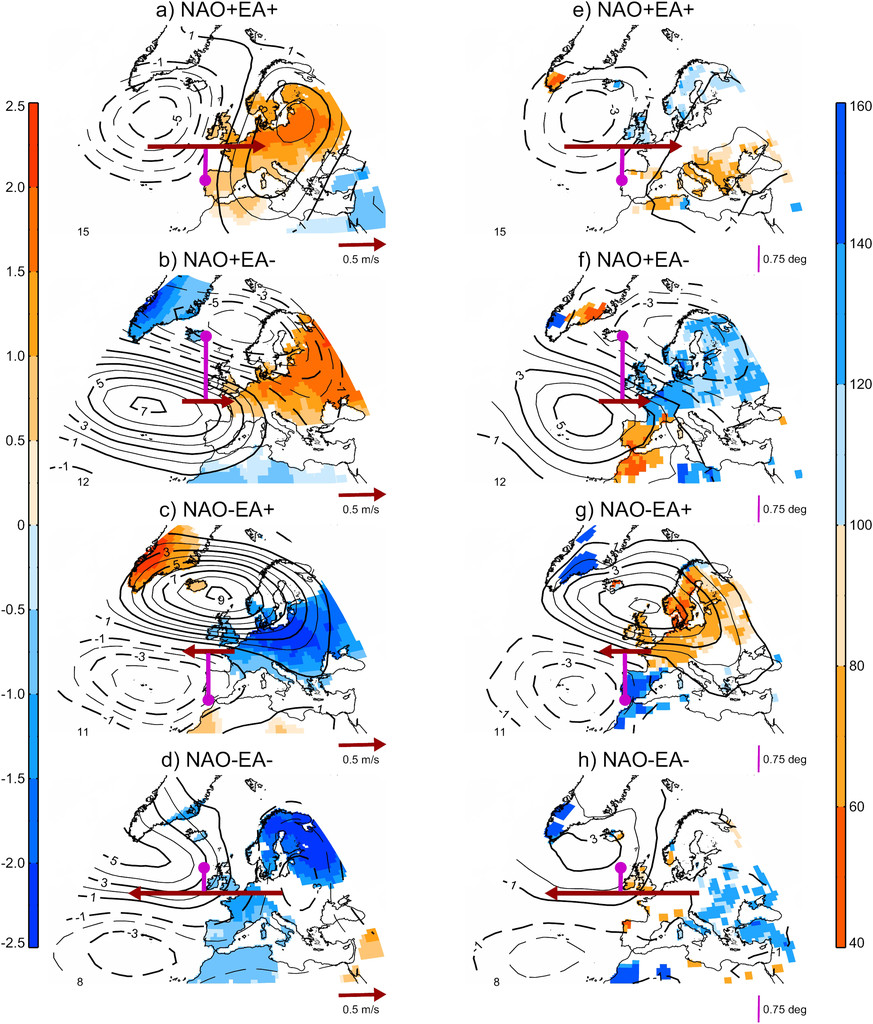
Figure 3 from Mellado-Cano et al. (2019). Winter composites of: (a)–(d) near-surface temperature (shading, in °C) and geopotential height at 500 hPa (contours, in dam) anomalies; (e)–(h) precipitation (shading, in percentage of normals) and SLP (contours, hPa) anomalies for different combinations of NAODI and EADI indices with absolute values larger than 0.5 standard deviations: (a) NAODI+/EADI+, (b) NAODI+/EADI−, (c) NAODI−/EADI+, and (d) NAODI−/EADI−. Anomalies are computed with respect to 1901–2010. Numbers in the left bottom corner of each panel represent the number of cases employed in each composite. Only temperature and precipitation anomalies that are significantly different (p < 0.05) from the climatology are shown, after a 5000-trial bootstrap test. Horizontal red arrows and vertical purple lines summarize the composited winter anomalies of the jet speed and latitude respectively, with the length being proportional to the anomaly. Eastward (westward) red arrows indicate a strengthening (weakening) of the jet. Purple lines pointing upward (downward) indicate a poleward (equatorward) shift of the jet.
This blog post and the “Deep Dive” podcast, created by Google Notebook, are based on “Examining the North Atlantic Oscillation, East Atlantic Pattern, and Jet Variability since 1685” by Mellado-Cano et al. (2019).
This research utilizes historical wind observations from the English Channel to reconstruct a 330-year record of the North Atlantic Oscillation (NAO) and East Atlantic (EA) patterns. By analyzing data from 1685 to 2014, the authors demonstrate that the EA pattern significantly modifies the climatic effects of the NAO, particularly influencing European precipitation and temperature distribution. The study reveals that nearly half of the winters over the last three centuries were dominated by the EA, which often obscures traditional NAO signals in regions like Greenland and the Mediterranean. Furthermore, these combined atmospheric records allow for a detailed reconstruction of the North Atlantic jet stream’s speed and latitudinal shifts. The findings suggest that understanding the joint interaction of these two systems is essential for accurately interpreting past climate variability and improving future projections. Ultimately, this long-term perspective shows that shifts in atmospheric action centers are recurrent natural phenomena rather than modern anomalies.
Introduction: The Invisible Architects of Winter
For centuries, European winters have been defined by a restless variability—shifting unpredictably from biting Arctic chills to unusually mild, rain-soaked stretches. Understanding the drivers of these fluctuations is more than an academic pursuit; it is a necessity for predicting our climate future. However, meteorologists have long grappled with a significant “blind spot”: our instrumental records for primary climate patterns, such as the North Atlantic Oscillation (NAO), are historically brief, rarely extending further back than the mid-19th century.
To pierce this veil, a groundbreaking study has looked to an unconventional source: the handwritten logbooks of 17th and 18th-century mariners navigating the English Channel. By applying “Directional Indices” (DIs)—a methodology that measures the persistence of wind in the four cardinal directions—researchers have reconstructed a 330-year history of the North Atlantic’s atmospheric circulation (1685–2014). This long-view perspective, pulled from the rigging of the past, reveals that the invisible architects of our weather are engaged in a dance far more complex than we previously realized.
The “Other” Climate Mode That Changes Everything
While the North Atlantic Oscillation (NAO) is the most famous driver of European weather, it does not act alone. The study highlights the critical role of the East Atlantic (EA) pattern, often overlooked as the “second pattern” of variability. While traditional models described the EA as a dipole, recent scientific literature—and this 330-year reconstruction—characterizes it as a well-defined sea level pressure monopole located south of Iceland and west of Ireland.
If the NAO is the primary engine of the North Atlantic, the EA is the steering mechanism. It modulates the physical location of the “action centers”—the Azores High and the Icelandic Low. Relying on the NAO alone to explain winter weather is like trying to understand a dance by only watching one partner; the EA dictates where those partners actually stand on the floor.
“The EA also modulates the location of the North Atlantic action centers and can shape the surface responses to the NAO. For example, the EA played a key role in determining the climate anomalies during the outstanding negative NAO episodes associated with the extremely cold European events of December 2010.”
The Jet Stream’s Dual Steering Committee
The North Atlantic eddy-driven jet stream—the high-altitude ribbon of air that guides storms toward Europe—is governed by the interplay of the NAO and the EA. Crucially, these two patterns influence the jet in a “counter-intuitive” way, separating changes in wind speed from changes in the wind’s path.
This dual steering committee creates distinct “storylines” for European winters based on how the patterns align:
- Largest departures in jet speed: These occur when the NAO and EA are in the same phase (both positive or both negative).
- Largest latitudinal shifts: These happen when the patterns are in opposite phases (one positive, one negative).
- The “Wavy” Pattern: When both indices are in a negative phase (NAO-/EA-), the jet doesn’t just slow down; it becomes significantly “wavier,” a configuration that allows Arctic air to meander further south and settle over mid-latitudes.
These shifts dictate the real-world impact on the ground, determining whether a storm track slams into Scotland or dives toward the Mediterranean.
Why Climate “Rules” Are Often Broken
Meteorologists often rely on established “rules”—for instance, that a negative NAO phase typically brings cold, dry weather to northern Europe and rain to the south. However, the 330-year record shows these signals are “non-stationary,” meaning the rules can be dampened or even reversed by the EA.
The EA pattern is frequently the reason these climate rules seem “broken.” In Greenland, the expected warming associated with a negative NAO is not a guarantee; the study found this warming is substantially damped or even reversed during negative EA phases. Similarly, in the western Mediterranean (Iberia), the “canonical” rainy signature of a negative NAO only manifests clearly when the EA is in the opposite phase. When the EA and NAO are in-phase, the precipitation signal shifts eastward, leaving Iberia unexpectedly dry.
This serves as a stern warning for scientists using natural proxies like tree rings or ice cores to reconstruct the past. The “blurring effect” of the EA can lead to misleading conclusions if the researcher assumes the NAO was the only hand on the tiller.
330 Years of History in the Rigging
The use of Directional Indices to digitize wind records from the 17th and 18th centuries is a masterclass in “data archaeology.” This record reveals that the atmospheric shifts we consider “modern” anomalies are often part of a recurrent historical rhythm.
For instance, the study provides a dynamical window into the Late Maunder Minimum (1700–1715), showing how specific NAO/EA combinations drove the documented droughts in southern Europe. It also clarifies the “anomalous winter” of 1783/84 following the Laki volcanic eruption. While previous theories blamed a simple negative NAO, the DI records reveal a simultaneous negative EA phase, which together caused an extreme weakening of the jet stream and the subsequent circum-Atlantic deep freeze.
Crucially, the study notes that the eastward migration of climate centers seen between 1975 and 2000 was driven by a specific transition from the EADI2 to the EADI1 phase. Far from being unprecedented, similar transitions have been recurrent since 1685, suggesting our current climate anomalies are chapters in a very old story.
Conclusion: Navigating an Uncertain Future
This 330-year perspective is more than a look back; it is a map for navigating our future. As we face a warming world, projections for the jet stream remain clouded by uncertainty. This research suggests that distinguishing between changes in jet speed and jet latitude is critical for predicting regional impacts in Europe.
By looking at the handwritten logs of sailors from three centuries ago, we gain the context needed to understand today’s weather. Much of our “unprecedented” modern climate may actually be part of a complex, long-term atmospheric dance between the NAO and the EA. The question for the next century is how the rising heat of the planet will alter the rhythm of this ancient dance.
Mellado-Cano, J., D. Barriopedro, R. García-Herrera, R. M. Trigo, and A. Hernández, 2019: Examining the North Atlantic Oscillation, East Atlantic Pattern, and Jet Variability since 1685. J. Climate, 32, 6285–6298, https://doi.org/10.1175/JCLI-D-19-0135.1.


Leave a comment