
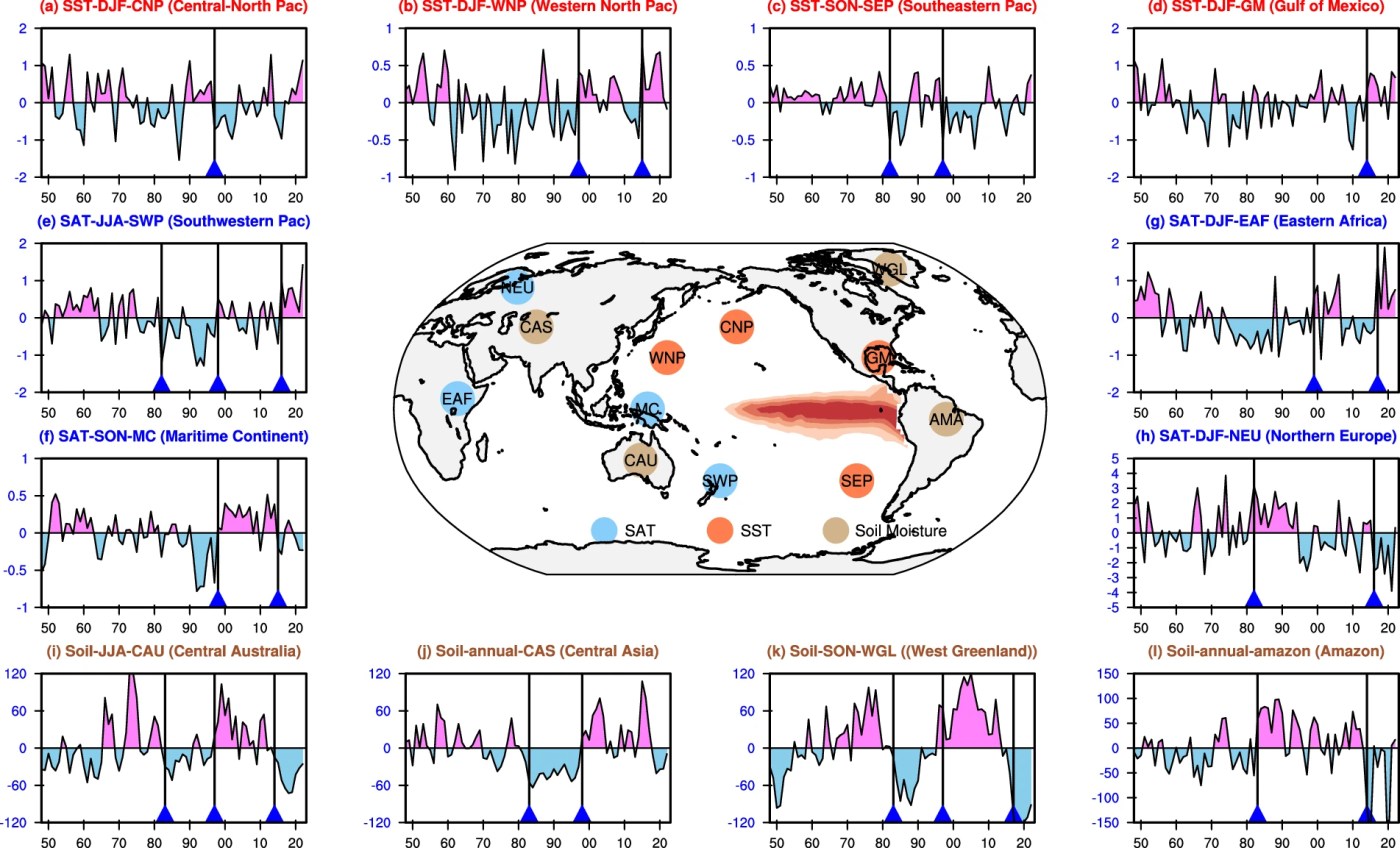
Fig. 3 from Xue et al. (2025): Evidence of super El Niño-induced climate regime shifts (CRSs) across various regions and climatic variables. Time series of standardized anomalies for sea surface temperature (SST), surface air temperature (SAT), and surface soil moisture (Soil) across selected regions with respect to 1948–2022 climatology. The vertical black lines and blue triangles denote the timing of CRSs in each variable associated with three super El Niño events significant at the 95% confidence level. The central map highlights the key regions selected as examples. a–d SST regions include the Central North Pacific (CNP), western North Pacific (WNP), southeastern Pacific (SEP) and Gulf of Mexico (GM); e–h SAT regions include the southwestern Pacific (SWP), Maritime Continent (MC), Eastern Africa (EAF), and northern Europe (NEU); i–l Surface soil moisture regions include the Central Australia (CAU), Central Asia (CAS), western Greenland (WGL) and the Amazon (AMA). “PAC” in the panel titles denotes “Pacific”. DJF, MAM, JJA, SON, and annual represent December–February, March–May, June–August, September–November, and annual mean, respectively. Pink and blue shaded areas denote positive and negative anomalies, respectively.
This blog post and the “Deep Dive” podcast, created by Google Notebook, are based on “Super El Niño events drive climate regime shifts with enhanced risks under global warming” by Xue et al. (2025).
This research article demonstrates that super El Niño events serve as powerful catalysts for climate regime shifts, which are sudden and lasting changes in environmental states. By analyzing observational data and computer simulations, scientists found that these intense weather phenomena significantly increase the probability of abrupt transitions in sea surface temperatures, air temperatures, and soil moisture levels. These shifts often persist long after the initial event due to feedback loops and climate memory, potentially reorganizing regional baselines for years. The study warns that global warming will likely intensify this relationship, making such disruptive climate transitions more frequent and widespread. Consequently, the authors emphasize that understanding these extreme events is vital for improving early warning systems and protecting vulnerable ecosystems and economies. This research underscores a deeper, more enduring environmental footprint left by super El Niño events than previously recognized.
1. Introduction: The Ghost of El Niño Past
When a Super El Niño arrives, the world braces for immediate chaos: record-breaking heatwaves, devastating floods, and parched landscapes. We often view these as temporary “weather events”—monsters that eventually retreat, allowing the climate to return to its previous state. However, the latest research into climate systems suggests a more disturbing reality. These events are not just passing storms; they are powerful “triggers” that can permanently shift the climate’s baseline.
These transitions, known as Climate Regime Shifts (CRSs), represent abrupt and persistent changes in the climate system. Rather than a simple return to “normal,” a Super El Niño can push the planet into a new state, locking in changes that last for years or even decades.
2. Not All El Niños are Created Equal
While regular El Niño events occur frequently, they typically result in “patchy” and localized climate changes that only marginally exceed the background average. In contrast, “Super” El Niño events—specifically the three observed cases in 1982/83, 1997/98, and 2015/16—exert a far more profound influence.
Data shows that while standard events have inconsistent impacts, Super events create “widespread and coherent enhancements” in the probability of a regime shift. Crucially, these shifts are detectable even after the long-term global warming trend has been removed, highlighting that Super El Niños act as systemic disruptors independent of the general warming background. As the research defines them:
“Regime shifts are large, sudden, and persistent changes in the function and structure of natural systems… which are hard to reverse and, in some cases, irreversible.”
3. The Triple Threat: Air, Sea, and Soil
Super El Niños trigger these shifts across three distinct domains, fundamentally reorganizing the Earth’s physical characteristics:
- Sea Surface Temperature (SST): Super events drive “basin-scale responses” in the North Pacific and Indian Oceans. These shifts amplify oceanic transitions and reshape the dynamics between the atmosphere and the sea.
- Surface Air Temperature (SAT): The heat from a Super El Niño does not always dissipate. Significant temperature shifts persist over land, particularly in ENSO-sensitive mid- and high-latitude regions including East Africa, the Maritime Continent, and South America.
- Surface Soil Moisture: These events disrupt the terrestrial water balance, creating hotspots for agricultural drought in Central Australia, the Amazon, and Central Southern Asia.
The interconnectedness of these systems is a result of complex land-atmosphere coupling. For example, a single ocean anomaly in the Pacific can lead to a multi-year soil moisture deficit in the Amazon. In such humid regions, the process is sustained because soil moisture changes influence evaporation and latent heat flux, which in turn promotes rainfall anomalies that persist long after the initial El Niño has faded.
4. The “Reemergence” Mechanism: Why the Climate Remembers
One of the most surprising findings is the climate’s “memory.” Even after the initial Pacific warming has ended, the system can “remember” the anomaly through the Reemergence mechanism, where the ocean acts as a vault for thermal data.
In this process, cooling anomalies triggered in the ocean during winter may disappear from the surface during the summer months as the mixed layer shallows, effectively “hiding” in the subsurface. As the mixed layer deepens again in the following cold season, these stored subsurface anomalies are re-entrained into the surface layer. This positive feedback loop sustains climate shifts and allows anomalies to recur even after ENSO phases have officially shifted back to neutral.
5. Greenhouse Warming is a Force Multiplier
Analysis using advanced climate simulations, including the CESM2-LE and CMIP6 models, reveals that human-caused global warming acts as a “powerful amplifier” for these shifts. While Super El Niños are dangerous today, they will become even more volatile in a warmer future.
The risk does not increase in a steady, predictable line; it is a nonlinear threat. A warmer climate renders the land-soil system more sensitive, and we are already observing a distinct “escalation trend” in the baseline of surface soil moisture. This rising baseline means that future Super El Niño “spikes” will trigger regime shifts more frequently and with greater severity than anything recorded in our historical data.
6. Triggering the Decadal “Big One”: The PDO Connection
Beyond seasonal or multi-year changes, Super El Niños play a critical “precursory role” in triggering major decadal transitions. Specifically, they are linked to phase shifts in the Pacific Decadal Oscillation (PDO)—a long-term pattern of climate variability centered in the North Pacific.
Evidence shows that the major PDO phase shifts in the late 1990s and 2016 aligned almost perfectly with Super El Niño events. This suggests that these extreme events are the primary catalysts that kick the global climate into entirely new decadal phases, effectively acting as the architects of the long-term trends that define our decades.
7. Conclusion: Navigating a Shifting Baseline
The core takeaway is clear: Super El Niños leave a “persistent climate footprint” that is far deeper than a single season of bad weather. They are the mechanisms by which the climate moves from one state to another, redefining what we consider “normal.”
As global warming intensifies these “monsters,” the development of advanced early warning systems becomes a matter of global security. We must move beyond reacting to individual storms and start preparing for the new, abrupt baselines they leave behind.
If our seasonal weather “monsters” are actually the architects of our long-term climate, can we ever truly return to the “normal” we once knew?
Xue, A., Geng, X., Jin, FF. et al. Super El Niño events drive climate regime shifts with enhanced risks under global warming. Nat Commun 16, 11262 (2025). https://doi.org/10.1038/s41467-025-66143-7
 Ocean to Climate
Leave a comment