
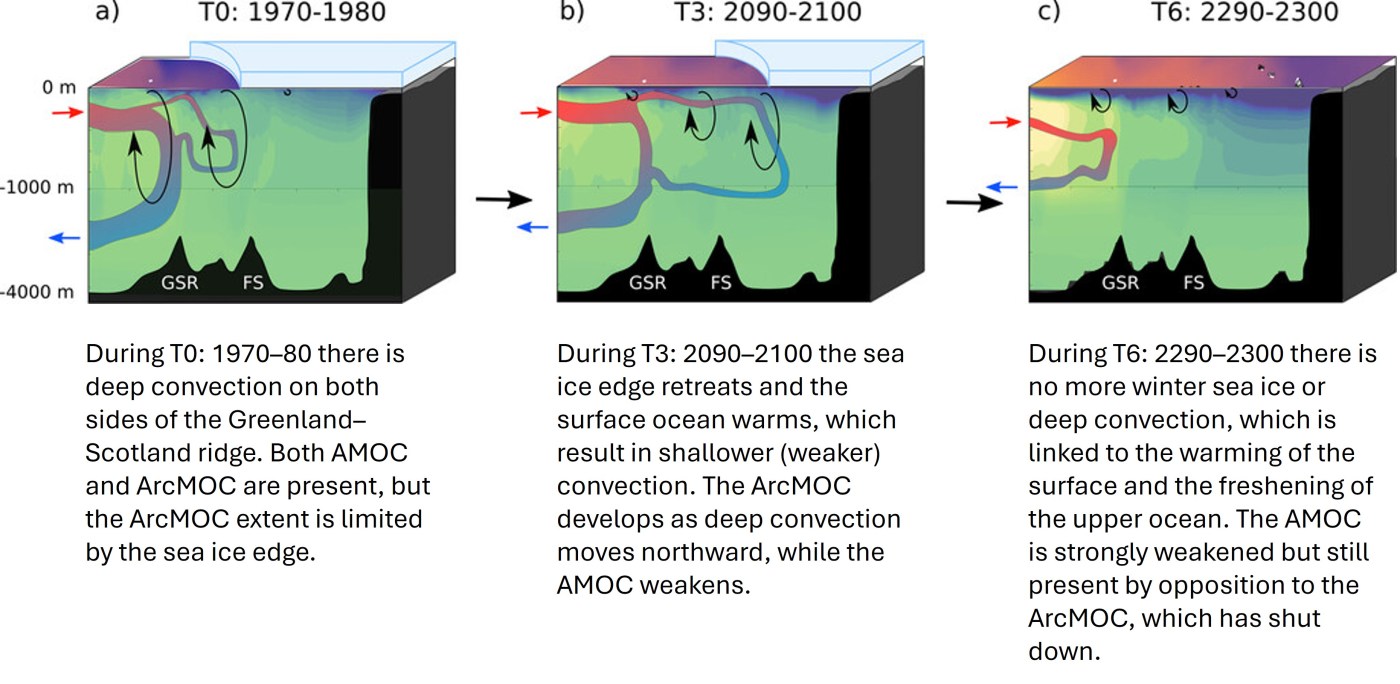
Fig. 13. from Bretones et al. (2022): Sketch summarizing the evolution of the deep mixing and the ArcMOC under the retreat of the sea ice edge. (a) During T0: 1970–80 there is deep convection on both sides of the Greenland–Scotland ridge. Both AMOC and ArcMOC are present, but the ArcMOC extent is limited by the sea ice edge. (b) During T3: 2090–2100 the sea ice edge retreats and the surface ocean warms, which result in shallower (weaker) convection. The ArcMOC develops as deep convection moves northward, while the AMOC weakens. Finally, (c) during T6: 2290–2300 there is no more winter sea ice or deep convection, which is linked to the warming of the surface and the freshening of the upper ocean. The AMOC is strongly weakened but still present by opposition to the ArcMOC, which has shut down.
This blog post and the “Deep Dive” podcast, created by NotebookLM, are based on “Transient Increase in Arctic Deep-Water Formation and Ocean Circulation under Sea Ice Retreat” by Bretones et al. (2022).
Using a long-term climate simulation, this research explores how Arctic sea ice loss influences ocean circulation and deep-water formation between the years 1850 and 2300. The study introduces a new metric, the Arctic meridional overturning circulation (ArMOC), to track changes as deep-sea mixing shifts from the North Atlantic into the central Arctic. As winter sea ice retreats, new areas of deep convection emerge in the Nansen Basin, temporarily strengthening the ArMOC even as the broader AMOC weakens. However, this northern migration eventually stalls when the sea ice edge reaches the Canadian Basin, where high freshwater content creates stable stratification that prevents deep mixing. Ultimately, the authors conclude that the temporary boost in Arctic overturning cannot compensate for the progressive decline of circulation in the Atlantic. This highlights that the location of sea ice is a decisive factor in the future of global ocean health.
The Hook: A Tale of Two Circulations
For decades, the “Day After Tomorrow” scenario has served as a chilling cultural touchstone for climate change—the fear that the Atlantic Meridional Overturning Circulation (AMOC), our planet’s massive heat-distributing conveyor belt, might simply stall. While evidence suggests this global system is indeed weakening, a far more mysterious phenomenon is emerging further north. Beyond the Greenland–Scotland Ridge, a secondary pulse known as the “Arctic meridional overturning circulation” or “ArcMOC” is temporarily turbo-charging as the ice retreats.
Think of the ocean’s circulation as a central heating system. While the main furnace in the North Atlantic is losing its flame, a smaller, temporary heater is kicking in within the Arctic Circle. This shift isn’t just a geographical quirk; it represents a fundamental rewiring of how our planet moves water, heat, and carbon. As the traditional gateways for sinking water fail, the Arctic is stepping in to provide a temporary, albeit modest, “backup plan.”
Takeaway 1: The Rise of the ArcMOC
The ArcMOC is a newly identified metric designed to track the overturning of water masses north of the Greenland–Scotland Ridge and into the central Arctic. While the primary AMOC is projected to suffer a significant reduction in strength by the year 2100, the ArcMOC is currently doing the opposite. Research indicates that this internal Arctic circulation nearly doubles in strength as the ice edge migrates into the Nansen Basin.
However, we must manage our expectations about this “backup plan.” While the ArcMOC is turbo-charging relative to its own size, its strengthening (roughly a 1.8 Sv boost) is small compared to the massive 8.5 Sv reduction projected for the broader AMOC. According to the research, the ArcMOC “partly compensates” for the early weakening of the AMOC, but it is a temporary buffer rather than a one-to-one replacement for the Atlantic’s failing pulse.
| Circulation System | Projected Trend (to 2100) | Long-term Fate (post-2200) |
| AMOC (North Atlantic) | 22% Reduction | Stabilizes at ~7 Sv (by year 3200) |
| ArcMOC (Central Arctic) | Nearly Doubles | Baseline by 2225; negligible by 2300 |
Takeaway 2: Deep-Water Mixing is Moving North
To understand this surge, we have to look at “deep convection”—the process where cold surface water becomes dense enough to sink to the ocean floor. Traditionally, the “sweet spot” for this sinking occurs in the Labrador and Greenland Seas, where the atmosphere effectively “chills” the salt-heavy water. As the world warms, these traditional sites are losing their ability to mix, and the point of maximum density is migrating toward the pole.
This migration follows the retreating winter sea ice edge, which provides the critical boundary where cold air meets open water. The source data reveals a clear path of this northward trek across distinct eras:
- 2050–2060 (T2): Mixing reduces in the Labrador Sea and intensifies in the Nordic Seas.
- 2060: The Arctic becomes officially ice-free during the summer months.
- 2090–2100 (T3): Deep convection reaches its northernmost extent in the Nansen Basin.
- 2165: The Arctic Ocean becomes perennially ice-free, marking the end of winter sea ice.
There is a stark irony in this transition: the retreat of sea ice—a primary symptom of a warming planet—is the very thing that opens up the open-ocean convection needed to drive this temporary circulation.
Takeaway 3: The “Freshwater Wall” in the Canadian Basin
One might assume that as the ice continues to melt, this new Arctic circulation would keep expanding across the entire pole. However, the ArcMOC eventually hits a dead end known as the “freshwater wall.” The Arctic is divided between the Atlantic-influenced Eurasian Basin and the Canadian Basin, which is heavily saturated with river runoff and Pacific water inflow.
This high freshwater content creates a state of intense stratification, acting like a “buoyant lid” or an oil slick on a pond. Because freshwater is less dense than saltwater, it floats on top and refuses to let the water column mix, regardless of how cold the winter air becomes. This represents a hard geographical limit to the Arctic’s backup plan; the ArcMOC simply cannot penetrate the stable “wall” of the Canadian Basin, no matter how much the ice retreats.
Takeaway 4: 2165—The Year the Arctic Changes Forever
The ArcMOC is a transient phenomenon—a “flash in the pan” on a geological timescale. After peaking around 2100, the system begins a steady decline as the upper ocean becomes too warm and fresh to maintain sinking. By the year 2165, when the Arctic becomes ice-free year-round, the mechanics supporting this northern pulse begin to fail entirely.
By the period of 2290–2300, the ArcMOC essentially vanishes, marking a permanent “decoupling” of the two systems. While the primary AMOC eventually stabilizes at a much lower mean value of 7 Sv (down from its historical 15 Sv), the ArcMOC becomes negligible. The two systems stop moving in tandem because the ArcMOC is driven by local Arctic ice dynamics that eventually hit a ceiling, while the AMOC responds to broader, global Atlantic trends.
Conclusion: A Different Kind of Blue
We are heading toward a future where the Arctic is blue year-round, but it will be a different kind of ocean than the one we know today. The ArcMOC is a testament to the ocean’s ability to reorganize itself under extreme stress, but it is not a permanent solution. It is a temporary bridge across the Greenland–Scotland Ridge that eventually leads to a dead end.
As we look toward a future without this northern “backup plan,” we must confront the reality of a more stagnant oceanic era. The migration of deep-water formation is a countdown, reminding us that the ocean’s ability to adapt has its limits. When the bridge finally disappears, we will be left with an Arctic that is ice-free, but whose pulse has finally gone quiet.
The ArcMOC is a transient pulse—a temporary migration of the ocean’s circulation that will eventually hit a freshwater wall and serve as a bridge to a stagnant future.
Bretones, A., K. H. Nisancioglu, M. F. Jensen, A. Brakstad, and S. Yang, 2022: Transient Increase in Arctic Deep-Water Formation and Ocean Circulation under Sea Ice Retreat. J. Climate, 35, 109–124, https://doi.org/10.1175/JCLI-D-21-0152.1.


Leave a comment