Why the South Atlantic is Getting Saltier and Why It Matters for Our Climate
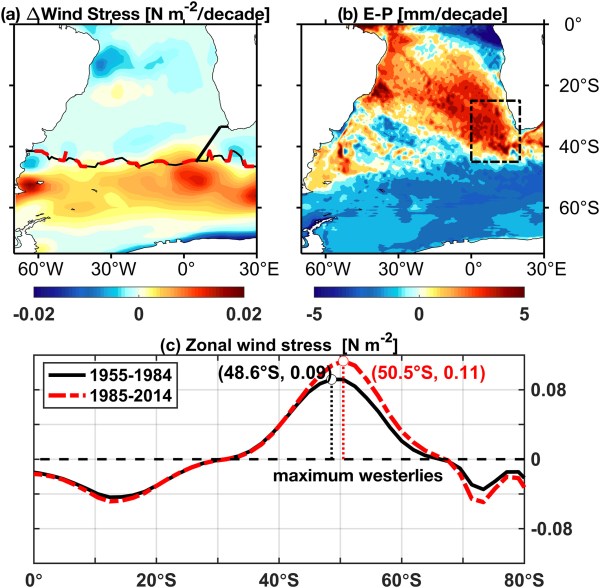
Figure 6 from Cui et al. (2026): (a) Linear trend of zonal wind stress (units: N m−2/decade) averaged over the period 1955–2014 from ERA5. The black solid line indicates the position of the Subtropical Front (STF) during 1955–1984, while the red dashed line represents the STF position during 1985–2014. The black polyline marks the location of... Continue Reading →

The Rise and Fall of the Arctic Meridional Overturning Circulation (ArcMOC)

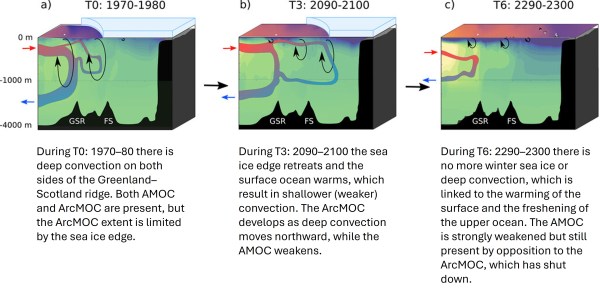
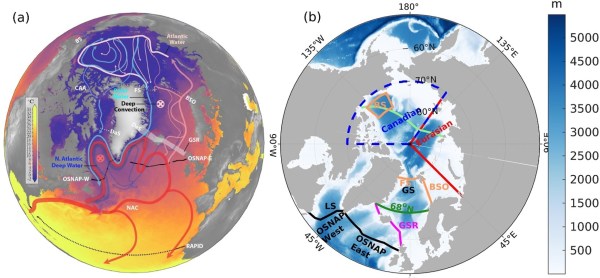
Fig. 13. from Bretones et al. (2022): Sketch summarizing the evolution of the deep mixing and the ArcMOC under the retreat of the sea ice edge. (a) During T0: 1970–80 there is deep convection on both sides of the Greenland–Scotland ridge. Both AMOC and ArcMOC are present, but the ArcMOC extent is limited by the... Continue Reading →

Smart-Tech Race to Measure the AMOC with Microscopic Precision

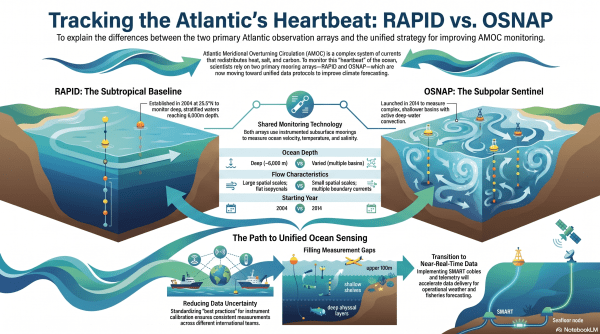
This blog post and the “Deep Dive” podcast, created by NotebookLM, are based on “Strengthening connections in observing the North Atlantic Meridional Overturning Circulation: Outcomes from a joint RAPID-OSNAP workshop" by Foukal et al. (2025). This article summarizes the findings of a collaborative workshop held in 2025 to harmonize the efforts of the RAPID and... Continue Reading →

Why the South Atlantic is Key to Monitoring the Future Weakening of the AMOC

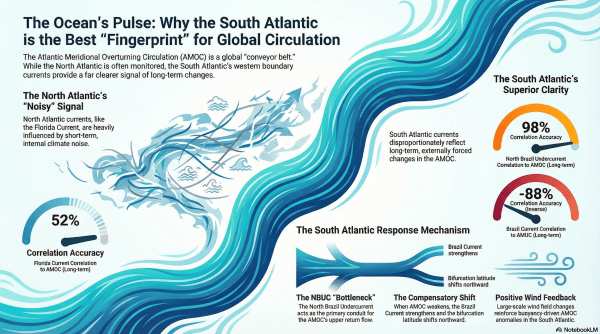
This blog post and the “Deep Dive” podcast, created by NotebookLM, are based on “Rainfall sustains multiyear La Niña” by Tian et al. (2026). This research investigates how the Atlantic Meridional Overturning Circulation (AMOC) imprints its signal on regional ocean currents, specifically comparing the North and South Atlantic. By analyzing 22,000 years of climate simulations,... Continue Reading →

Scientists Urge International Cooperation to Mitigate a Catastrophic AMOC Failure

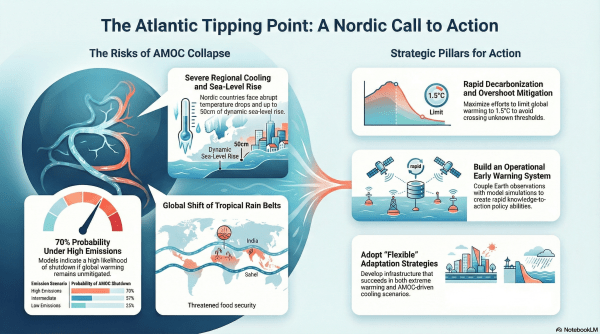
This blog post and the “Deep Dive” podcast, created by NotebookLM, are based on “A Nordic Perspective on AMOC Tipping: Impacts and Strategies for Prevention and Governance” by Nummelin et al. (2026). For centuries, the North Atlantic has functioned as the Earth’s thermal engine, driven by a "heartbeat" known as the Atlantic Meridional Overturning Circulation... Continue Reading →

Steering the Deep Atlantic Conveyor Belt: The Role of the Eastern Arctic’s Eurasian Basin

This blog post and the “Deep Dive” podcast, created by NotebookLM, are based on “Impacts of eastern Arctic Eurasian Basin water mass properties on the AMOC and Beaufort Sea Atlantic water layer.” by Wei and Zhang (2026). Wei and Zhang (2026) investigates how water mass properties in the eastern Eurasian Basin influence global ocean patterns... Continue Reading →

A 20-Year Record of the Subpolar AMOC: Key Findings from the SCOTIA Program

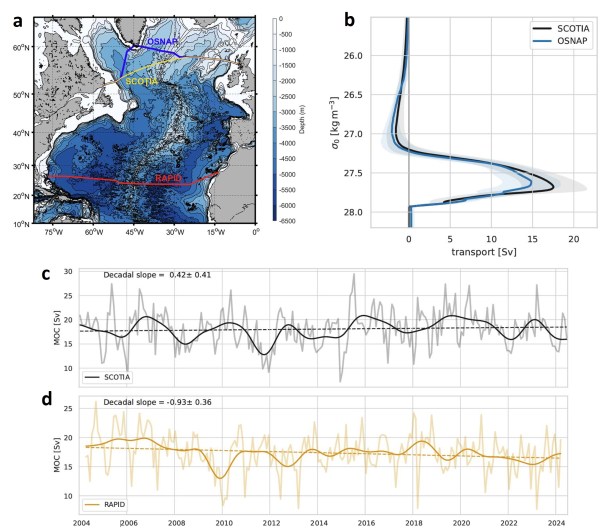
This blog post and the “Deep Dive” podcast, created by NotebookLM, are based on “The Scotland-Canada overturning array (SCOTIA): twenty years of meridional overturning in the subpolar North Atlantic” by Fox et al. (2026). The SCOTIA observing array provides a new 20-year record of the Atlantic meridional overturning circulation (AMOC) at subpolar latitudes from 2004 to 2024. By integrating mooring data, Argo... Continue Reading →

Four primary “engines” of the Atlantic Meridional Overturning Circulation (AMOC)

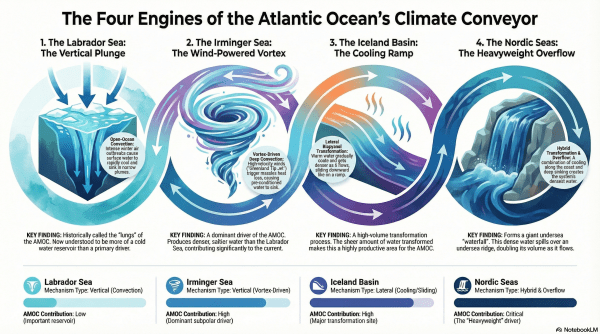
This blog post and the “Deep Dive” podcast, created by Google Gemini Pro and NotebookLM, provide a brief summary of the four primary "engines" of the Atlantic Meridional Overturning Circulation (AMOC) based on Pickart et al. (2003), Chafik & Rossby (2019),, Lozier et al. (2019), Zou et al. (2020), Petit et al. (2020), Chafik et... Continue Reading →

The Tail Wags the Dog: How the ‘Quiet’ Labrador Sea Sets the Rhythm for a Critical Atlantic Current

This blog post and the “Deep Dive” podcast, created by NotebookLM, are based on “An outsized role for the Labrador Sea in the multidecadal variability of the Atlantic overturning circulation” by Yeager et al. (2021). This research article by Yeager et al. (2021) utilizes high-resolution climate simulations to investigate the Labrador Sea's influence on long-term... Continue Reading →

Convection ≠ Overturning: Why Labrador Sea Convection Doesn’t Drive The AMOC

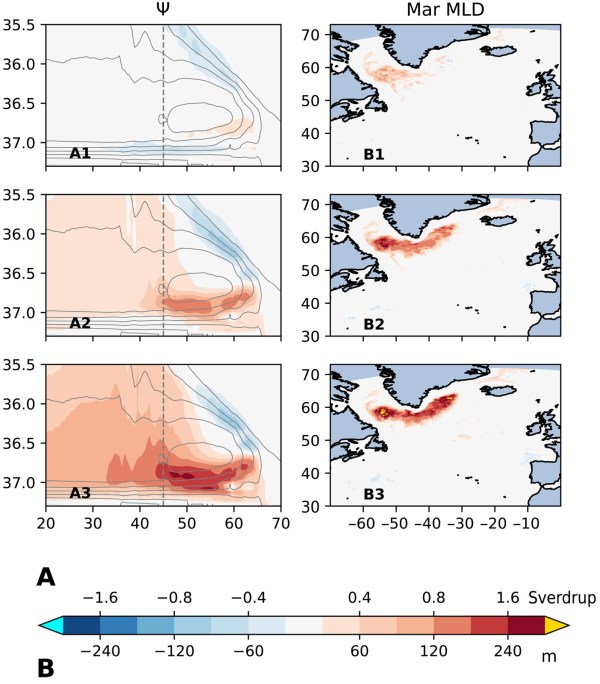
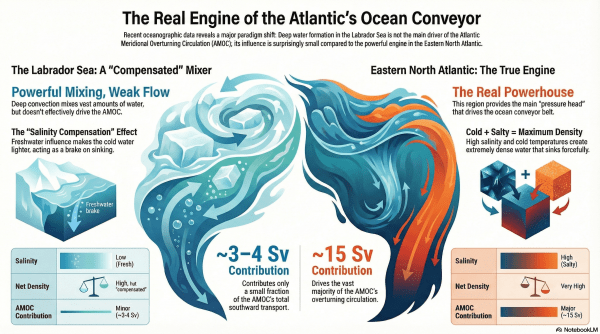
The oceanographic community is currently re-evaluating the Labrador Sea's role in maintaining the Atlantic Meridional Overturning Circulation (AMOC). While historical estimates suggested a contribution of up to 9 Sv (Böning et al., 1996; Mauritzen and Häkkinen, 1999; Talley, 2003; Brandt et al., 2007), recent data from the Overturning in the Subpolar North Atlantic Program (OSNAP)... Continue Reading →

Website Powered by WordPress.com.

Up ↑