
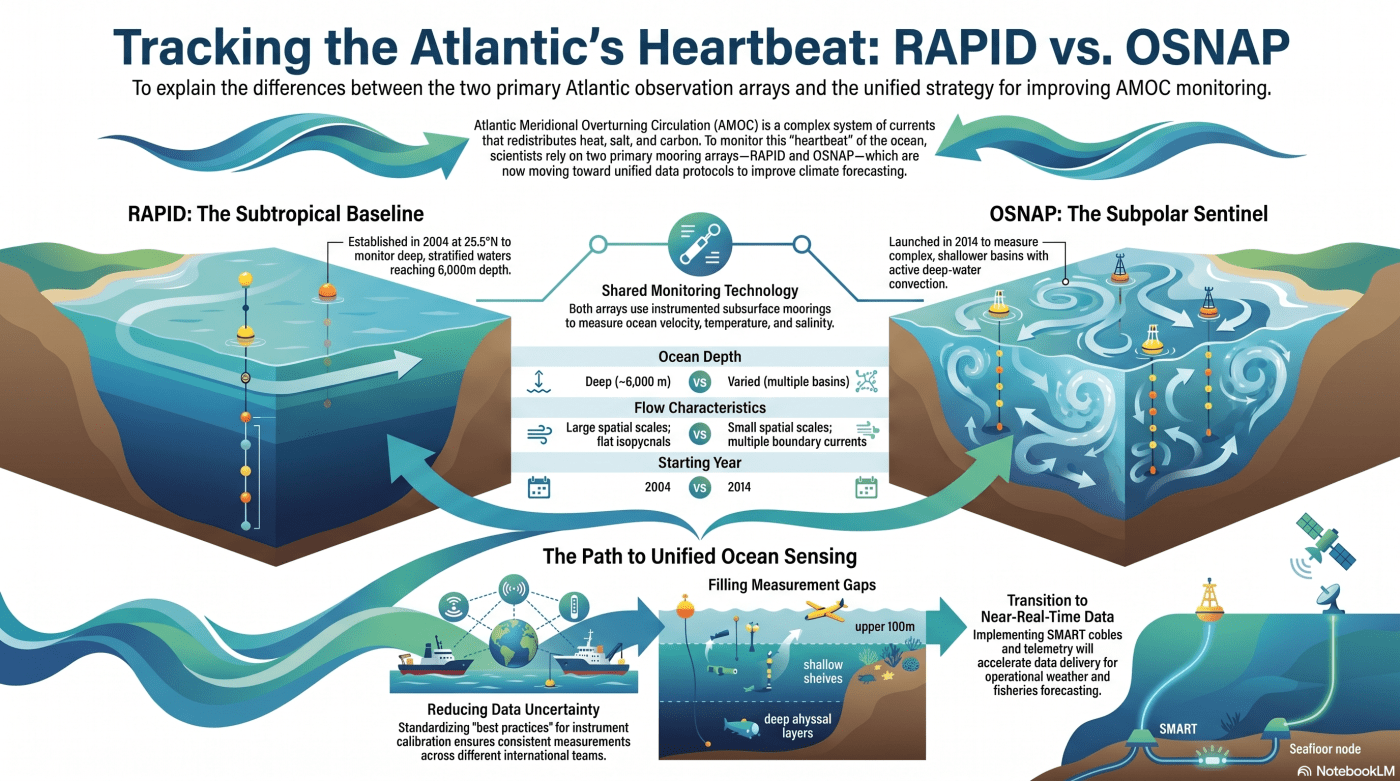
This blog post and the “Deep Dive” podcast, created by NotebookLM, are based on “Strengthening connections in observing the North Atlantic Meridional Overturning Circulation: Outcomes from a joint RAPID-OSNAP workshop” by Foukal et al. (2025).
This article summarizes the findings of a collaborative workshop held in 2025 to harmonize the efforts of the RAPID and OSNAP ocean observation programs. These initiatives monitor the Atlantic Meridional Overturning Circulation (AMOC), a vital system for regulating global climate and nutrient distribution. The document outlines the methodological differences between subtropical and subpolar measurements, highlighting the need for consistent calibration, data gridding, and uncertainty quantification. Experts advocate for integrating emerging technologies, such as deep-sea sensors and satellite data, to fill existing observational gaps. Ultimately, the sources emphasize standardizing protocols and improving data accessibility to support more accurate climate forecasting and stakeholder engagement.
1. Introduction: The Invisible Engine of Our Climate
Beneath the rolling surface of the Atlantic lies a gargantuan, invisible engine that effectively governs the pace of life on Earth. Known as the Atlantic Meridional Overturning Circulation (AMOC), this “Great Conveyor Belt” is a planetary-scale plumbing system that redistributes heat, salt, oxygen, carbon, and nutrients. Its influence is tectonic: it provides the warmth and moisture that keep Northern Europe habitable, is responsible for displacing the Intertropical Convergence Zone northward of the equator, and seeds the subpolar North Atlantic with the nutrients required for the massive annual phytoplankton bloom.
Yet, for all its power, the AMOC is notoriously difficult to capture. Scientists are tasked with measuring a system thousands of kilometers wide and kilometers deep that fluctuates on scales from a single day to an entire millennium. The signal they seek is often buried; recirculating flows in the Atlantic can be an order of magnitude—ten times—stronger than the actual overturning circulation itself. This creates a daunting oceanographic challenge: how do we track a global pulse when the “noise” is ten times louder than the heartbeat?
2. A Tale of Two Oceans: The RAPID and OSNAP Divide
To solve this, researchers have deployed two primary observing arrays that treat the Atlantic as two distinct scientific frontiers. Because the ocean’s dynamics shift radically with latitude, a “one size fits all” approach would fail to capture the true complexity of the system.
The RAPID-MOCHA Array (26.5°N) Focusing on the subtropical North Atlantic since 2004, the RAPID array monitors a basin that is approximately 6,000 meters deep and strongly stratified. Here, the internal layers—or isopycnals—are relatively flat, and the western boundary current is largely confined to the Florida Straits. In a fascinating blend of high-tech and legacy infrastructure, the project estimates the transport of the Florida Current by measuring voltages on underwater telephone cables, combined with satellite altimetry and pressure sensors.
The OSNAP Array (Subpolar North Atlantic) Launched in 2014, the Overturning in the Subpolar North Atlantic Program (OSNAP) confronts a far more chaotic environment. Spanning from eastern Canada to Scotland, OSNAP monitors three distinct basins: the Labrador, Irminger, and Iceland Seas. This region is a cauldron of active deep convection and strongly inclined layers. Unlike the stratified subtropics, the flow here is more barotropic—uniform from top to bottom—and dominated by multiple boundary currents and small-scale features that require a much denser, more complex measurement strategy.
3. The Precision Crisis: Where 0.003 Matters
The scale of the AMOC may be massive, but the data used to understand it is incredibly fragile. Because the recirculating flows are so much stronger than the AMOC itself, even the slightest instrument error can lead to a total miscalculation of the ocean’s heat and freshwater transport. This “precision crisis” is most acute at the endpoint dynamic height moorings, where instrument calibration is a matter of global significance.
“McCarthy et al. (2015) found that a 0.003 salinity bias on one side of the RAPID array relative to the other can impact the accuracy of the total MOC [Meridional Overturning Circulation] by over 4%.”
This level of sensitivity is counter-intuitive. A salinity discrepancy smaller than what most commercial sensors can even detect at the edge of the array can fundamentally alter our understanding of the Atlantic’s health.
4. The “Blind Spots” in the Deep and Shallow
Despite our sophisticated arrays, large swaths of the Atlantic remain the “dark matter” of oceanography—essential to the system but currently invisible to our sensors. These gaps are not merely missing data; they represent the next technological frontier:
- Shallow Shelf Regions: Particularly at the OSNAP array, flow over coastal shelves often bypasses the deep-sea moorings.
- The Upper Water Column: The top 100 meters of the ocean, where the sea meets the sky, is often situated above the reach of the shallowest moored instruments.
- The Abyssal Deep: The vast regions below 2,000 meters lack both mooring and Argo float coverage, leaving the ocean’s “basement” largely unobserved.
- Bottom Triangles: The angled gaps along sloping topography where traditional moorings cannot easily sit.
- Local Recirculations: Intense, uncaptured flows offshore of boundary currents in the Labrador, Irminger, and Sargasso Seas.
Without resolving these gaps, sampling errors persist, leaving us unable to fully account for how small-scale features like eddies or upper-ocean velocity shears impact the global climate.
5. From Biannual Updates to Near-Real-Time SMART Tech
Currently, our view of the AMOC is frustratingly delayed. Because data is stored locally on subsurface instruments, it can only be retrieved when a ship physically recovers the moorings, typically every two years. This biannual update cycle makes the data a powerful historical record but limits its use for real-time operational forecasting or immediate fisheries management.
To modernize the system, researchers are eyeing “Alternative Technologies” that could bridge the gap:
- SMART Cables: Science Monitoring and Reliable Telecommunications cables that could turn the seafloor into a live data network.
- Telemetry Data Pods: Small devices that can release from a mooring and pop to the surface to beam data via satellite.
- Autonomous Gliders: Mobile sensors that can patrol shallow shelves where permanent moorings are impractical.
While these tools offer the promise of near-real-time monitoring, they present a cost-benefit tension. Telemetry adds immense value to maritime awareness and fisheries, but it significantly increases the financial burden of maintaining these vast arrays.
6. The Collaborative Future: Code, Calibration, and Community
The primary outcome of the 2025 joint workshop in Woods Hole was the recognition that human collaboration is as critical as the sensors themselves. The mission is shifting toward a “FAIR” (Findable, Accessible, Interoperable, and Reusable) framework for open science.
This is more than just sharing files; the goal is to standardize calibration protocols and share processing code so that any independent scientific group can recreate the exact steps—from raw sensor data to final AMOC calculation. By eliminating redundant efforts and creating a unified “best practices” manual, the community is building a more resilient and sustained observing system that can survive the vagaries of funding and ship schedules.
7. Conclusion: Tracking a Changing Pulse
The AMOC is the most vital sign of our planet’s changing climate, and our ability to monitor it is finally moving toward maturity. While the RAPID and OSNAP arrays provide the unambiguous time series needed to benchmark climate models, they are now evolving to serve a broader world, from biogeochemists tracking carbon to fisheries managers protecting local economies.
As the deep ocean continues to change, a critical question looms over the scientific community: are we building a digital twin of the ocean fast enough to predict its potential collapse? Only by closing our remaining “blind spots” and moving toward a live, real-time pulse can we hope to keep pace with the rapid changes occurring in the Atlantic’s deep-sea engine.
The infographic was generated by Notebook LM.
Foukal, N., I. Le Bras, Y. Fu, T. Petit, T.C. Biló, S. Elipot, and B. Moat. 2026. Strengthening connections in observing the North Atlantic Meridional Overturning Circulation: Outcomes from a joint RAPID-OSNAP workshop. Oceanography 39(1):44–49, https://doi.org/10.5670/oceanog.2026.e110.


Leave a comment