
This blog post and the “Deep Dive” podcast, created by NotebookLM, are based on “Deep ocean cooling and freshening from Subpolar North Atlantic reaches Subtropics at 26.5°N” by Chomiak et al. (2025).
Chomiak et al. (2025) identifies a surprising cooling and freshening trend in the deep waters of the Subtropical North Atlantic, specifically at the 26.5°N latitude off the Bahamas. While much of the global ocean is warming due to climate change, data from the last forty years reveal that these deeper layers are currently reflecting historical subpolar conditions. Scientists have traced these changes back to environmental shifts in the Labrador Sea and surrounding northern basins that occurred over two decades ago. The study utilizes long-term hydrographic surveys, moorings, and seafloor sensors to connect the movement of deep water masses to atmospheric patterns like the North Atlantic Oscillation. Despite the recent cooling, the authors anticipate a shift toward warming and increased salinity in the near future as more recent northern signals arrive. These findings are critical for understanding how large-scale ocean circulation influences global heat distribution and rising sea levels.
In an era of record-shattering atmospheric heat and rising surface temperatures, the narrative of a warming planet seems absolute. Yet, beneath the waves of the North Atlantic, the deep ocean is settling a planetary ledger that dates back decades, revealing a counter-intuitive secret. While the upper layers of the ocean absorb the brunt of modern carbon emissions, a significant portion of the abyss has been steadily cooling and freshening for forty years—acting as a cold, submerged echo of a previous century.
A 2025 study led by Leah N. Chomiak, published in Communications Earth & Environment, has illuminated this mystery along the Abaco 26.5°N hydrographic line off the Bahamas. As part of the longest-running observation program of its kind, this “strategic listening post” has captured a decades-long anomaly that challenges our fundamental assumptions about how the global ocean responds to a warming climate.
Takeaway 1: Challenging the Global Warming Paradigm
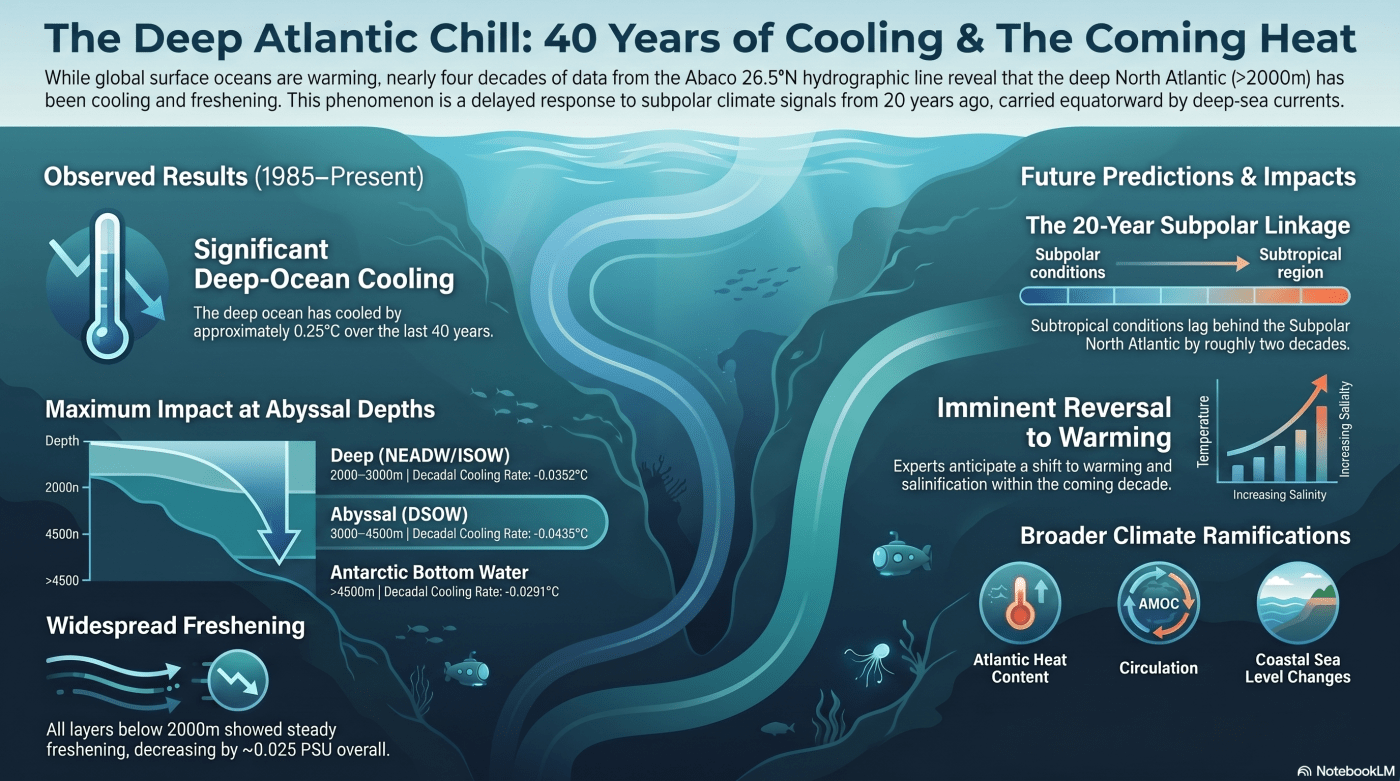
Since 1985, data from the Abaco line has revealed a stark contradiction to the global warming narrative: at depths greater than 2000 meters, the Subtropical North Atlantic is significantly cooling and freshening. While most of the Atlantic has seen widespread heat uptake since the turn of the century, the water masses at 26.5°N—specifically the Deep, Abyssal, and Antarctic Bottom Water (AABW) layers—show decadal cooling rates of -0.0352°C and -0.0433°C, respectively.
This finding is particularly provocative because it offers a “localized” contradiction to established research. While prior studies (References 34 and 35) suggested that AABW was warming across the broader Atlantic, the observations at 26.5°N show the opposite. This suggests that the deep ocean is not a monolith; it is a complex, fragmented system where regional drivers can temporarily mask or override global trends.
“Sustained hydrographic, mooring, and seafloor temperature surveys off Abaco Island, Bahamas at 26.5°N have illuminated significant cooling and freshening of the deep ocean (>2000m) over the past four decades, challenging the paradigm of anticipated deep ocean warming in the Subtropical North Atlantic.”
Takeaway 2: The Ocean’s 20-Year Memory
The deep ocean acts as a planetary memory bank, currently settling a 20-year-old account. Unlike the surface, which reacts almost instantly to atmospheric shifts, the properties of deep water—temperature and salinity—are “imprinted” at the time of their formation in the subpolar regions. The water currently passing the Bahamas at a depth of two miles is a time capsule, carrying the signature of atmospheric conditions that occurred in the Labrador or Irminger Seas over two decades ago.
There is a distinct mechanical difference in how these layers remember. While the Intermediate layer (1000–2000m) has already completed the passage of its cooling and warming cycle, the deeper layers (>2000m) are currently in the midst of an ongoing manifestation of the subpolar minimum from the mid-1990s.
“Property changes at depth often reflect surface conditions from the past, providing memory to the deep ocean.”
Takeaway 3: The Deep Western Boundary Current (DWBC) as a Climate Conveyor
The primary engine transporting these ancient climate signals is the Deep Western Boundary Current (DWBC). This current functions as a massive conveyor belt, carrying cold, fresh water formed through subpolar convection equatorward. The study highlights that Zone 1 of the 26.5°N line—the 140 km region closest to the continental shelf—serves as the critical core of this throughflow.
By monitoring this strategic location, researchers can capture the “return flow” of the Atlantic’s massive meridional overturning circulation. This makes 26.5°N more than just a data point; it is a vital diagnostic site that allows scientists to track how subpolar environmental imprints move through the entire basin, effectively using the subpolar past to predict the subtropical future.
Takeaway 4: The “Great Salinity Anomaly” Connection
The current subtropical freshening is an echo of the “Great Salinity Anomaly,” a multi-decadal event that gripped the subpolar basins from the 1960s through the 1990s. Driven by an extreme positive state of the North Atlantic Oscillation (NAO) and massive Arctic ice exports, this anomaly reached its minimum salinity in the subpolar regions between the mid-1990s and early 2000s.
Because of the advective lag, that freshening peak is only now fully manifesting at 26.5°N. The data shows how a shift in Arctic ice decades ago can ripple through the deep ocean, arriving in the subtropics long after the surface conditions in the North have begun to “rebound” toward warmer, saltier states.
Takeaway 5: A Warming Reversal is on the Horizon
The era of deep cooling at 26.5°N is likely reaching its end. Based on the subpolar “rebound” that began around the year 2000, researchers anticipate an imminent onset of subtropical deep ocean warming and salinification. In fact, a slight uptick in salinity observed in 2019 may be the leading edge of this reversal.
This shift carries urgent societal implications. Deep ocean warming triggers thermal expansion, a primary driver of sea-level rise. Coastal observing systems along the western Atlantic have already documented sea-level increases exceeding +10mm per year. If the deep ocean begins to warm in tandem with the upper layers, the resulting expansion could significantly accelerate the flood risks already threatening coastal communities.
Conclusion: Looking Beneath the Surface
The surprising cooling at 26.5°N underscores the non-negotiable need for sustained monitoring programs like the WBTS, MOCHA, and RAPID. Without four decades of continuous observation, the deep ocean’s “memory” would remain a silent mystery, leaving us blind to the massive shifts occurring miles beneath the surface.
As we stand on the threshold of a predicted warming reversal, the Abaco line serves as a reminder that the ocean never forgets. It simply takes its time. By studying the “echoes” of the past buried in the abyss, we gain our best chance at predicting the climate impacts of our future. How many other signals from the past are still traveling through the dark, waiting to reach us?
The infographic was generated by Notebook LM.
Chomiak, L.N., Volkov, D.L., Johns, W.E. Hooper, J.A. & Smith, R.H. (2025). Deep ocean cooling and freshening from Subpolar North Atlantic reaches Subtropics at 26.5°N. Commun Earth Environ 6, 235. https://doi.org/10.1038/s43247-025-02170-y


Leave a Reply