
This blog post and the “Deep Dive” podcast, created by NotebookLM, are based on “Observational constraints project a ~50% AMOC weakening by the end of this century” by Portmann et al. (2026).
Portmann et al. (2026) published in Science Advances utilizes observational constraint methods to refine future projections of the Atlantic Meridional Overturning Circulation (AMOC), a critical system of ocean currents. While standard climate models from CMIP6 predict a wide range of outcomes, the authors apply ridge-regularized linear regression to integrate multiple observable variables, such as sea surface salinity and temperature. Their findings suggest a ~50% weakening of the AMOC by the end of the century, a decline significantly more severe than the multi-model mean typically cited. This adjustment is largely driven by correcting model biases in South Atlantic salinity, which indicates the circulation may be closer to a tipping point than previously realized. Ultimately, the study highlights the necessity of more aggressive adaptation strategies to address the potential for dramatic climate shifts across the Atlantic region.
The Ocean’s Engine is Stalling: Why New Research Predicts a 50% AMOC Weakening by 2100
1. Introduction: The Atlantic’s Great Conveyor Belt is Faltering
Deep beneath the Atlantic’s surface, a massive system of currents known as the Atlantic Meridional Overturning Circulation (AMOC) acts as the planet’s primary heat engine. Often described as a “great conveyor belt,” this system transports warm, salty water from the tropics to the North Atlantic. Upon arrival, these waters release their heat into the atmosphere, become colder and denser, and eventually sink to the abyss to flow back southward.
While climate models have long predicted that this circulation will weaken as the planet warms, new research published in Science Advances suggests we have been significantly underestimating the magnitude of this decline. By employing “observational constraints”—a technique that uses real-world data to refine and “correct” computer simulations—scientists have discovered that the Atlantic’s pulse is slowing much faster than our previous models suggested.
2. The New Math: A “Very Likely” 51% Weakening
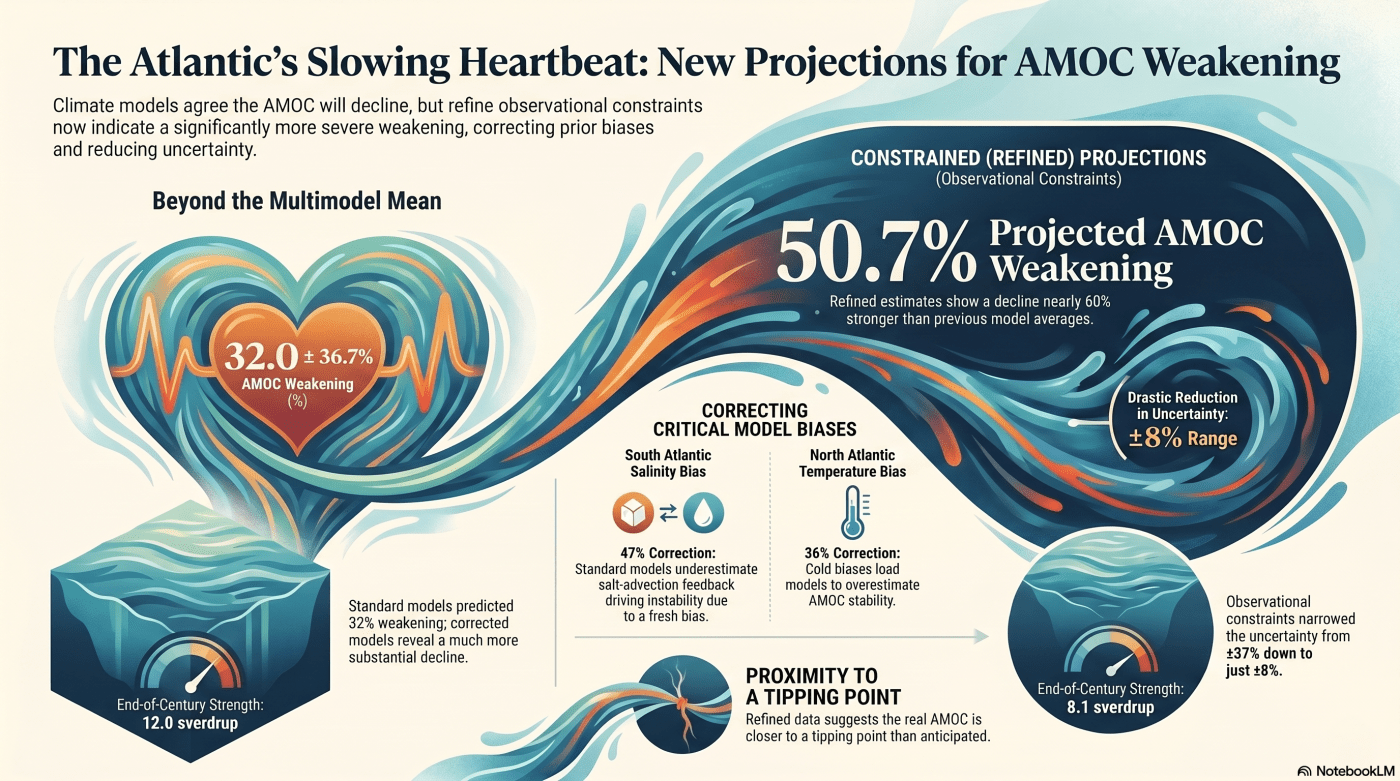
Standard climate models, grouped together as the “Multimodel Mean” (MMM), have historically offered a somewhat manageable outlook. Under the SSP2-4.5 scenario (a median emissions pathway), these unconstrained models projected a 32 ± 37% weakening of the AMOC by the end of this century.
However, when researchers applied ridge-regularized linear regression to observational data, the numbers shifted dramatically. The new math projects an AMOC weakening of 51 ± 8% by 2100, relative to the 1850–1900 pre-industrial baseline. This represents a slowdown roughly 60% stronger than what the Intergovernmental Panel on Climate Change (IPCC) has previously suggested. Crucially, this study attaches a 90% probability to these figures, meeting the IPCC’s “very likely” threshold for scientific certainty.
“According to a recent IPCC report, a slowdown of more than 50% can be called a ‘substantial weakening of the AMOC.’ This substantial weakening could have important implications for future adaptation plans in various regions affected by the AMOC, around the Atlantic and in teleconnected regions.”
3. The Physics Paradox: Why Computer Code Matters More Than Our Carbon Footprint
In the world of climate journalism, the narrative is usually simple: our future depends on how much CO2 we choose to emit. However, for the AMOC, the study reveals a startling “very unusual” reality. By the year 2100, “model uncertainty”—how the fundamental physics of the ocean are written into computer code—accounts for a staggering 78% of the variance in projections. In contrast, “scenario uncertainty”—the choice between a high-carbon or low-carbon future—accounts for only 14%.
This suggests that our current scientific tools are struggling to agree on the basic mechanics of the Atlantic. It means that, for the moment, our ignorance of the ocean’s physical response is a bigger hurdle to prediction than human behavior itself.
4. The South Atlantic Bias: Why Our Models Were Too Optimistic
Why were previous projections so far off the mark? The researchers identified a critical technical flaw known as “fresh bias.” Most current climate models simulate the South Atlantic as being significantly “fresher” (less salty) than it is in reality.
To find the signal in this data, scientists used ridge-regularized linear regression, a statistical method that helps manage “noisy,” overlapping variables like temperature and salinity to find the real physical drivers. The results were clear: a more saline South Atlantic leads to a more unstable AMOC because it amplifies the salt-advection feedback—the process where salt transport helps sustain the current’s strength.
Because models assumed a South Atlantic that was too fresh and ignored “cold biases” in North Atlantic regions (specifically the subtropical region, subpolar East, and Nordic Seas), they incorrectly predicted an AMOC that was far more stable than it actually is. By correcting these biases with real-world observations, the true instability of the conveyor belt is revealed.
5. Global Repercussions: Losing Half a Petawatt of Heat
The weakening of the AMOC is not merely a statistical curiosity; it is a physical shift in the Earth’s energy balance. The study notes that a primary consequence of this slowdown is the equatorward shift of the Intertropical Convergence Zone (ITCZ). This atmospheric shift would lead to a devastating “drying out” of the Sahel region in Africa, creating a direct threat to agriculture and food security for millions.
The scale of this energy loss is difficult to comprehend using standard measurements.
“Every sverdrup of the absolute AMOC in 2100 is important, as it represents ~0.05 PW of the northward heat transport.”
To put this in perspective, real-world observations from the RAPID array show the AMOC currently averages about 16.9 sverdrups. A 50% reduction in strength means the Northern Hemisphere stands to lose roughly 0.4 to 0.5 Petawatts (PW) of heat transport. This is a massive redirection of the planet’s thermal energy that will rewrite local climates across the globe.
6. We Are Closer to the Tipping Point Than We Realized
The most sobering takeaway from the research is that the real-world AMOC may be “closer to a tipping point” than mainstream models suggest. The physical link is the salt-advection feedback: because the CMIP6 models underestimate this feedback in a South Atlantic they mistakenly believe to be fresh, they have effectively masked the current’s proximity to a full circulation collapse.
By refining our estimates with actual salinity and temperature constraints, it becomes clear that we have been blind to the true fragility of the Atlantic’s circulation. We aren’t just looking at a slow decline; we are looking at a system losing the very mechanics that keep it upright.
7. Conclusion: A New Map for a Changing Ocean
We are moving from an era of moderate oceanographic concern to one of high-stakes urgency. The shift from a predicted 32% decline to a 51% weakening by the end of the century requires a total recalibration of our climate expectations. For scientists, the priority must now be reducing model biases in salinity and temperature to provide more precise warnings.
But for the rest of us, a deeper question remains: If the primary heat engine of our ocean is losing half its strength in just a few generations, how must our global adaptation strategies change to survive a reality that our models are only now beginning to see?
The infographic was generated by Notebook LM.
Portmann, V., Khattab, O., & and Chavent, M. (2026). Observational constraints project a ~50% AMOC weakening by the end of this century. Sci. Adv.12, eadx4298. https://doi.org/10.1126/sciadv.adx4298

