
This blog post and the “Deep Dive” podcast, created by NotebookLM, are based on “Evolving synchronization of the Gulf Stream and Kuroshio-Oyashio Extension in a changing climate” by Joh et al. (2026).
This research article by Joh et al. (2026) investigates the decadal and seasonal synchronization between two major ocean currents: the Gulf Stream and the Kuroshio-Oyashio Extension. Using historical observations and high-resolution climate simulations, the authors demonstrate that these currents exhibit their strongest temperature covariance during the boreal summer. This inter-basin connection is likely triggered by Arctic sea-ice loss in the Greenland and Barents Seas, which generates atmospheric waves that alter midlatitude jet streams. While this coupled climate mode has intensified in recent decades, model projections suggest the relationship may weaken under future high-emission scenarios as sea-ice variability diminishes. Ultimately, understanding these synchronized oceanic shifts is vital for improving long-term weather predictability and managing coastal ecosystems across the Northern Hemisphere.
Deep within the North Atlantic and the North Pacific, two massive “rivers” of saltwater drive the circulatory health of our planet. These are the Western Boundary Currents and Extensions (WBCEs)—specifically the Gulf Stream and the Kuroshio-Oyashio Extension (KOE). Moving more water than all the world’s surface rivers combined, these giants are the heavy lifters of the Earth system, ferrying vast amounts of tropical heat toward the poles and dictated the weather for entire continents. For decades, oceanographers viewed these two basins as separate kingdoms, each responding to its own local rhythms.
However, a startling new synchronization has been discovered. Despite being separated by the massive bulk of North America and thousands of miles of open sea, these two oceanic titans are pulsing in unison. Scientists have found that the Gulf Stream and the Kuroshio are no longer acting independently; they have begun a secret “handshake” across the hemisphere, coordinated by a remote control located at the top of the world.
The Summer “Handshake”: When the Oceans Align
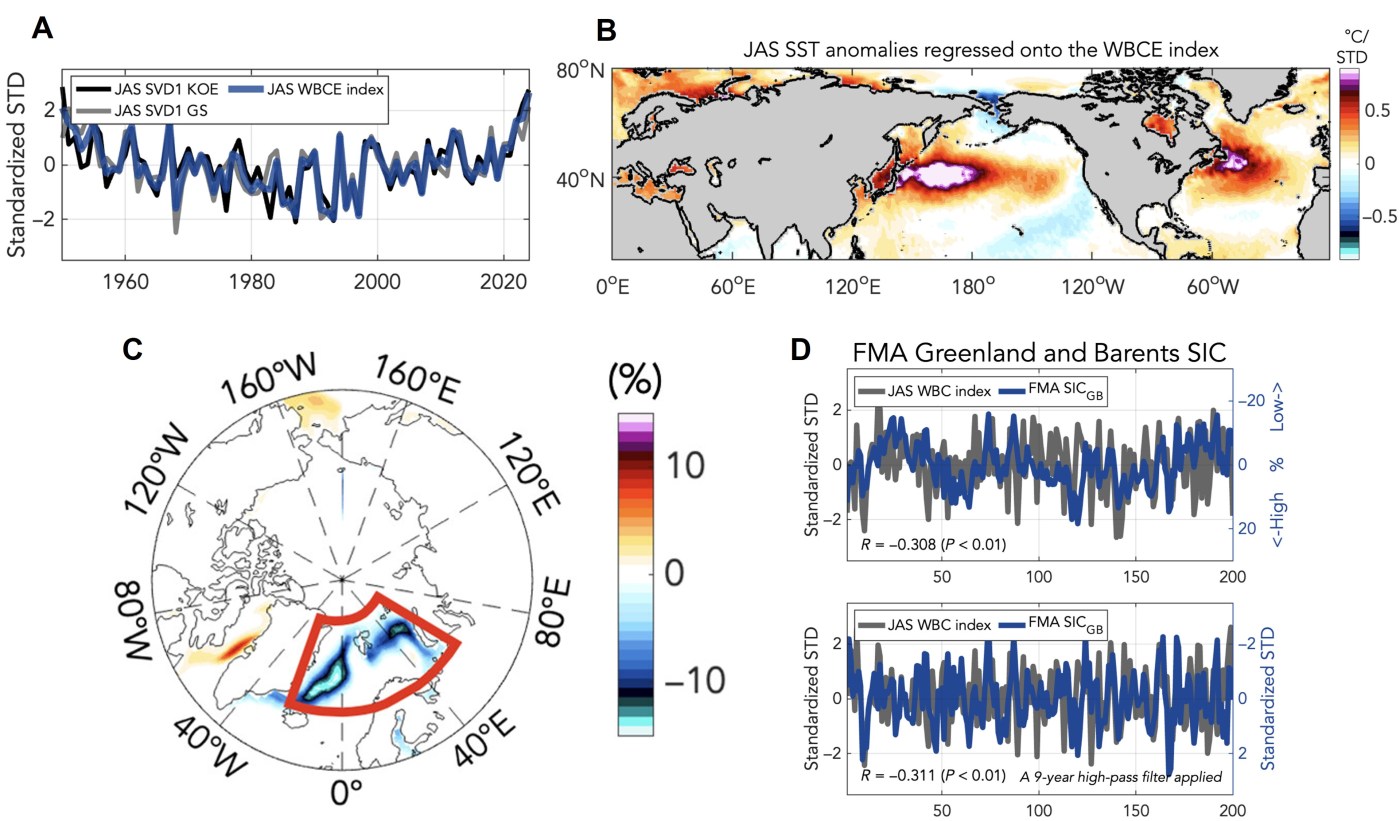
While the oceans are in a state of perpetual motion, their temperatures align with uncanny precision during a specific three-month window: the boreal summer of July, August, and September (JAS). High-resolution climate simulations and satellite data reveal that during these months, the sea surface temperatures (SST) of these two distant regions rise and fall as one.
This is not a minor statistical quirk. This synchronization is so powerful that it accounts for more than 20% of the total sea surface temperature variance across the entire midlatitude ocean. During the summer, the two basins effectively merge into a single, dominant climate mode that dictates the thermal state of the Northern Hemisphere.
“Our findings reveal that WBCE covariability is characterized by strong seasonality… the interbasin coupled variability emerges as the dominant climate mode over the Northern Hemisphere midlatitudes in JAS… [acting as the] leading mode of global midlatitude SST variability.”
The Arctic “Remote Control”: How Winter Ice Sets the Summer Stage
The trigger for this massive oceanic alignment isn’t found in the tropics, but in the freezing reaches of the Greenland and Barents Seas. The causal mechanism is a “remote control” effect where winter sea-ice loss in the Arctic dictates the following summer’s ocean temperatures thousands of miles to the south.
When Arctic ice vanishes in the winter, it exposes the dark ocean beneath, releasing a “turbulent heat flux” into the cold atmosphere. This sudden injection of heat is like dropping a massive boulder into a pond; it creates ripples in the atmosphere known as quasi-stationary Rossby waves. These waves form a “Eurasian teleconnection”—a chain of high and low pressure that stretches across the continents. These ripples eventually “anchor” the planetary jet streams, shifting them poleward and creating stagnant high-pressure domes over the Gulf Stream and the Kuroshio. These “anticyclonic anomalies” trap heat and warm the water in both oceans simultaneously.
The Chain Reaction
- Phase 1: Winter (FMA – Feb/Mar/Apr): Sea-ice loss in the Greenland and Barents Seas peaks, triggering a massive release of heat from the ocean to the sky.
- Phase 2: Spring (MAM – Mar/Apr/May): This heat release generates the Rossby wave train, creating a bridge of atmospheric pressure across Eurasia.
- Phase 3: Early Summer (MJJ – May/Jun/Jul): The midlatitude jet streams act as a waveguide, directing these waves and shifting the atmospheric “steering wheels” over the Atlantic and Pacific.
- Phase 4: Peak Summer (JAS – Jul/Aug/Sep): High-pressure anomalies settle over the WBCE regions, leading to the synchronized warming of the Gulf Stream and the Kuroshio.
Why This Matters: The Link to Our Backyard Heatwaves
This oceanic synchronization is more than a maritime mystery; it is a primary driver of summer weather where people actually live. Research shows a scientifically heavyweight correlation (R = 0.67) between this “WBCE index” and land temperatures across the Northern Hemisphere.
When the Gulf Stream and Kuroshio pulse warm in unison, the atmospheric patterns they anchor bring extreme heat to “highly populated regions,” including Europe, East Asia, and Western North America. Beyond the heat, this synchronization shifts the productivity of the seas, affecting coastal ecosystems, nutrient upwelling, and the stability of global fisheries. For meteorologists, this discovery provides a crucial “source of predictability”—a way to look at winter ice levels in the Arctic and forecast the risk of a killer summer heatwave months in advance.
The Paradox: Why More Warming Could Break the Connection
Since 1970, the synchronization between these oceans has actually grown stronger as Arctic ice has thinned. But scientists have uncovered a “nonstationary” paradox: if we lose too much ice, the connection will break.
In the current climate, the variability of the ice—the fluctuation between a frozen and melted state—is what provides the energy for the atmospheric Rossby waves. Think of the ice as the battery in the remote control. Currently, the battery is pulsing. However, as the world warms toward a seasonally ice-free Arctic, the Greenland and Barents Seas will remain open water year-round. Without the fluctuation of ice to trigger the heat release, the atmospheric waves will lose their energy. Ironically, by melting the Arctic completely, we may lose the very rhythmic pulse that currently allows us to predict our summer weather.
Can We Reset the Pulse? The Overshoot Scenario
Is this planetary rhythm gone forever once the ice disappears? Researchers tested this using an “Overshoot” (SSP245OS) experiment. In this model, greenhouse gas concentrations (CO2 and CH4) continue to rise until they peak around 2040, after which they are aggressively reduced.
The results offer a rare glimmer of hope regarding climate “reversibility.” The experiment showed that as the Arctic cooled and sea-ice variability returned, the synchronization between the Gulf Stream and the Kuroshio was restored. This suggests that the planet’s circulation is not just a one-way street of decay, but a complex series of rhythms that can potentially be reset if the underlying Arctic “heart” is allowed to heal.
Conclusion: The Interconnected Future
The Arctic is the rhythmic heart of the Northern Hemisphere’s climate. The health of the ice in the Greenland and Barents Seas dictates the pulse of the world’s most powerful currents, which in turn determines the intensity of the summers we experience on land.
Our ability to predict the next great summer heatwave depends on our ability to protect a sea that most of us will never visit. The pulse of the planet is a single, interconnected system; when the rhythm of the ice falters, the heartbeat of the ocean changes, and the heat is felt at the edges of every continent.
“Our findings suggest that midlatitude summer ocean predictions may benefit from long-lead forecast skill when initialized in winter and could be enhanced by improved Arctic sea ice representation in high-resolution models.”
Figure derived from Figures 1 & 4 in Joh et al. (2026): (A-B) Western Boundary Current Extension (WBCE) temperature variability as an indicator of summer midlatitude climate. (A) Standardized SVD1 time series (black for Kuroshio-Oyashio Extension (KOE) and gray for Gulf Stream (GS)) and the WBCE index (blue), which is defined as the mean of those paired time series. Standardized STD on the y-axis denotes that the time series have been standardized by their respective standard deviations (STDS). (B) Pattern of the SVD1 computed as the regression coefficients of July-September (JAS) SST (°c) anomalies on the WBCE index. As in panel (A), standardized STD indicates normalization by the standard deviation. Both panels are derived from the ERA5 reanalysis dataset between 1950 and 2024. (C-D). Dynamical impacts of preceding winter Greenland and Barents SIC on midlatitudes in 1990CTRL. (A) Regression coefficients of February-April (FMA) SIC anomalies onto the JAS WBCE index. (B) Comparisons of the raw (top) and 9-year high-pass–filtered (bottom) JAS WBCE index (gray) and FMA regional-mean SIC (blue) over the Greenland and Barents Sea region (67° to 82°N, 20°W to 65°E), indicated with a red box in (A). Note that the y axis of SIC is reversed.
Joh Y., Yeh, S.-W., Delworth, T. L., Labe, Z. M., Wittenberg, A. T., Cooke, W. F., Lou, J., & Park, Y.-G. (2026). Evolving synchronization of the Gulf Stream and Kuroshio-Oyashio Extension in a changing climate. Science Advances, 12, eadx6366(2026). https://doi.org/10.1126/sciadv.adx6366
 Ocean to Climate
The main conclusion is also consistent with an earlier study by Kohyama et al. (2021, Science):
Tsubasa Kohyama et al., The Gulf Stream and Kuroshio Current are synchronized. Science 374, 341-346 (2021). https://www.science.org/doi/10.1126/science.abh3295