
This blog post and the “Deep Dive” podcast, created by NotebookLM, are based on “Rapid subsurface warming in the subpolar North Atlantic from freshening” by Menviel et al. (2026).
Menzviel et al. (2026) study explores how increased freshwater from melting Arctic ice and the Greenland Ice Sheet triggers rapid subsurface warming in the subpolar North Atlantic. Using climate simulations, researchers demonstrate that adding meltwater enhances ocean stratification, which traps heat by preventing cold surface waters from mixing with deeper layers. This process leads to a significant temperature rise along Greenland’s coasts and in Baffin Bay, even with relatively small amounts of freshening. Such warming creates a dangerous feedback loop that could accelerate glacier retreat and further destabilize the Atlantic Meridional Overturning Circulation. Additionally, the research indicates that while surface cooling occurs in some areas, the Nordic Seas may experience both surface and subsurface heating due to changes in regional currents. Ultimately, the authors emphasize that current climate models must accurately represent deep-ocean convection to correctly predict these localized temperature shifts.
It seems like an elementary physics problem: if you dump billions of tons of ice-cold meltwater from the Greenland Ice Sheet into the North Atlantic, the ocean should get colder. For decades, this “cool lid” theory has dominated our mental model of Arctic climate change. But nature is rarely that linear.
Menviel et al. (2026) has identified a startling “Arctic Paradox.” Instead of simply chilling the North, the freshening of the Atlantic is triggering a rapid, hidden heat wave in the subsurface layers of the ocean. By rewiring the Atlantic’s plumbing, this meltwater is trapping heat where it does the most damage—at the roots of our polar glaciers.
Here are the five most critical takeaways from these new climate simulations that change everything we thought we knew about ice-sheet stability and global ocean circulation.
1. Rewiring the Atlantic’s Plumbing: The Subsurface Heat Trap
The primary driver of this paradox is a process called “enhanced stratification.” Because freshwater is less dense than saltwater, the meltwater from Greenland doesn’t mix; it sits on the surface like a buoyant, insulating blanket.
In a healthy system, the ocean “breathes” through a process called ventilation. Cold, oxygen-rich surface water sinks into the deep, essentially inhaling the atmosphere’s chill and redistributing it. The Menviel et al. study reveals that this new freshwater “lid” effectively chokes off this ventilation. It prevents cold water from sinking, which traps heat in the subsurface layers—specifically between 100 and 400 meters deep.
“This warming arises from enhanced stratification, weakened deep convection in the subpolar gyre, and a weaker Labrador Current.” — Menviel et al. (2026)
The result is a counter-intuitive disaster: while the surface might look colder to a satellite, the water just a few hundred meters down is becoming a cauldron, sequestering heat that has nowhere else to go.
2. The 0.05 Sverdrup Threshold: Small Flux, Massive Impact
One of the most sobering findings is how little meltwater it takes to destabilize the region. The researchers tested the impact of a 0.05 Sverdrup (Sv) meltwater flux—a unit representing one million cubic meters of water per second.
To put that in perspective, 0.05 Sv is roughly equivalent to the “Great Salinity Anomaly” of the late 1960s (which was 0.065 Sv). It is a “moderate” pulse in geological terms, yet the results were explosive. Within just 10 years, this flux triggered a subsurface warming of approximately 1°C in Baffin Bay and along the southern and western coasts of Greenland.
The fact that a 1°C spike can occur within a single decade suggests that our climate models are likely “flying blind.” Most standard models omit these specific Greenland meltwater inputs, meaning they are almost certainly underestimating the immediate regional risks to the Arctic.
3. The Glacial Guillotine: A Self-Sustaining Cycle of Melting
This subsurface warming creates a lethal positive feedback loop. The Arctic and Greenland are home to 745 “marine-terminating glaciers”—the massive ice rivers that meet the sea.
The danger is geographical. This trapped heat lives at the exact depth where these glaciers meet the ocean floor. As the subsurface water warms, it eats away at the glaciers from below, a process far more efficient and destructive than surface air melting.
This leads to the “Glacial Guillotine”:
- Subsurface warming melts the glacier’s base.
- The glacier releases more freshwater as it retreats.
- The additional freshwater strengthens the stratification lid.
- More heat is trapped, accelerating the melt even further.
The location of the meltwater is critical. The study suggests that liquid runoff released close to the coast (versus ice discharge further out) dictates the severity of this heat trap, specifically targeting the stability of the entire Greenland Ice Sheet.
4. The Nordic Sea Surprise: A Vacuum Pulling Heat Northward
While the subpolar gyre experiences surface cooling, the Nordic and Barents Seas are facing a different beast: an “intensified Atlantic inflow.”
Freshening the North Atlantic changes the horizontal density gradients of the ocean. This creates a density gap that acts like a vacuum, pulling warmer, saltier water from the south into the Nordic Seas. The study found that this inflow could strengthen by as much as 50%.
This causes a regional surface warming that defies the broader Atlantic cooling trend. Researchers project that surface air temperatures in the central Nordic Seas could rise by approximately 2°C between 2030 and 2039 due to these shifted currents. This imported heat further destabilizes Arctic sea ice from the eastern side, proving that meltwater in one region can spark a heat wave in another.
5. The Stalling “Great Conveyor Belt”: Weakening Faster Than Predicted
The Atlantic Meridional Overturning Circulation (AMOC)—the “Great Conveyor Belt” that regulates global climate—is in more trouble than standard models suggest.
Menviel et al. (2026) compared standard models (Hist-SSP585) with their “Freshwater” version (Hist-SSP585-FW). The discrepancy is alarming. When Greenland’s meltwater is accurately accounted for, the AMOC is projected to be 35% to 49% weaker than its pre-industrial state by the mid-to-late 21st century. This is nearly double the decline predicted by models that ignore freshening.
This slowdown has a ripple effect. The study explicitly links the freshening and resulting Kelvin waves to a significant weakening of the Gulf Stream. However, the study also reveals a major scientific tension: the results depend heavily on where the models think deep-ocean convection happens.
- The ACCESS-OM2-025 model suggests convection in the Labrador Sea is too strong.
- The ACCESS-ESM1.5 model suggests it is too weak.
This model conflict is the new frontline of climate science. If our models don’t correctly identify the “lungs” of the ocean where water sinks, we cannot accurately predict when the “Arctic Paradox” will transition from a regional warning to a global catastrophe.
A Hidden Horizon
The findings from Menviel et al. (2026) serve as a final notice for climate policy: looking at surface temperatures is no longer enough. The ocean is hiding its heat, and that heat is currently undermining the very foundations of the Greenland Ice Sheet.
As we move toward a world with accurate deep-ocean simulations, we are forced to confront a lingering, uncomfortable question: how many other “hidden” shifts are occurring in the deep sea, unnoticed simply because we are only looking at the surface?
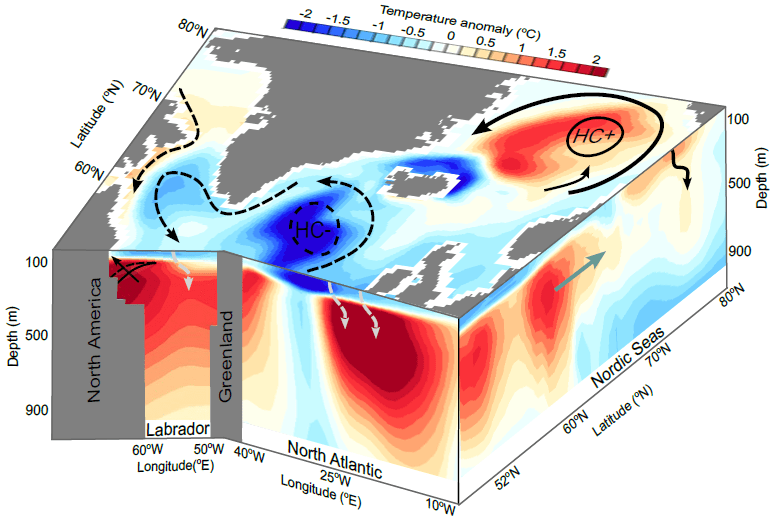
Figure 4 from Menviel et al. (2026): Summary of processes leading to surface (top 50m) and subsurface (0-1000m depth) temperature changes in (lower left side panel) the Labrador Sea (section at 60°N), (centre side panel) the North Atlantic (section at 60°N) and (right side panel) the North Atlantic and Nordic Seas (averaged over 30°W–10°E). Weaker meridional oceanic heat transport towards the North Atlantic (reduced heat convergence, HC-), coupled with a weaker subpolar gyre (dashed black cyclonic circulation) and enhanced stratification (dashed downward arrows) leads to a surface cooling in the North Atlantic, but weaker Baffin Island and Labrador currents (dashed black southward arrow) lead to surface warming in the Hudson Strait and Labrador shelf. Enhanced stratification and reduced convection (grey dashed downward arrows) lead to a subsurface warming in the North Atlantic, Baffin Bay and the Labrador Sea – with a flattening of the isopycnals (solid and dashed lines with side arrows) allowing for incursion of warmer water onto the shelf in the Labrador Sea. A stronger cyclonic circulation in the Nordic Seas (black cyclonic loop), with stronger Norwegian Atlantic Front Current and Norwegian Atlantic Slope Current (and increased heat
convergence, HC+), increases the density of surface waters in the central Nordic Seas, reducing stratification and leading to a
surface and subsurface warming. A transient stronger Atlantic inflow could further warm the Nordic Seas (green arrow).
Menviel, L.C., Pontes, G., Lapeze, M. et al. Rapid subsurface warming in the subpolar North Atlantic from freshening. Nat Commun (2026). https://doi.org/10.1038/s41467-026-70635-5
 Ocean to Climate
Leave a comment