
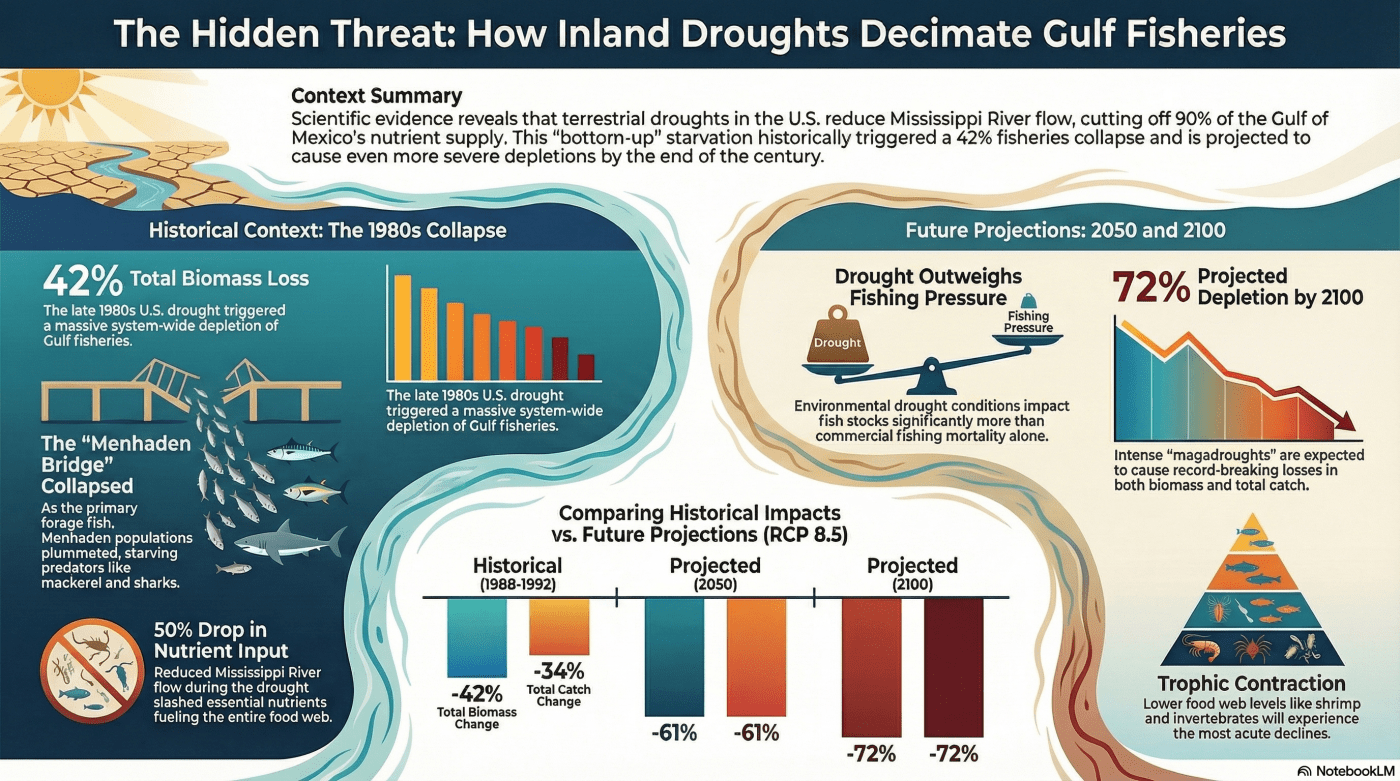
This blog post and the “Deep Dive” podcast, created by NotebookLM, are based on “Historical depletion and future drought-driven risks to Gulf of Mexico fisheries production” by Berenshtein et al. (2026).
This research examines how terrestrial droughts in the United States drastically reduce fisheries production in the Gulf of Mexico by decreasing Mississippi River nutrient discharge. The study links a historical 42% decline in fish biomass during the early 1990s to a major late-1980s drought that depleted the forage fish base, specifically Gulf menhaden. Using ecosystem simulations, the authors project that more frequent and intense megadroughts fueled by climate change could cause total biomass losses of up to 72% by the end of the century. These findings suggest that bottom-up nutrient limitation during dry periods has a more profound impact on the marine food web than fishing pressure alone. Consequently, the authors advocate for adaptive management strategies to mitigate the looming ecological and economic risks to the region.
1. Introduction: The River and the Reef
We have long viewed the Mississippi River as a vein of commerce—a highway of steel and water carrying the harvest of the American Midwest to the world. But to the Gulf of Mexico, the river is more accurately a nutrient artery. This massive waterway delivers over 90% of the nitrogen and phosphorus that fuels the Gulf’s biological engine. Without it, the Gulf is fundamentally oligotrophic—a “biological desert” where the lack of natural upwelling or oceanic nutrient currents leaves marine life entirely dependent on the runoff from a continent away.
This dependency creates a profound “hidden truth”: the pulse of the ocean is dictated by the weather in the heartland. A landmark study by Berenshtein et al. (2026), published in Nature Communications, reveals that the fate of the Gulf’s fisheries is not just decided by the nets at sea, but by the rain—or lack thereof—in cornfields thousands of miles inland. It is a story of how a dry summer in the Midwest can trigger a silent starvation in the deep blue.
2. The Great Disappearance of 1990
In the early 1990s, the Gulf of Mexico’s productivity simply vanished. Total fisheries production suffered a staggering 42% depletion, a collapse that left local economies reeling. For decades, the true driver of this event remained obscured, not because the data was missing, but because the link between terrestrial meteorology and marine biology had not been fully synthesized.
The “hidden variable” was the great North American drought of the late 1980s. While the nation focused on the $60 billion in agricultural damage and the smoke from inland wildfires, the Mississippi River’s flow dropped by more than 50%. This was a “double whammy” for the Gulf: the drought peaked during the crucial spring-summer months, the exact window when fish larvae begin feeding on the phytoplankton blooms usually triggered by river nutrients.
“A major depletion of ~42% in total fisheries production occurred in the Gulf of Mexico in the early 1990’s but received limited scientific attention.”
The collapse went largely unstudied because of a historical disconnect in scientific silos. We measured the drought’s impact on barges and crops, but few were looking toward the horizon to see how the restriction of that nutrient artery was effectively silencing the forage base of the ocean.
3. The Gulf Menhaden: The Linchpin of the Food Web
If the Mississippi River is the artery of the Gulf, the Brevoortia patronus—the Gulf menhaden—is the heart that pumps that energy through the system. This small, oily forage fish is perhaps the most critical entity in the entire ecosystem. It serves as the primary “trophic link,” converting microscopic phytoplankton into a high-energy protein source for the Gulf’s most iconic predators.
Because menhaden are bottom-up specialists, they are the first to feel the effects of a dry river. When the nutrient flow stalls, the menhaden population contracts, breaking the energy pathway to the rest of the ocean. Without this forage base, the entire food web begins to starve, from the mackerels and marine mammals to the apex sharks that define the Gulf’s apex.
4. Drought vs. The Nets: A Counter-Intuitive Rivalry
In the traditional narrative of marine decline, overfishing is the perennial villain. However, Berenshtein et al. present a counter-intuitive reality: terrestrial drought conditions have a far more acute and systematic effect on total biomass than fishing mortality (F). This was especially evident in the 1980s, when the ecosystem was hit by the highest menhaden fishing effort on record at the same time the river ran dry.
The researchers used ecosystem model simulations to contrast these two stressors, revealing a startling difference in their scope:
- The Dominant Drivers:
- Fishing Mortality: Acts as a surgical strike. It targets specific high-value groups and their immediate competitors. For instance, while certain fish stocks decline, competitors like cephalopods may actually increase in their absence.
- Terrestrial Drought: Acts as a carpet bomb. It causes “systematic declines” across 89% of all functional groups. It does not just target a species; it hollows out the entire ecosystem.
While fishing pressure remains a concern, drought compromises the ecosystem’s very ability to compensate for harvest. This suggests that “Adaptive Management” can no longer just be about quotas; it must account for the health of the river. If the river runs dry, even a fishing mortality rate of zero may not be enough to prevent a collapse.
5. A Forecast for 2100: The 72% Warning
As we look toward the end of the century, the risk moves from historical curiosity to an existential warning. Under the RCP 8.5 high-emissions scenario, the “megadrought” may become the new norm for the Mississippi River basin. Berenshtein et al. utilized nutrient reduction factors (the “math of starvation”) to project a future that is substantially more acute than any previous estimates.
- By 2050: Total biomass and catch are projected to deplete by 61%, driven by a nutrient reduction factor of 0.57.
- By 2100: Total biomass and catch are projected to deplete by 72%, driven by a nutrient reduction factor of 0.45.
These numbers represent a permanent contraction of the Gulf’s life-sustaining capacity. In this future, the record-breaking depletions of 1990 would be seen as a mere preview of a systematic, drought-driven decline.
6. Conclusion: Beyond the Horizon
The evidence is clear: the Gulf of Mexico is the downstream recipient of our inland climate reality. To protect our marine resources, we must move toward an integrated management of water and land use that recognizes the Mississippi River as the lifeblood of the sea.
If we fail to bridge the gap between inland weather and marine science, we risk a permanent “drought-induced regime shift.” This is a future where traditional fisheries are replaced by jellyfish—opportunistic survivors that thrive in nutrient-poor waters. Jellyfish don’t just fill the void; they actively compete with fish larvae for zooplankton and prey on the few larvae that remain, creating a feedback loop that locks the ecosystem into a state of permanent depletion.
As the climate continues to shift, we are forced to ask a final, sobering question: If the future of our oceans is being decided in the heart of our farmlands, are we looking at the wrong map to save our fisheries?
The infographic was generated by Notebook LM.
Berenshtein, I., Kirtman, B., de Mutsert, K. et al. Historical depletion and future drought-driven risks to Gulf of Mexico fisheries production. Nat Commun 17, 2409 (2026). https://doi.org/10.1038/s41467-026-69116-6
 Ocean to Climate
Leave a comment