
This blog post and the “Deep Dive” podcast, created by NotebookLM, are based on “Interactions between the Arctic Mediterranean and the Atlantic Meridional Overturning Circulation: A review” by Weijer et al. (2022).
This brief review article discusses the critical relationship between the Atlantic Meridional Overturning Circulation (AMOC) and the Arctic Mediterranean, highlighting how their interaction regulates the Earth’s climate. The AMOC functions as a massive conveyor belt, transporting warm, salty water from the subtropics toward the North Atlantic, where it cools and sinks to form dense deep-water currents. Recent research emphasizes that processes within the Arctic, such as sea ice formation and shelf cooling, are essential drivers of this circulation’s lower limb. However, scientists are concerned that anthropogenic warming and increased freshwater runoff could weaken this system, potentially leading to a “heat crisis” or a collapse of historical ocean patterns. Sophisticated numerical models and long-term monitoring programs like OSNAP are currently being used to track these changes and predict how Atlantification—the increasing influence of Atlantic water in the Arctic—will impact future global temperatures. Ultimately, the source underscores that the Arctic is no longer just a destination for ocean heat but a primary regulator of the circulation that stabilizes the global climate system.
The Atlantic Meridional Overturning Circulation (AMOC) is the Earth’s long-term memory. Unlike the erratic, fast-moving atmosphere, the AMOC operates on a massive, slow-motion scale, acting as a global engine for heat and carbon sequestration. By burying anthropogenic heat deep within the abyss, it serves as a silent shock absorber for a warming world.
This engine is driven by a process of visceral physical transformation. In the freezing reaches of the north, sea ice formation triggers “brine rejection”—a mechanical shedding of salt that leaves the remaining water incredibly dense. This heavy, saline water sinks, creating the downward stroke of the ocean’s heartbeat and pulling warmer waters from the tropics to fill the void.
History warns us that this heartbeat is not guaranteed. Past climate “swings,” such as the Younger Dryas, show that when this circulation falters, the Northern Hemisphere can plunge into cooling even as the rest of the planet warms. Today, the stakes have shifted. Recent research in the Arctic Mediterranean—the northern terminus of this great loop—suggests the rules of the game are changing in ways our models are only beginning to grasp.
The “Switchyard” of the North Atlantic
The Eastern North Atlantic (ENA) functions as a sophisticated “switchyard,” a geographical pressure point that determines exactly what kind of water enters the Arctic. This process begins at a critical bifurcation of the North Atlantic Current. While much of the current’s volume recirculates toward the subtropics, roughly 15 Sverdrups—a unit representing one million cubic meters of water per second—escape the loop and head northward.
Whether this inflow is warm and salty or cool and fresh depends on the state of the subpolar gyre, a massive counter-clockwise swirl of water governed by the North Atlantic Oscillation (NAO). When the gyre is expansive, it blocks the path of warmer currents, flooding the “switchyard” with subpolar melt. When it contracts, the gates open for subtropical waters to surge toward the pole.
“Between 50% and 70% [of the waters in the ENA] are derived from the subtropics, depending on the state of the subpolar gyre.”
This switch is a primary lever for European climate stability. A stronger subtropical contribution brings a higher salt and heat load, fundamentally altering the density of the water before it ever reaches the deep-sea sinking zones.
The Paradox of the Weakening Current vs. The Warming Arctic
Climate science often grapples with a counter-intuitive finding: while the AMOC is almost certain to weaken this century, the Arctic is likely to get hotter, not cooler. Usually, a slowing conveyor belt would imply a reduction in poleward heat transport. However, recent data suggests that ocean heat transport (OHT) can become “decoupled” from the mechanical strength of the AMOC.
This occurs because of a thermal trade-off. Even if the total volume of water moving north (the AMOC’s “flow rate”) decreases, the water itself is retaining more of its heat. In the past, Atlantic water lost much of its warmth to the atmosphere in the Nordic Seas; today, as those seas warm, the water arrives at the Arctic gates with its thermal energy largely intact.
“A trade-off between reduced supply of warmer waters is won—at least at Arctic latitudes—by ocean warming.”
This suggests that the Arctic is entering a “heat crisis” regardless of the conveyor’s speed. The temperature of the incoming water is simply rising faster than the current is slowing down, allowing more heat to penetrate the polar interior than at any point in recorded history.
The “Freshwater Bomb” in the Beaufort Gyre
While heat transport threatens the Arctic from below, a “freshwater bomb” threatens the AMOC’s stability from above. Since 1997, the Beaufort Gyre—a wind-driven reservoir in the western Arctic—has been in a persistent state of accumulation, trapping a staggering 6,400 km³ of liquid freshwater. This buoyant lens of water is held in place by circular currents, but its eventual release is inevitable.
The scale of this risk is best understood through a comparison of flow rates. The entire Greenland Ice Sheet discharges roughly 0.04 Sverdrups of freshwater annually. A rapid release of the Beaufort Gyre’s stored water is estimated at 0.02 Sverdrups—meaning an episodic burst from this single reservoir could equal half the discharge of all Greenland’s melting glaciers combined.
Such a release would have devastating consequences for the ocean’s density-driven engine. This surge of freshwater would likely migrate into the Labrador Sea, potentially lowering surface salinities by as much as 0.4. This “freshening” acts as a lid, stifling the brine rejection and deep convection that allow water to sink, effectively stalling the AMOC’s downward limb.
“Atlantification”: When the Arctic Starts to Look Like the Atlantic
The Eurasian Basin of the Arctic is currently undergoing a fundamental structural shift known as “Atlantification.” To understand the gravity of this, one must view the Arctic through the “double-estuarine model”—a system of two distinct cells. One cell transforms Atlantic water into buoyant Polar water through freshening; the other creates deep, dense overflow through shelf-driven cooling.
Atlantification is essentially the collapse of this dual system. As warm Atlantic Water “shoals”—moving from the deep interior toward the surface—it erodes the cold halocline layer that traditionally protects sea ice from oceanic heat. This creates a feedback loop: as ice vanishes, the ocean is exposed to more radiative warming, which further weakens the stratification.
The result is a transition from a sea-ice-dominated, tranquil environment to a turbulent, Atlantic-like state. The Arctic is losing its unique identity; it is no longer a passive recipient of global changes but a dynamic, volatile driver of the ocean’s future circulation.
Conclusion: A System in Transition
The future of the AMOC is written in processes that are frustratingly “small-scale and episodic.” These events—the winter-time brine rejection on shallow shelves or the swirling of eddies—are the true gears of the global conveyor. Yet, they occur at the “Rossby radius of deformation,” a technical term for the natural “pixel resolution” of the ocean’s weather.
In the Arctic, this radius is a mere 1–15 km. For most of our current 10-kilometer-resolution climate models, these critical processes are essentially invisible, falling through the cracks of the digital grid. Until we can resolve these “pixels,” our ability to predict the timing of an AMOC collapse remains blurred.
We are watching a system in the midst of a fundamental regime shift. The interconnection of the “Arctic Mediterranean” and the global climate ensures that a crisis in the north will eventually be felt in the south. As the Arctic shifts toward an Atlantic state, a ponderous question remains: are our monitoring systems prepared for a heat crisis that could fundamentally rewrite the rules of the global ocean?
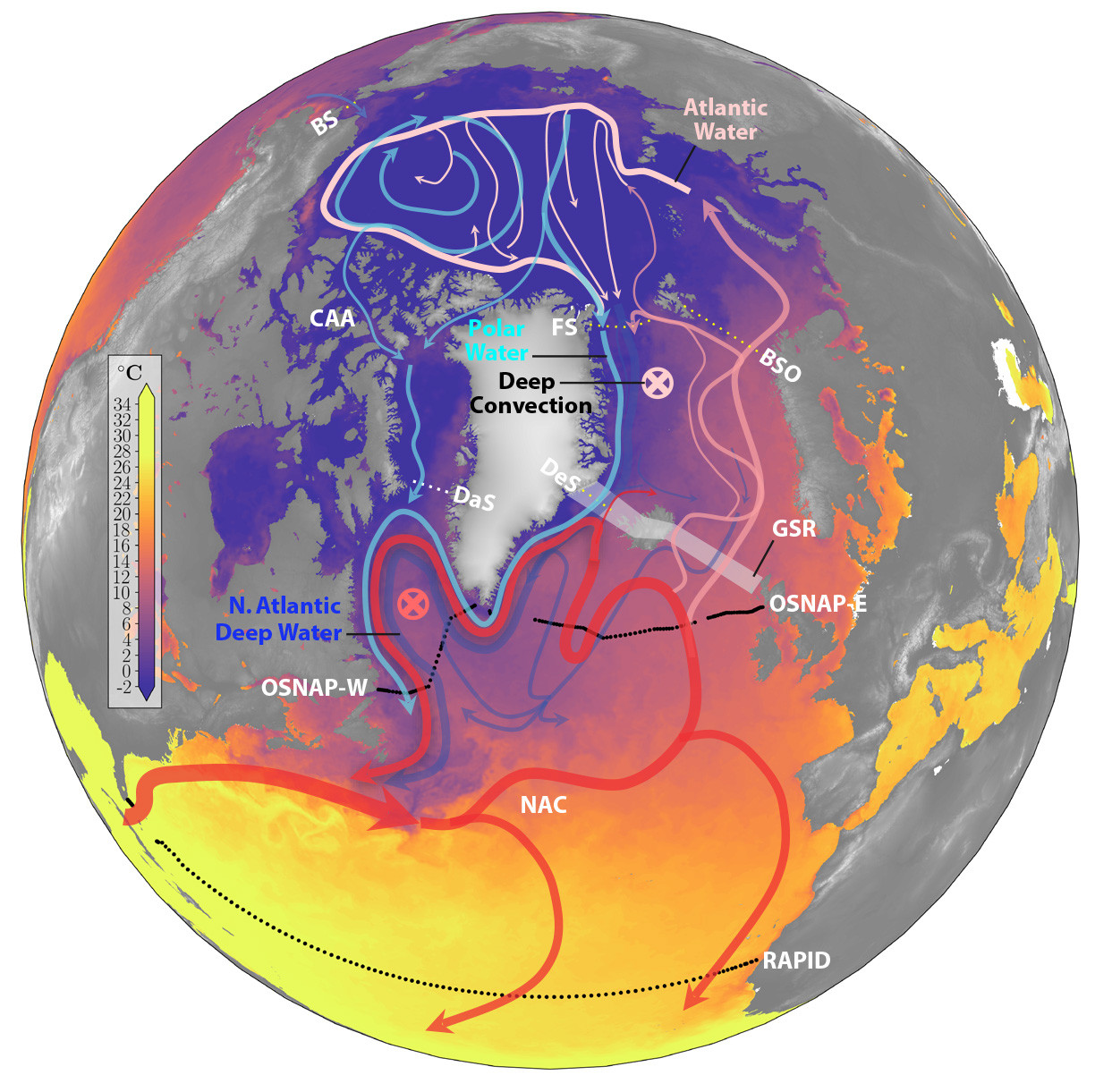
Figure 1 from Weijer et al. (2022). Schematic of the horizontal circulation in the North Atlantic and Arctic Mediterranean. The Polar Water (cyan) lies at the surface, the North Atlantic Deep Water (blue) lies at depth, and the Atlantic Water from the North Atlantic Current lies at the surface in the Atlantic and Nordic Seas and at intermediate depth in the Arctic Ocean (red and pink). The Rapid Climate Change (RAPID) and Overturning in the Subpolar North Atlantic Program (OSNAP) arrays are shown with black dots. The base map shows sea surface temperature for June 2021 (from Group for High Resolution Sea Surface Temperature [GHRSST]; JPL Mur MEaSUREs Project, 2015). See also Figure 2, which emphasizes the vertical overturning circulation. BS = Bering Strait. CAA = Canadian Arctic Archipelago. FS = Fram Strait. BSO = Barents Sea Opening. DaS = Davis Strait. DeS = Denmark Strait. GSR = Greenland-Scotland Ridge. NAC = North Atlantic Current.
Weijer, W., T.W.N. Haine, A.H. Siddiqui, W. Cheng, M. Veneziani, and P. Kurtakoti. (2022). Interactions between the Arctic Mediterranean and the Atlantic Meridional Overturning Circulation: A review. Oceanography 35(3–4):118–127, https://doi.org/10.5670/oceanog.2022.130.
 Ocean to Climate
Leave a comment