
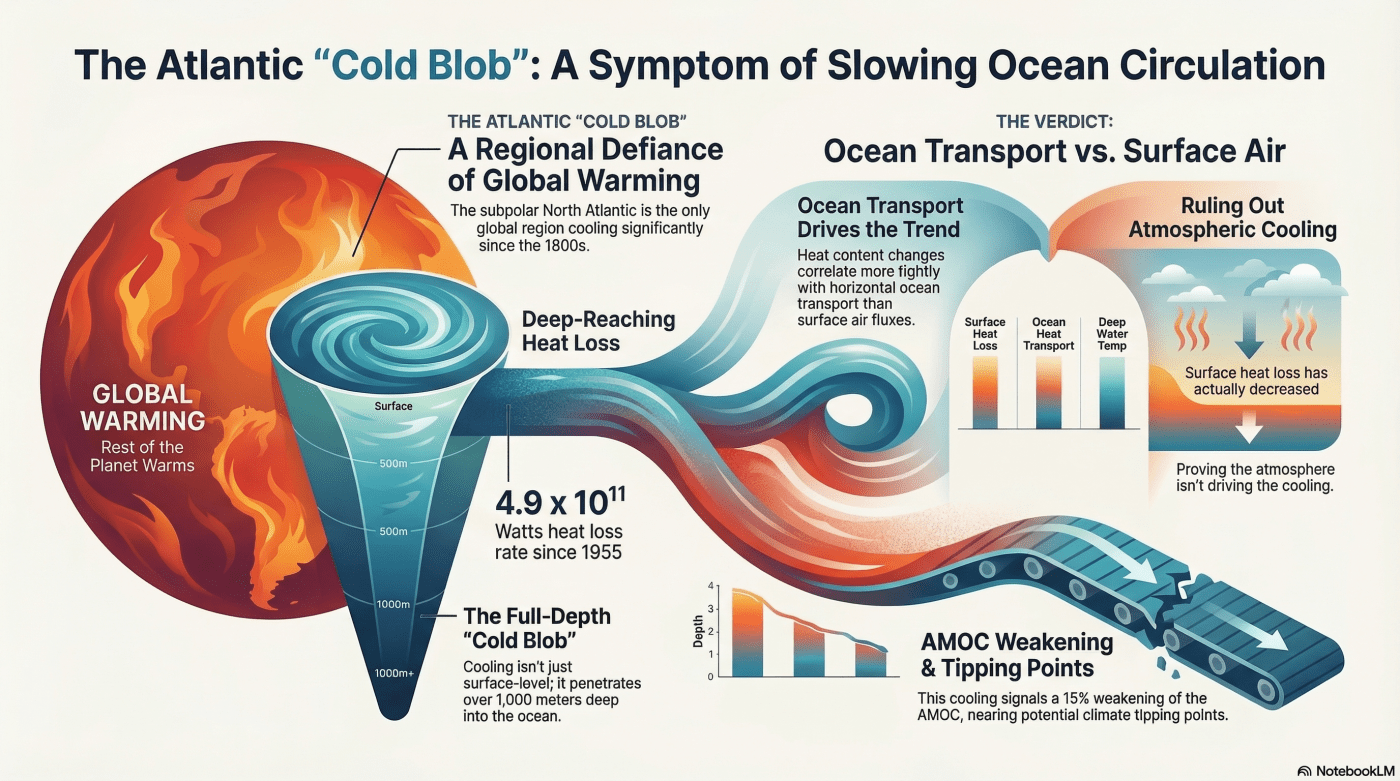
This blog post and the “Deep Dive” podcast, created by NotebookLM, are based on “Post-1950s Atlantic ‘warming hole’ is caused by ocean heat transport change, not surface fluxes” by Rahmstorf et al. (2026).
This preprint paper investigates the “cold blob,” a unique region in the North Atlantic that has cooled since the 19th century despite global rising temperatures. By analyzing observation-based data, the authors demonstrate that this cooling is a deep-ocean phenomenon rather than a simple change in surface weather. The study concludes that the decline in heat is primarily driven by a weakening of ocean currents, specifically the Atlantic Meridional Overturning Circulation (AMOC), which now transports less warmth into the area. While some theories suggest surface heat loss to the atmosphere is the cause, the researchers show that these surface fluxes actually respond to, rather than drive, the internal ocean changes. The findings warn that a continued slowdown of these currents could reach a critical tipping point, potentially triggering severe shifts in global weather and climate patterns.
In the visual language of modern climatology, the NASA GISTEMP maps offer a stark narrative: a planet engulfed in deepening shades of orange and crimson. Since the late 19th century, nearly every corner of the globe has succumbed to a relentless warming trend. Yet, sitting defiantly south of Greenland and Iceland is a stubborn, persistent patch of blue. This “Atlantic warming hole”—or “cold blob”—is the only region on Earth resisting the global heatwave. For decades, the scientific community has debated this anomaly: is a changing atmosphere chilling the water from above, or is the ocean’s internal plumbing failing to deliver the heat this region requires to stay temperate?
New analysis of oceanographic data spanning 1955 to 2024 has finally settled the score. The cold blob is not a mere atmospheric fluke; it is the physical manifestation of a massive, structural shift in the Atlantic’s circulation.
1. The Ocean’s Long Memory: A Full-Depth Decline
It is a common misconception that ocean temperature anomalies are “skin-deep” fluctuations driven by seasonal weather. However, the data reveals a far more profound structural decay. The cooling in the subpolar North Atlantic is a deep-reaching phenomenon that penetrates the entire water column.
Crucially, the most coherent temperature changes occur within the top 1,000 meters—a depth that corresponds exactly to the thickness of the northward-flowing layer of the Atlantic Meridional Overturning Circulation (AMOC). While the cooling signature extends down to 2,500 meters, this 1,000-meter synchronization is the “smoking gun” linking the cooling directly to a slowing of the great ocean conveyor.
“The ‘warming hole’ or ‘cold blob’ in the northern Atlantic represents a full-depth heat content decline.”
2. The Negative Feedback: Why the Atmosphere is Trying to Help
A long-standing hypothesis suggested that the blob was caused by “chilly winds”—increased surface heat loss where the ocean releases energy into the air. The data from 1955–2024 reveals the exact opposite: surface heat loss in this region has actually decreased.
This is a classic “negative feedback” loop. Because the ocean has become so much colder, the temperature gradient between the water and the air has narrowed. Consequently, the ocean is losing less heat to the atmosphere than it used to; in fact, the atmosphere is effectively trying to warm the blob. The cooling is happening despite the air, not because of it. This relationship is captured in the fundamental heat budget equation:
dHC/dt = OHT + SHF
In plain English: the change in a region’s heat content (dHC/dt) is the sum of horizontal Ocean Heat Transport (OHT) and the Surface Heat Flux (SHF) from the air. Because the surface flux is currently adding relative warmth, the staggering drop in heat content can only be explained by a collapse in the heat being ferried into the region by ocean currents.
3. A Breakdown in the Great Conveyor
The primary driver of this cooling is the weakening of the AMOC. This circulation system is the engine of the North Atlantic, pulling warm, salty water from the South Atlantic across the equator. This heat transport is the biological and climatological reason why the Northern Hemisphere remains 1–2°C warmer than the Southern Hemisphere.
The decline in lateral ocean heat transport (OHT) into the subpolar gyre is the definitive cause of the cold blob. As the AMOC slows, it fails to deliver the thermal energy that once buffered the North Atlantic against the chill.
“An analysis of temperature data sets based on measurements show it is… changing ocean heat transport – which dominates heat content changes in the ‘cold blob’.”
4. The AMOC Fingerprint: A Tale of Two Coasts
The freezing “blob” does not exist in a vacuum. It is dynamically linked to a secondary, startling feature: a “strip of strong warming” along the North American coast, north of Cape Hatteras.
This localized heatwave is the other half of the AMOC fingerprint. As the circulation weakens, the Gulf Stream—the AMOC’s most famous component—undergoes a distinct northward shift. This shift floods the coastal waters of the United States with excessive heat while simultaneously starving the subpolar North Atlantic of that same warmth. These opposite trends—extreme cooling in the deep North Atlantic and extreme warming near the U.S. coast—are two sides of the same broken coin.
5. Approaching the Tipping Point
The slowing of the Atlantic circulation is no longer a theoretical concern for the next century. Paleoclimatic proxy data suggests that the AMOC is currently at its weakest state in a millennium. We are observing a system losing its stability in real-time.
While climate models vary, a substantial subset of the latest CMIP6 simulations suggests that the AMOC could cross a critical tipping point by the middle of this century. Scientists have already identified “early warning signals” in the subpolar gyre’s salinity and density. From a risk management perspective, the potential for a total circulation shutdown represents a high-impact catastrophe that demands urgent policy intervention.
“Given the well-established existence of a tipping point of the AMOC… the strong evidence for a weakening AMOC is a serious concern for society and policy.”
The Future of the North Atlantic
The “Cold Blob” is far more than a geographic curiosity; it is a robust, physical alarm bell. The deep-reaching loss of heat content confirms that the ocean’s ability to transport warmth northward is in a state of historic decline. This is a transformation that will eventually dictate the weather of Europe, the sea levels of the Americas, and the stability of the global climate.
Are we truly prepared to rewrite the geography of the Northern Hemisphere as the ocean’s great conveyor belt grinds to a halt?
The infographic was generated by Notebook LM.
Rahmstorf, S., Jendrkowiak, J., Gou, R., Cheng, L., Ruiz- Angulo, A., & Björnssonet, H. (2026) Post-1950s Atlantic ‘warming hole’ is caused by ocean heat transport change, not surface fluxes. ESS Open Archive. March 03, 2026. https://doi.org/10.22541/essoar.177254916.66278884/v1
 Ocean to Climate
This study convincingly shows that the oceanic heat content (OHC) in the subpolar North Atlantic (SPNA) is driven by oceanic heat transport via the AMOC at interdecadal and longer time scales. However, what’s ultimately driving the historical changes in the SPNA OHC and the AMOC is the North Atlantic Oscillation (NAO), not the global warming at least up until now (Lee et al., 2023): https://www.nature.com/articles/s43247-023-00727-3/figures/3
Lee, SK., Lumpkin, R., Gomez, F. Yeager, S., Lopez, H., Takglis, F., Dong, S., Aguiar, W., Kim, D. & Baringer, M. (2023). Human-induced changes in the global meridional overturning circulation are emerging from the Southern Ocean. Commun Earth Environ 4, 69. https://doi.org/10.1038/s43247-023-00727-3