
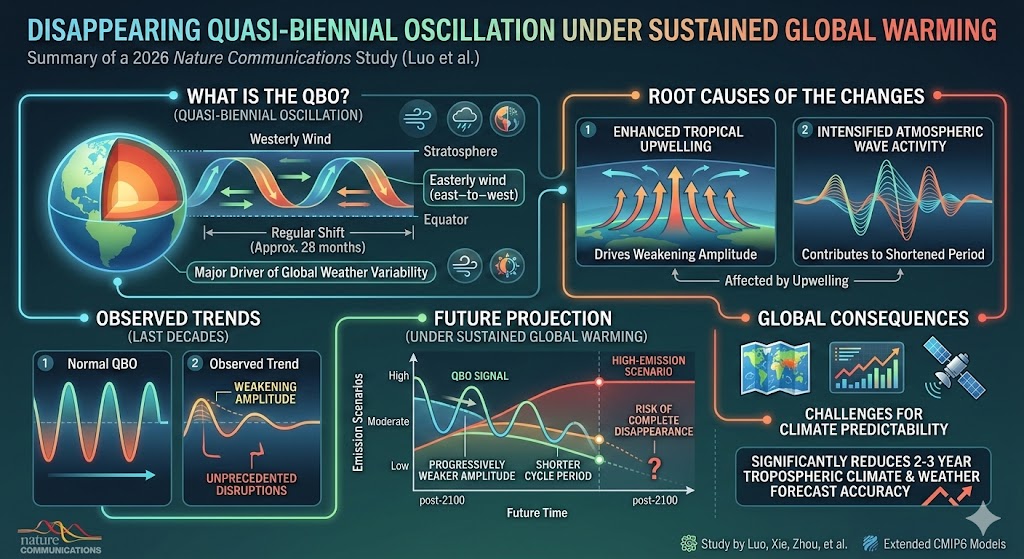
This blog post and the “Deep Dive” podcast, created by NotebookLM, are based on “The disappearing quasi-biennial oscillation under sustained global warming” by Luo et al. (2026).
Luo et al. (2026) examines the potential permanent disappearance of the Quasi-Biennial Oscillation (QBO), a major atmospheric cycle, due to prolonged global warming. Using CMIP6 climate models and high-emission scenarios, the study finds that rising temperatures intensify tropical upwelling and wave activity, which weakens the QBO’s strength and shortens its duration. Eventually, these changes lead to a total loss of the quasi-biennial signal in the lower stratosphere, shifting the atmosphere into a regime dominated by annual or semi-annual cycles. This transformation is projected to significantly impair the predictability of weather and climate patterns on two-to-three-year timescales. Sensitivity experiments further indicate that this collapse is a response to sea-surface warming rather than a direct effect of carbon dioxide. Ultimately, the research highlights a critical climatic tipping point that underscores the importance of meeting global emissions targets.
For over six decades, meteorologists have observed a reliable, rhythmic “pulse” in the tropical stratosphere known as the Quasi-Biennial Oscillation (QBO). Acting as a global metronome, this cycle of alternating winds has been one of the most predictable features of our climate system since it was first documented in the 1950s. However, this ~28-month beat is faltering. Following unprecedented disruptions in 2015/16 and 2019/20, new research suggests these were not mere anomalies, but tremors preceding a fundamental structural collapse. Under high-emission global warming scenarios, the QBO is losing its strength and speed, risking a future where this atmospheric heartbeat disappears entirely, silencing a rhythm we have relied upon for generations.
The Stratospheric Metronome: A Global Modulator
The QBO is defined by alternating layers of westerly and easterly winds that form in the tropical stratosphere and propagate downward. Driven by a complex interplay of waves—specifically Kelvin, Rossby-gravity, and other gravity waves—this cycle completes its circuit approximately every 28 months. While these winds shear and swirl miles above the Earth’s surface, their influence is felt globally, acting as a master conductor for tropospheric weather.
The QBO modulates everything from the intensity of tropical monsoons to the path of winter storms in the mid-latitudes. As researchers Luo et al. (2026) emphasize:
“The stratospheric quasi-biennial oscillation (QBO) is a key modulator of interannual variability in global weather and climate.”
By providing a stable backdrop for interannual variability, the QBO offers a rare window of predictability in an otherwise chaotic system. When this metronome skips a beat, the effects ripple from the poles to the equator.
A Symphony Silenced by 2075
Using advanced CMIP6 climate models, scientists have peered into the QBO’s future under varying carbon pathways. Under the high-emission SSP5-8.5 scenario—a “business-as-usual” trajectory—the projections are remarkably consistent in their direction, even if they differ on the exact timing of the final note. The CESM2-WACCM model predicts a disappearance as early as 2075, followed by IPSL-CM6A-LR in 2100 and EC-Earth3-Veg by 2150.
The Stepwise Shortening of the Atmospheric Cycle The death of the QBO is projected to be a “stepwise shortening” rather than a sudden stop. The usual 28-month cycle begins to compress, accelerating as it loses its unique identity. Eventually, it converges into the standard annual or semi-annual cycles driven by the sun. Notably, this collapse is not an inevitability of all futures; under the SSP1-2.6 low-emission scenario—which aligns with the Paris Agreement targets—the QBO remains a stable, coherent pulse.
The Mechanics of Collapse: A Reordering of Harmonics
The “silencing” of the stratosphere is driven by a two-pronged attack on the QBO’s fluid dynamics. The first is a weakening of amplitude caused by enhanced tropical upwelling. As the planet warms, air rises more vigorously from the tropics, creating a powerful “vertical headwind” that inhibits the downward propagation of the QBO winds, effectively thinning the signal until it can no longer reach the lower stratosphere.
The second factor is a reordering of atmospheric harmonics. A warming climate intensifies certain wave activities while dampening others. Specifically, researchers have observed a strengthening of symmetric waves (Kelvin and equatorial Rossby waves) and a weakening of antisymmetric waves (mixed Rossby-gravity waves).
There is a profound irony in this shift: while “intensified wave activity” sounds like a surge of energy, it actually destabilizes the delicate shear zones of the QBO. This reordering of atmospheric musical notes pushes the system into “phase locking,” where the QBO trades its complex, multi-year rhythm for a monotonous annual or semi-annual regime.
Predicting in the Dark: The Signal-to-Noise Casualty
The loss of the QBO is not merely a technical concern for climatologists; it represents a catastrophic degradation of our “Signal-to-Noise Ratio” (SNR). The QBO is a primary source of “signal” that allows us to forecast climate patterns 2 to 3 years in advance. Without it, we are left only with the “noise” of internal variability.
This loss of predictability creates dangerous blind spots in three key regions:
- R1 (Southern Hemisphere Subtropics): Disrupting the predictability of subtropical jets.
- R2 (Northern Hemisphere Subtropics): Increasing the difficulty of forecasting multi-year droughts and precipitation shifts in East Asia.
- R3 (Northern Hemisphere Mid-latitudes): Compromising our ability to anticipate shifts in winter storm tracks and temperature extremes.
As the research highlights, the potential disappearance of this cycle:
“poses new challenges for climate change under high emission.”
The Ocean’s Revenge: It’s the Heat, Not the Gas
Crucial sensitivity experiments have clarified that the QBO is not being “poisoned” by the chemistry of CO2. When researchers simulated a world with high CO2 concentrations but kept sea-surface temperatures low, the QBO persisted.
The “killer” is the thermal inertia of the warming oceans. The heat absorbed by the sea drives the changes in tropical convection and upwelling that ultimately grind the stratospheric gears to a halt. This distinction reveals a sobering reality: the atmosphere’s internal rhythms are inextricably tied to the health of our oceans. Even if we could stabilize atmospheric chemistry tomorrow, the thermal “revenge” of the warming seas has already set the stage for this stratospheric collapse.
Conclusion: A Tipping Point for the Paris Agreement?
The potential vanishing of the QBO is more than a change in wind patterns; it is a “climate tipping point” that could permanently alter the limits of human foresight. The research suggests that the 2°C target of the Paris Agreement is not just a benchmark for rising tides or heatwaves, but a necessary threshold to keep the atmosphere’s pulse alive.
If we lose the rhythmic predictability of our atmosphere, the work of global adaptation becomes exponentially harder. We would be entering a world where our 2-3 year forecasting models are effectively blinded. As this 60-year-old metronome slows and skips, we must ask ourselves: how can we prepare for a future that we can no longer hear coming?
The infographic was generated by Google’s Nano Banana 2.
Luo, F., Xie, F., Zhou, T. et al. The disappearing quasi-biennial oscillation under sustained global warming. Nat Commun 17, 2138 (2026). https://doi.org/10.1038/s41467-026-68922-2
 Ocean to Climate
Leave a comment