
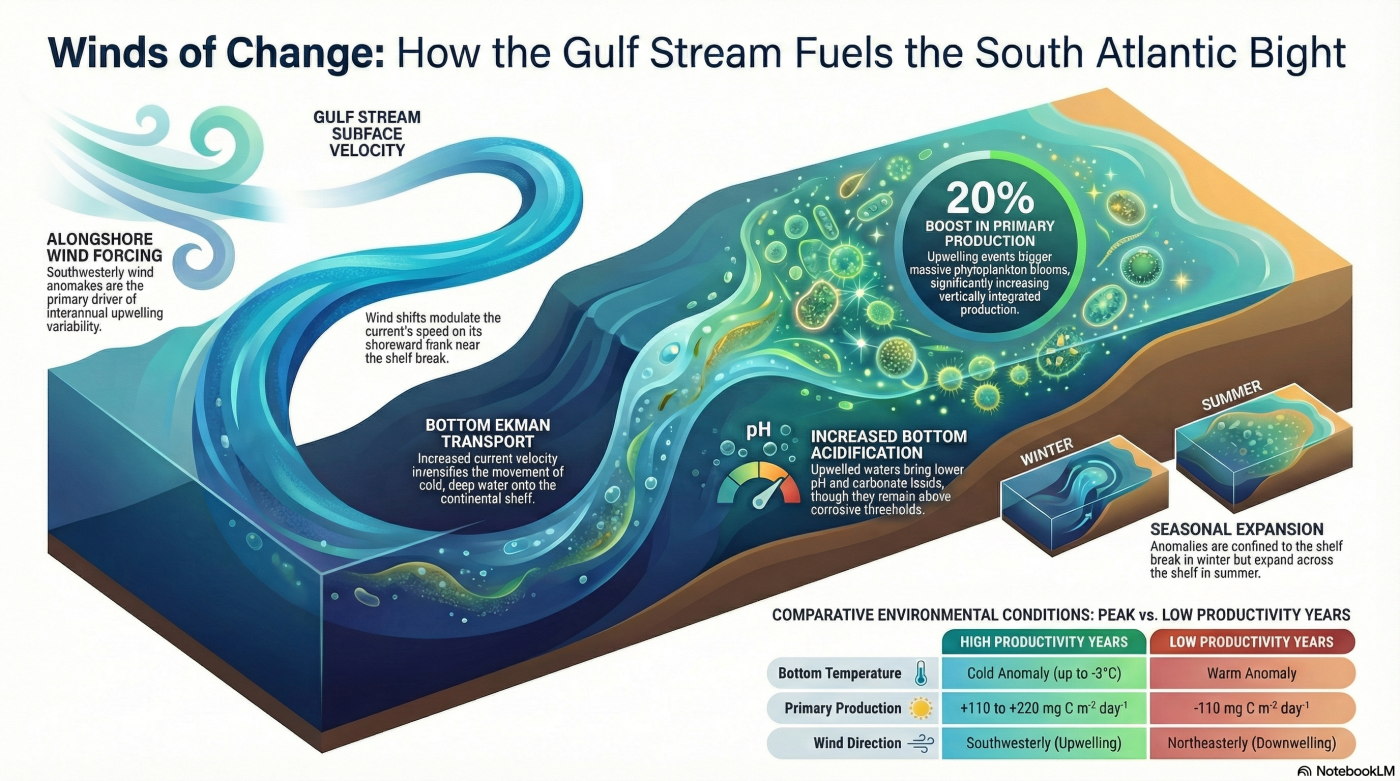
This blog post and the “Deep Dive” podcast, created by NotebookLM, are based on “Wind control of the interannual ocean-biogeochemical variability in the South Atlantic Bight.” by Gomez et al. (2026).
This research investigates how alongshore wind variability and the Gulf Stream control interannual changes in the marine ecosystem of the South Atlantic Bight. By utilizing a high-resolution ocean-biogeochemical model, satellite data, and ocean reanalysis, the authors demonstrate that shelf-break upwelling is the primary driver of year-to-year fluctuations in phytoplankton production and chlorophyll levels. These upwelling events are triggered by changes in the surface velocity of the Gulf Stream’s inner edge, a process significantly modulated by local wind stress rather than the current’s total volume transport. The study also reveals that increased upwelling introduces cold, nutrient-rich, and low-carbonate waters to the shelf, which reduces bottom oxygen and increases acidification. Ultimately, the findings highlight the critical role of surface winds as the ultimate driver of biogeochemical patterns and provide a framework for monitoring and predicting coastal ecosystem responses in the region.
However, a breakthrough 30-year study (1993–2022) led by Fabian Gomez and colleagues reveals that the “mighty” Gulf Stream might not be the primary boss of this ecosystem. Instead, the true master of the SAB’s biological productivity is something far more subtle: the local alongshore winds. It turns out that to understand the health of the Atlantic’s “secret garden,” we must look at the breeze as much as the current.
1. Why the “Mighty” Gulf Stream Isn’t the Only Boss
While the total volume of the Florida Current is staggering, the research shows that primary productivity in the SAB is only weakly related to the current’s total depth-integrated transport. Instead, the engine of life is driven by the Coastal Gulf Stream Index (cGSI)—a measure of the surface velocity anomaly specifically along the current’s “onshore flank” (the 40–500 meter depth range).
The link between the wind and the water is a masterclass in geostrophic physics. When alongshore winds shift, they trigger a mechanical domino effect:
- Wind-Driven Drift: Alongshore wind stress pushes surface waters, creating an Ekman transport anomaly.
- The Coastal Tilt: This movement causes the sea surface height (SSH) to tilt. As the sea level drops or rises near the coast, it alters the cross-shelf pressure gradient.
- Velocity Shift: Through geostrophy, this pressure change forces the Gulf Stream’s onshore velocity to speed up or slow down.
- The Mechanical Lift: As the current’s velocity shifts, it triggers bottom Ekman transport. This is the crucial mechanical link that drags cold, nutrient-rich water up the continental slope and onto the shelf break.
As the study highlights:
“The GS’s velocity changes, and the temperature and production anomalies, are well correlated to the alongshore wind stress, suggesting that local wind is the leading driver of the shelf-break upwelling variability at interannual timescales.”
2. The Summer “Stretch” vs. The Winter “Narrow”
The ocean keeps a different rhythm with the seasons. The study found a striking contrast in how these wind-driven upwelling events manifest throughout the year. In the Winter, upwelling anomalies are typically confined to a narrow, restricted ribbon of productivity right at the shelf break. In the Summer, however, the impact expands significantly, with nutrient-rich water stretching across the entire continental shelf.
This happens because summer brings higher vertical stratification and prevailing winds that allow the ocean to respond more vigorously to atmospheric nudges. This seasonality makes the SAB a shifting target for marine management; conservation strategies cannot rely on a single “representative” month because summer upwelling penetrates the inner shelf, potentially exposing a much wider range of sensitive habitats to chemical shifts than the narrow winter band.
3. The “Acidic” Breath of the Deep
Upwelling is often celebrated as a life-giver because it delivers nitrates to hungry phytoplankton, but it also carries a chemical “dark side.” The water rising onto the shelf originates from Antarctic Intermediate Water and other intermediate waters (AAIW+), a massive reservoir found at depths of 500 to 1,200 meters. These deep waters are characterized by high nutrients but are also low in oxygen and lower in pH.
When this “breath of the deep” surges onto the shelf, it brings a signature of “bottom acidification.” To quantify this, the researchers tracked how water chemistry shifts in relation to temperature.
By the Numbers (Rates of change per 1°C increase in temperature anomalies):
- Aragonite saturation (Ωar): Increase of 0.14 units.
- pH: Increase of 0.015 units.
- Dissolved oxygen: Increase of 3 micromoles per kilogram (μmol kg⁻¹).
Crucially, because upwelling causes cooling, the effect is the inverse: a surge of deep water makes the shelf significantly more acidic (lower pH), less oxygenated, and less saturated with the minerals calcifying organisms need to build their shells.
4. The 70-Meter “Sweet Spot” and Satellite Sentinels
The most critical ecological changes in the SAB happen at the shelf break, which sits at a depth of roughly 70 meters. This is unusually shallow compared to other U.S. continental shelves, which typically break at 200 meters.
This “sweet spot” allows for a major breakthrough in remote sensing. By using satellite chlorophyll records (OC-CCI), scientists can now monitor these “invisible” interannual cycles from space. Essentially, the satellite acts as a sentinel, capturing a surface signal of a bottom process. This allows researchers to track deep-water upwelling events that were previously only detectable through expensive, ship-based expeditions.
“Our study characters GS patterns associated with high and low productivity years, and highlights the role of surface wind as ultimate driver of the interannual upwelling variability in the South Atlantic Bight.”
5. A Built-in Buffer Against Acidification
Despite the influx of low-pH water, there is a reassuring finding for the region’s corals and shellfish. The study found that the SAB outer shelf remains “well buffered.” Over the 30-year study window, aragonite undersaturation—the point where water becomes corrosive to shells—was virtually non-existent on the mid and outer shelves.
This suggests the region possesses a natural resilience, a chemical shield that protects it from the temporary acidic surges brought by the wind. However, the authors provide a necessary warning: as global climate change and ocean acidification progress, they could eventually “modify the amplitude” of these anomalies, potentially pushing this naturally buffered system toward a tipping point in the coming decades.
Conclusion: The Forecast in the Breeze
The findings of Gomez et al. represent a paradigm shift in our understanding of the Atlantic. To predict the health of the South Atlantic Bight, we cannot simply watch the speed of the Gulf Stream; we must look to the winds that whisper over its surface.
As climate change alters the trajectory of Western Boundary Currents globally, the local winds of the SAB currently remain the dominant provider and protector for the ecosystem. But the future remains a question of balance.
In a warming world, can the SAB’s natural buffering capacity withstand the combined pressure of shifting winds and a changing Gulf Stream?
The infographic was generated by Notebook LM.
Gomez, F. A., Ross, A. C., Lee, S.-K., Volkov, D., Kim, D., John, J. G., & Stock, C. A. (2026). Wind control of the interannual ocean-biogeochemical variability in the South Atlantic Bight. Journal of Geophysical Research: Oceans, 131, e2025JC023322. https://doi.org/10.1029/2025JC023322
 Ocean to Climate
Leave a comment