
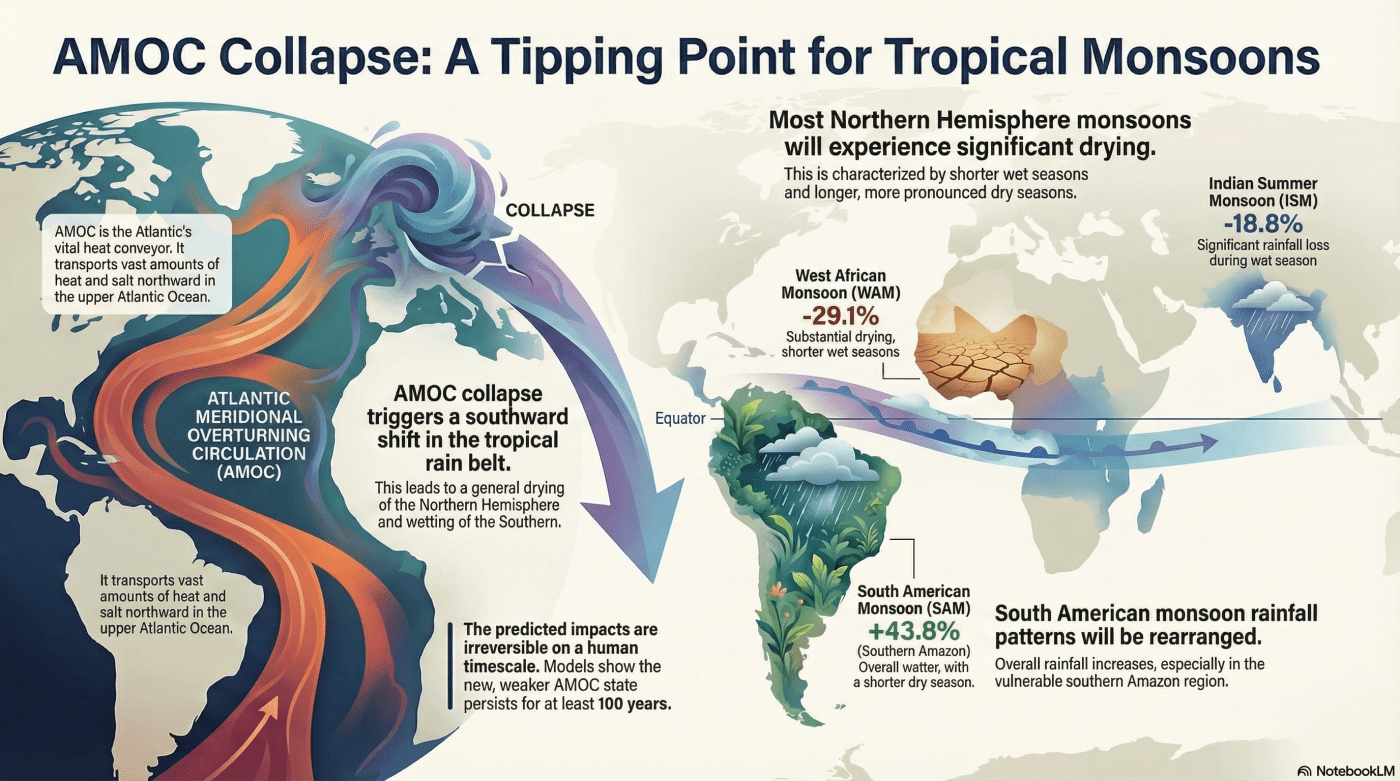
This blog post and the “Deep Dive” podcast, created by NotebookLM, are based on “Impacts of AMOC Collapse on Monsoon Rainfall: A Multi‐Model Comparison” by Ben-Yami et al. (2024).
Summary: Ben-Yami et al. (2024) analyzes how a potential collapse of the Atlantic Meridional Overturning Circulation (AMOC) would drastically alter tropical monsoon rainfall patterns worldwide. By comparing four independent climate models using identical freshwater hosing scenarios, the study found a surprising level of agreement regarding seasonal and regional shifts. While the West African, Indian, and East Asian monsoons would likely face severe drying and shorter wet seasons, the South American Monsoon shows a complex increase in precipitation, particularly in the southern Amazon. These disruptions are largely driven by a southward shift of the Inter-tropical Convergence Zone (ITCZ) following the reduction of northward ocean heat transport. Importantly, the study highlights that these climatic reorganizations could persist for over a century, making the impacts effectively irreversible within a human lifetime. This multi-model comparison provides a more robust and detailed framework for understanding the socioeconomic and ecological risks associated with a weakened AMOC.
A Critical Ocean Current is Faltering. New Research Reveals 4 Alarming Ways It Could Reshape Weather for Billions.
The Atlantic Meridional Overturning Circulation (AMOC) is a key element of the Earth’s climate system. You can think of it as a massive oceanic conveyor belt, transporting vast amounts of heat and salt northward in the Atlantic. This circulation plays a fundamental role in regulating global weather patterns. Scientists are increasingly concerned that the AMOC could weaken and collapse in response to climate change, a shift that would trigger catastrophic ecological and societal consequences.
This threat is especially acute for the vulnerable monsoon regions of the tropics. Over half of the world’s population lives in areas dominated by monsoons, with societies and agricultural systems that depend heavily on the timing and amount of their seasonal rains.
A new multi-model study offers the clearest picture yet of what an AMOC collapse would mean for these critical weather systems. The findings reveal a series of profound and permanent disruptions that would rearrange weather patterns across the globe. Here are the four key takeaways.
The Takeaways: A World Rearranged
1. For the First Time, Top Climate Models Are in Striking Agreement
In the past, predicting the precise effects of an AMOC collapse was challenging. Different climate models often produced conflicting results, making it difficult for scientists to state with certainty what the future might hold.
This new study marks a major breakthrough. In a detailed analysis, researchers found a “remarkable, previously unseen, agreement between four independent state‐of‐the‐art climate models.” This high level of consensus gives scientists much stronger confidence in the predictions. Remarkably, the models showed higher agreement on the impacts of an AMOC collapse in the tropics than they do for some future global warming scenarios, underscoring the robustness of these new findings.
2. Three of the World’s Great Monsoons Would Weaken Dramatically
An AMOC collapse would cause substantial disruptions for three of the planet’s most important monsoon systems: the West African Monsoon (WAM), the Indian Summer Monsoon (ISM), and the East Asian Summer Monsoon (EASM). This collapse would cool the Northern Hemisphere, effectively pushing the Earth’s tropical rain belt—the Inter-Tropical Convergence Zone (ITCZ)—southward and starving these monsoons of moisture.
Across the board, these regions would experience shorter wet seasons and longer, more punishing dry seasons. The severity of this shift is stark. According to the study, annual rainfall would plummet by an ensemble mean of approximately 29% in the West African monsoon region, 19% in the Indian Summer Monsoon region, and a more modest, but still significant, 4% in the East Asian Summer Monsoon. Such a dramatic reduction in rainfall would have profound socio-economic consequences for billions of people in regions where agriculture is the backbone of the economy and society.
3. The South American Monsoon Would Do the Opposite
In a counter-intuitive finding that resolves previous scientific debate, not all monsoons would weaken. The study shows that the South American Monsoon (SAM) would experience an overall increase in rainfall. This is a prime example of the new study’s power: the striking agreement across models finally brings clarity to what was previously a murky and debated outcome.
The effect would be particularly complex across the Amazon basin. While the northern Amazon would see a modest rainfall increase of about 5%, the southern Amazon could see an annual rainfall increase of over 43% and a shorter dry season. This outcome is complicated; while more rain could bring its own challenges, the study notes that a shorter, wetter dry season might prove beneficial for a rainforest ecosystem that has been rapidly losing resilience in recent decades.
4. These Changes Aren’t a Temporary Blip—They’re Irreversible
Perhaps the most sobering finding is the permanence of these changes. The study is unique because it modeled a scenario where the AMOC collapses into a new, stable, and weak state that persists long after the initial freshwater trigger is gone.
This means the impacts on monsoon systems are not a temporary weather anomaly that will eventually correct itself. They represent a permanent re-ordering of the global climate. A key finding from the study drives this point home with chilling clarity:
Revealed impacts persist for at least 100 years, and so are irreversible over at least a human lifetime
In human terms, “irreversible” means that these shifts would become the new, long-term reality. The altered climate patterns would be the baseline for future generations, fundamentally redrawing the map of where and how people can live and grow food.
Conclusion: A Final Thought
The science is becoming alarmingly clear. The collapse of the Atlantic Meridional Overturning Circulation would trigger a “major rearranging of all tropical monsoon systems.” The remarkable agreement now seen across leading climate models transforms this from a speculative risk into a robust and deeply concerning projection. With profound drying projected for the great monsoons of West Africa and South and East Asia, and a dramatic shift in South America, the lives and livelihoods of billions would be impacted.
As the planet continues to warm, the question is no longer just how we can prevent such tipping points, but how societies can begin preparing for fundamental and irreversible shifts in the climate systems that sustain us all.
The infographic was generated by Notebook LM.
Ben-Yami, M., Good, P., Jackson, L. C., Crucifix, M., Hu, A., Saenko, O., et al. (2024). Impacts of AMOC collapse on monsoon rainfall: A multi-model comparison. Earth’s Future, 12, e2023EF003959. https://doi.org/10.1029/2023EF003959
 Ocean to Climate
Leave a comment