
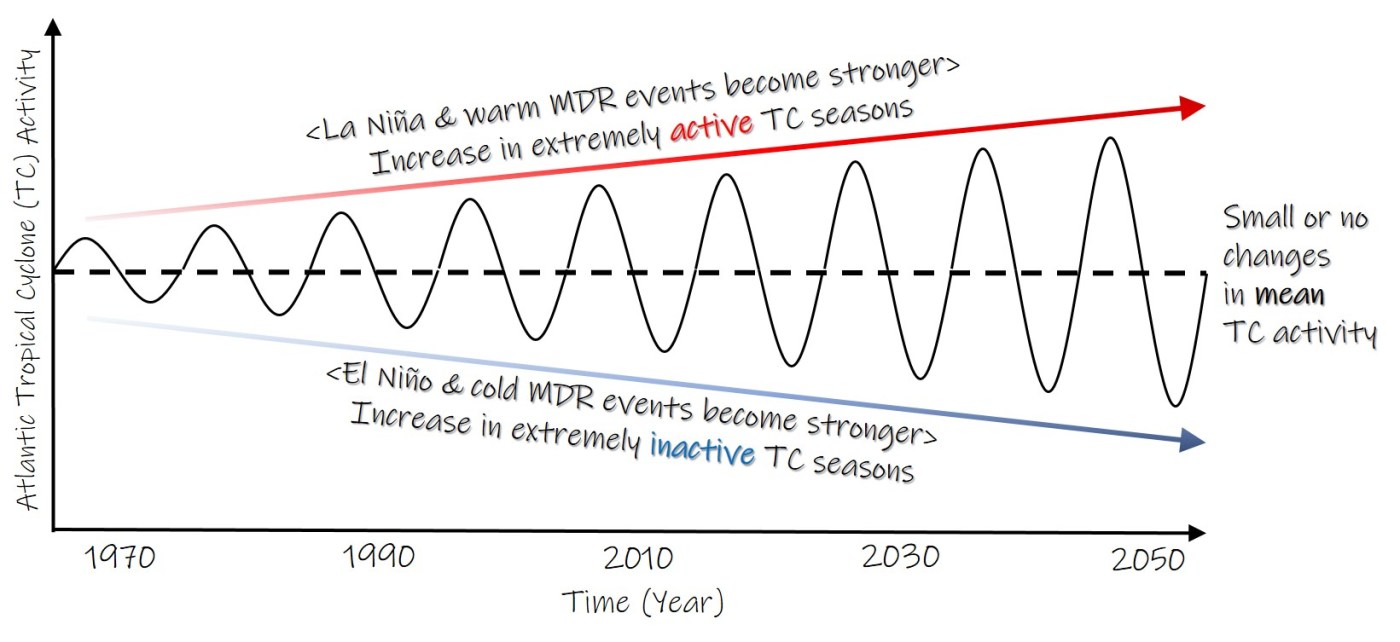
Tropical cyclone (TC) activity results in substantial loss of life and property damage. While the Atlantic basin has experienced a pronounced increase in accumulated cyclone energy (ACE) and the number of TCs over the past 50 years, TC-resolving climate models project a slight decrease in TC frequency throughout the 21st century (e.g., Roberts et al., 2015). However, relying on the averaged ACE or the averaged number of TCs as a sole measure of the Atlantic TC activity is problematic because the year-to-year variability in TC activity is much larger than the observed or projected trend in the mean TC activity. For instance, a 2°C global mean temperature increase is projected to result in a 15% reduction in the number of Atlantic TCs, which is about 2 TCs per year (e.g., Knutson et al., 2020), while the year-to-year variability in the number of Atlantic TCs is typically about 5 TCs per year. Despite the large year-to-year fluctuation in Atlantic TC activity, future changes in Atlantic TC variance have not been investigated, resulting in considerable uncertainty in climate projections of Atlantic TC activity and landfalls. In a recent study published in Science Advances, a team of scientists led by Hosmay Lopez at NOAA’s Atlantic Oceanographic and Meteorological Laboratory investigated past and future changes in Atlantic TC activity, focusing on interannual variability. According to the study, the interannual variability of Atlantic TC activity has already increased, evidenced by an increase in the occurrence of both extremely active and inactive TC seasons. Consistently, storm-resolving high-resolution climate models project a 36% increase in the variance of Atlantic TC activity, measured by accumulated cyclone energy, by the middle of the 21st century. These changes are linked to the projected increase in the variability of vertical wind shear and atmospheric stability in the Atlantic hurricane main development region, in response to enhanced Pacific-to-Atlantic interbasin sea surface temperature variations. The projected increase in the variance of Atlantic TC activity has large socioeconomic implications since it implies an increase in high-impact TC seasons. More specifically, the study suggests that the probability of occurrence of a high-impact extreme season similar to 2005 (i.e., 28 named storms) may increase around 4 times during the 2020 – 2049 period relative to the historical period (1970–2019).
Figure shows a schematic summary of Lopez et al. (2024).
Lopez, H., S.-K. Lee, R. West, D. Kim, G.R. Foltz, G.J. Alaka Jr., and H. Murakami, 2024. Projected increase in the frequency of extremely active Atlantic hurricane seasons. Sci. Adv., 10, eadq7856, https://doi.org/10.1126/sciadv.adq7856.
Roberts, M. J., P. L. Vidale, M. S. Mizielinski, M.-E. Demory, R. Schiemann, J. Strachan, K. Hodges, R. Bell, and J. Camp, 2015. Tropical cyclones in the UPSCALE ensemble of high-resolution global climate models. J. Clim. 28, 574–596.
Knutson, T. S. J. Camargo, J. C. L. Chan, K. Emanuel, C.-H. Ho, J. Kossin, M. Mohapatra, M. Satoh, M. Sugi, K. Walsh, and L. Wu, 2020. Tropical cyclones and climate change assessment: Part II: Projected response to anthropogenic warming. Bull. Am. Meteorol. Soc. 101, E303–E322.
New NOAA research predicts an increase in active Atlantic hurricane seasons https://www.aoml.noaa.gov/new-noaa-research-predicts-an-increase-in-active-atlantic-hurricane-seasons/
Why increasing variability in North Atlantic hurricanes matters for insurance climate change scenarios https://www.wtwco.com/en-sg/insights/2024/11/why-increasing-variability-in-north-atlantic-hurricanes-matters-for-insurance-climate
 Ocean to Climate
Leave a comment