
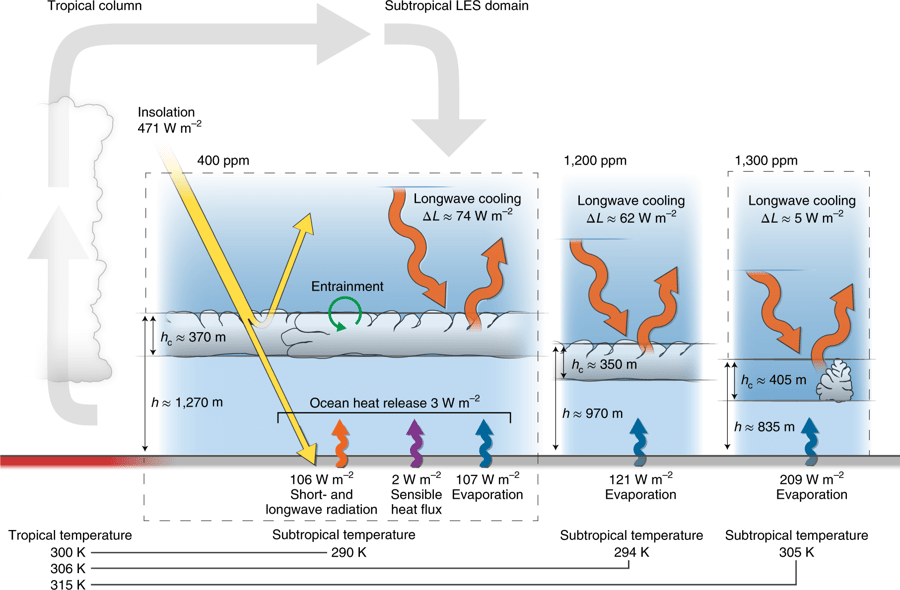
Stratocumulus clouds aloft the eastern subtropical Pacific and Atlantic Oceans cool the ocean by shading it from solar radiation. The stratocumulus cloud droplets absorb and emit longwave radiation very efficiently, while downwelling longwave flux above the cloud tops originates from high altitude and thus cooler atmospheric temperatures (becasue the free troposphere above the stratocumulus clouds is dry and has few clouds), and thus weaker than the upwelling longwave flux emitted by the cloud tops. The resulting longwave radiative cooling of the cloud tops (50~90 W m−2) drive convection that brings moisture from the surface. The convective moistening and longwave radiative cooling of the cloud layer are balanced by turbulent entrainment of dry and warm air above. A study published in Nature Geoscience performed large-eddy simulations (LES) that explicitly resolve cloud dynamics with varying CO2 concentrations. The study showed that when the atmospheric CO2 concentrations increases, the longwave cooling of the cloud tops weakens because the downwelling longwave radiation that reaches the cloud tops from above emanates at lower altitude and thus higher temperatures. The study found that the stratocumulus clouds become unstable and break up into scattered cumulus clouds when CO2 levels rise above 1,200 ppm (year 2128 in RCP8.5 scenario). This instability further triggers a surface warming of about 8 degC globally and 10 degC in the subtropics. Once the stratocumulus clouds have broken up, they only recover once CO2 concentrations drop substantially below the level at which the instability first occurred.
Figure 1 from Schneider et al. 92019): Simulated subtropical clouds in the present climate (400 ppm CO2), at higher CO2 (1,200 ppm) and after stratocumulus breakup (1,300 ppm).
Schneider, T., Kaul, C. M., & Pressel, K. G. (2019). Possible climate transitions from breakup of stratocumulus decks under greenhouse warming. Nature Geoscience, 12(3), 163. https://doi.org/10.1038/s41561-019-0310-1, https://www.nature.com/articles/s41561-019-0310-1
 Ocean to Climate
Here is a related paper. It shows that a reduced low-cloud cover in the northern mid-latitudes and tropics explains record warming in 2023. Perhaps, the low-cloud cover decline in 2023 was not largely caused by internal variability according to Schneider et al. (2019).
Goessling et al., Recent global temperature surge intensified by record-low planetary albedo. Science, 387, 68-73 (2025). https://www.science.org/doi/10.1126/science.adq7280