
This blog post and the “Deep Dive” podcast, created by NotebookLM, are based on “Increased ocean heat transport to the central Arctic despite a well working Barents Sea Cooling Machine” by Eisner et al. (2026).
This study uses the SODA4 reanalysis to examine a forty-year increase in ocean heat transport from the Barents Sea into the central Arctic. Researchers discovered that while Atlantic Water enters the region at significantly higher temperatures, the Barents Sea Cooling Machine partially offsets this heat before it exits through the St. Anna Trough. Findings indicate that these rising heat trends are driven primarily by warming water temperatures rather than changes in the physical volume of flow. The authors also propose a revised ocean feedback hypothesis, suggesting that increased salinity and density create sea surface height gradients that regulate sub-decadal water movement. Ultimately, this shifting climate suggests that while the Barents Sea still moderates Arctic warming, the northward migration of atmospheric cooling is fundamentally altering the region’s hydrography.
1. Introduction: The Gatekeeper of the North
The Barents Sea is more than a body of water; it is the Arctic’s primary radiator and its most critical gatekeeper. Historically, this shallow shelf sea has functioned as a massive “cooling machine,” intercepting warm, salty Atlantic Water (AW) before it can penetrate the deep central Arctic. By venting this heat into the atmosphere, the Barents Sea transforms these currents into denser, colder water masses, effectively rewiring the Arctic’s internal plumbing to protect the polar ice cap.
But as the region undergoes “Atlantification”—a process of rapid warming and “Borealization” where southern species march northward into once-frozen territories—a geophysical mystery has emerged. New data shows that while the central Arctic is heating up at a breakneck pace, the Barents Sea’s cooling machine is still “well working.” If the radiator isn’t broken, why is the Arctic still melting? The answer reveals a system that isn’t failing so much as it is migrating toward a dead end.
2. Takeaway 1: The “Cooling Machine” Isn’t Broken—It’s Migrating
Surprising new research suggests that the Barents Sea hasn’t lost its ability to shed heat; it has simply moved its operations. Scientists have identified a “dipolar pattern” in heat fluxes: while cooling has decreased in the southern Barents, there has been an overcompensating surge in heat loss in the northeast. This migration is the direct fingerprint of retreating sea ice.
This “migrating radiator” effect is most intense during the winter months (DJF). When sea ice retreats in the dead of winter, the relatively warm ocean is suddenly exposed to brutal, sub-zero polar air. This creates massive hotspots of heat loss in newly ice-free zones. While this keeps the machine running, it means the cooling happens much later in the water’s journey, leaving it less time to shed its thermal load before entering the central basins.
“The Barents Sea is a primary gateway for Atlantic Water entering the central Arctic Ocean and ubiquitous water-mass transformation on the Barents shelf is key for mitigating increases in heat transport.”
3. Takeaway 2: It’s the Heat, Not the Volume
A common misconception is that the Arctic is warming because a “firehose” of more water is flowing in from the Atlantic. However, 40 years of data from the SODA4 reanalysis shows “no discernible trend in the volume transports” through the Barents Sea Opening (BSO). The amount of water moving through the gates has remained remarkably steady for four decades.
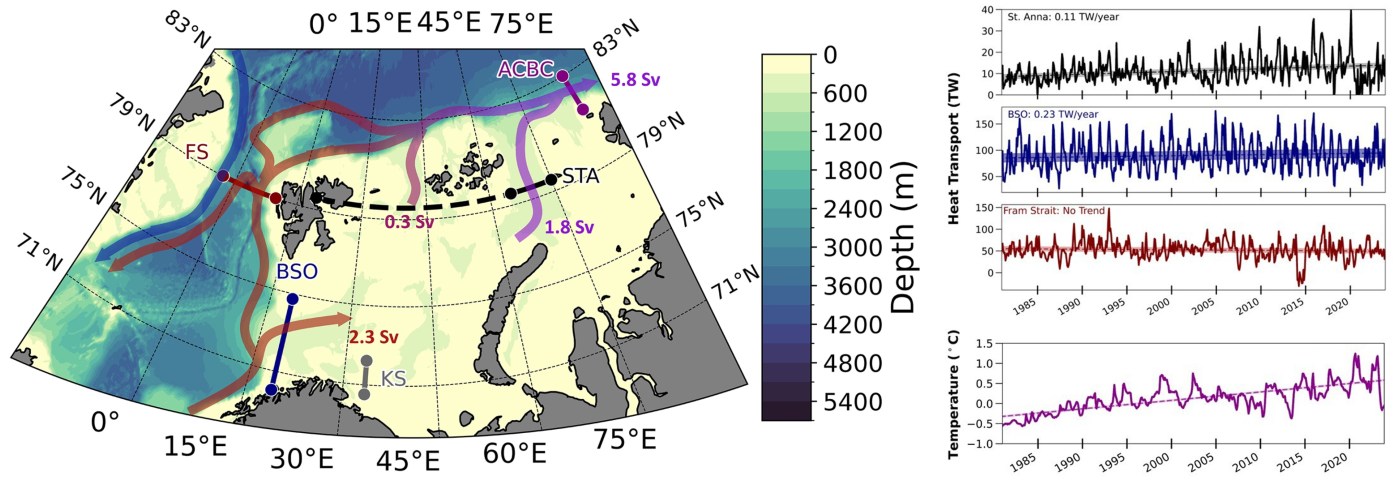
The real crisis is the quality of the water, not the quantity. The heat transport trend at the BSO is rising by 0.23 TW/yr, while the trend at the St. Anna Trough (the exit) is 0.11 TW/yr. While models like SODA4 can have slight absolute temperature biases, the long-term trends are rock-solid and validated against physical observations at the Kola and Bear Island sections. The machine is mitigating nearly half the incoming heat, but the water is simply arriving too hot for the radiator to keep up.
4. Takeaway 3: The Secret “Ocean Feedback” Loop
The stability of this system relies on a revised “Ocean Feedback” loop that functions like a self-regulating engine. This mechanism explains how the Barents Sea maintains its flow on sub-decadal timescales, though its future is increasingly fragile. The process follows a specific mechanical chain:
- Salinity Surge + Cooling: Inflowing Atlantic Water brings high salinity; when cooled, this water becomes exceptionally dense.
- SSH Depression: This heavy, dense water causes the Sea Surface Height (SSH) in the northeastern Barents to drop.
- The Downhill Slide: A pressure gradient forms between this low-point and the “atmospheric wall” of the permanently elevated Kara Sea.
- Enhanced Suction: This gradient creates a literal downhill flow that pulls water into the St. Anna Trough, which in turn sucks more warm water in through the Barents Sea Opening.
The irony is that while increased salinity fuels this engine today, long-term shifts in regional sea levels may eventually flatten this gradient, stalling the engine entirely.
5. Takeaway 4: The Downstream Domino Effect (Atlantification)
What happens to the heat that the cooling machine fails to catch? It escapes through the St. Anna Trough (STA) and surges into the Arctic Circumpolar Boundary Current (ACBC). Here, the core temperature is rising by approximately 0.025 °C/yr. This “excess heat” is fundamentally altering the thermodynamics of the deep Arctic.
The importance of the Barents route cannot be overstated. While the traditional Fram Strait route has seen its heat transport remain fairly constant, the Barents Sea path has become the “runaway” variable. This “Barents Branch” is now the primary source of new heat being advected into the central basins, effectively bypassing the Arctic’s historical thermal defenses and accelerating the biological shift of Borealization.
6. Conclusion: A Machine at Its Limit
The Barents Sea cooling machine is a testament to the ocean’s resilience, but it is a radiator running at its physical redline. As the incoming Atlantic Water becomes warmer and saltier, the machine is forced to migrate further north just to maintain its efficiency. This northward retreat is a finite resource; the radiator is running out of room.
We are watching a system that is doing its job perfectly and still losing the war. If the Arctic’s primary radiator is already operating at full capacity and the central basins are still warming, we must face a sobering question: What happens to the Arctic when the ice edge has nowhere left to retreat, and the machine finally runs out of cold air?
Figure derived from Figures 1 and 5 in Eisner et al. (2026): (left) The Barents Sea bathymetry and the analyzed sections; The Barents Opening (BSO), Fram Strait (FS), St. Anna Trough (STA), the Arctic Circumpolar Boundary Current (ACBC) and the Kola Section (KS). The northern boundary (19–75° E, 79.5° N) is also indicated as a dashed line. Colored red/purple arrows indicate the path of Atlantic Water as it traverses the shelf-break, enters, and leaves the Barents Sea. Colored blue arrows indicate outflow of Arctic water via the East Greenland Current. (right) Time series of heat transport through the Barents Sea Opening (BSO), St. Anna Trough and Fram Strait. Average temperature along a section of the (bottom) Arctic Circumpolar Boundary Current (ACBC) is also indicated. Linear trends are indicated with dashed lines. There are increasing trends in heat transport through St. Anna Trough and the average temperature through the ACBC section but no discernible trend in heat transport through Fram Strait.
Eisner, S. A., Carton, J. A., Chafik, L., and Smedsrud, L. H., 2026. Increased ocean heat transport to the central Arctic despite a well working Barents Sea Cooling Machine, Ocean Sci., 22, 1073–1084, https://doi.org/10.5194/os-22-1073-2026.
 Ocean to Climate
Leave a comment