
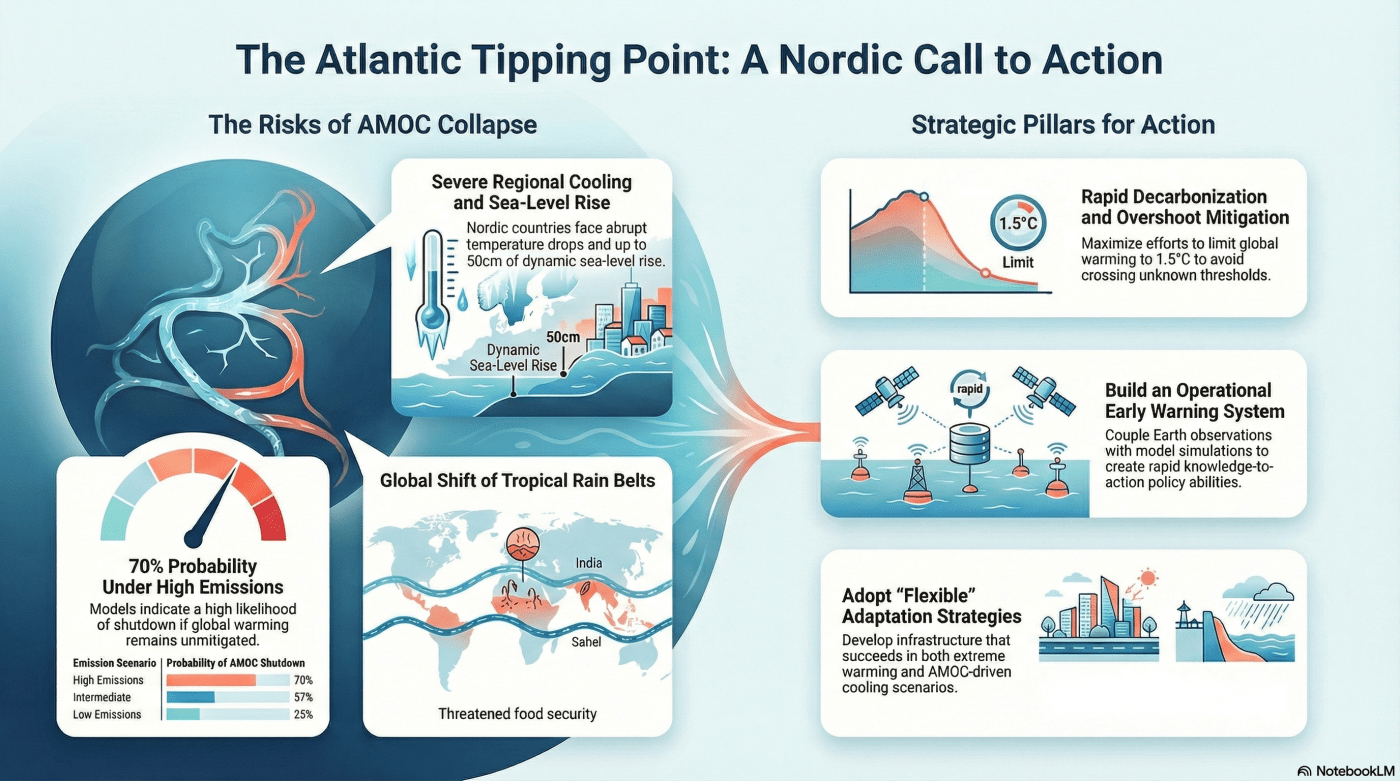
This blog post and the “Deep Dive” podcast, created by NotebookLM, are based on “A Nordic Perspective on AMOC Tipping: Impacts and Strategies for Prevention and Governance” by Nummelin et al. (2026).
For centuries, the North Atlantic has functioned as the Earth’s thermal engine, driven by a “heartbeat” known as the Atlantic Meridional Overturning Circulation (AMOC). This massive conveyor belt of water carries tropical warmth toward the poles, keeping the climate of Northwest Europe temperate, predictable, and remarkably lush for its latitude. It is the reason London doesn’t feel like Labrador and why Scandinavian harbors remain ice-free in the dead of winter.
But that heartbeat is skipping. In February 2026, following the high-stakes “Nordic Tipping Week” workshop held in Helsinki and Rovaniemi, a group of 44 leading climate scientists issued a stark warning to the Nordic Council of Ministers. Their message? The risk of an AMOC collapse has been dangerously underestimated. We are essentially rewiring the planet’s thermostat while the house is already on fire, and the consequences are far more abrupt than our political systems are prepared to handle.
While the rest of the world “burns” under the weight of greenhouse gas emissions, the North Atlantic may be on the verge of a localized deep freeze. This is the ultimate climate paradox: global heating could lead to regional cooling so severe it would fundamentally reorganize life on both sides of the Atlantic.
The Paradox of a “Warming Hole” in a Boiling World
In an era of record-breaking heatwaves, the idea of a sub-zero “warming hole” sounds like a relic of science fiction. Yet, the physical reality is that if the AMOC slows down—depriving the North of its tropical heat subsidy—the region will experience a net cooling that defies the global trend.
If this collapse occurs at roughly 2°C of global warming, Northwest Europe won’t just see a minor temperature dip; it will face a total atmospheric reorganization. We are looking at a massive expansion of winter sea ice reaching the entire coastline of Iceland and the northern Scandinavian shores. For nations like Finland, whose security of supply depends on maritime shipping, this isn’t just an environmental shift—it’s an economic blockade. Extensive ice in the Baltic Sea would make winter navigation prohibitively expensive and difficult, threatening the flow of food and medicine.
The 15-Year Sprint to Collapse
When we talk about climate change, we usually think in decades or centuries. But the AMOC doesn’t move in a straight line; it moves in “tipping points.” While a total shutdown might take hundreds of years, the “deep mixing” in the subpolar gyre—the engine room of the circulation—could fail in a geological blink of an eye.
Research indicates that once the threshold is crossed, a local cooling of 1–2°C could unfold over a mere 10 to 15 years. This “15-year sprint” is the most terrifying aspect for policy. Societies can adapt to gradual change over generations, but a 15-year shift leaves no time for the slow machinery of urban planning or agricultural transition. As the scientific consensus notes:
“It remains unclear how fast a collapse would unfold after crossing such a tipping point, with a timescale ranging from 15 to 300 years.”
The Global Injustice of Shifting Rain
It is a mistake to view this as a strictly “Nordic” problem. The ocean is a single, interconnected body. When the heat transport to the North fails, that energy remains trapped in the Southern Hemisphere, forcing a massive southward shift of the Intertropical Convergence Zone (ITCZ)—the Earth’s tropical rain belt.
This creates a brutal “climatic injustice.” While the North struggles with ice, the Global South faces hydrological disaster. Regions like the Sahel and India, which rely on stable monsoons for survival, could see catastrophic failures. We are already seeing the seeds of adaptation, such as India’s “Dry Farming” and organic indigenous crop initiatives, but these local efforts may be overwhelmed by a permanent shift in the world’s rain. If the monsoons fail, global food security collapses, potentially triggering institutional failures and mass migration on a scale we have never seen.
The 50-Centimeter Sea-Level “Surcharge”
Most people assume sea-level rise is just about melting ice. But an AMOC shutdown creates a “dynamic sea-level rise” that has nothing to do with melting glaciers. As the circulation slows, the North Atlantic fills with fresher, lighter water. Because this water is less dense than the cold, salty water that currently sinks to drive the belt, it occupies more volume.
This results in a 50-centimeter “surcharge” along European coastlines. This is an additional rise on top of the global increases already caused by thermal expansion. It is a literal reorganization of the water we already have, pushing it higher against the dikes of the Netherlands and the ports of the UK simply because the water has stopped moving.
The End of the “Age of the Ocean”
The economic and cultural stakes are perhaps best understood through the “Storylines” of those who might live through it. Imagine a 2087 where Liisa, a guide in Rovaniemi, walks past oak trees that were planted when the region was warming, only to face a sudden return to -30°C winters that the new infrastructure cannot handle. Or consider Ragnar, a fisherman in Iceland, sitting in a café drinking synthetic coffee because global trade routes have collapsed.
For Iceland, the collapse of marine primary productivity—caused by the lack of vertical nutrient mixing—would be an existential blow. When the fish leave, the soul of a maritime nation leaves with them. As one parliamentary transcript from the source’s 2087 scenario puts it:
“Fish export revenues declined by 83% between 2079 and 2086. The collapse of pelagic stocks is now total… The age of the ocean is over.”
Flying Blind: A “Bottom-Up” Monitoring Scandal
Perhaps the most scandalous revelation from the Nordic Tipping Week is how we monitor this global “heartbeat.” You might expect a robust, globally funded military-grade dashboard. Instead, AMOC monitoring is a fragile collection of “bottom-up” academic initiatives. It relies on scattered, project-based grants and the dedication of individual scientists.
We are essentially flying a plane into a catastrophic storm without a functional dashboard. Our monitoring systems are vulnerable to the socio-economic and political whims of individual countries. This is why scientists are now calling for a dedicated “EU Ocean Act” to turn these academic projects into a sustained, real-time early warning system. Without it, we won’t know we’ve crossed the tipping point until the ice is already at the door.
Conclusion: The Precautionary Imperative
The 1.5°C limit is not just a political slogan; it is a physical safety threshold for the AMOC. Every fraction of a degree of “overshoot” increases the risk of a nonlinear shock that our current governance frameworks—designed for gradual, predictable change—cannot handle.
The collapse of the AMOC would reshape the geopolitical map, straining NATO security, disrupting the Northern Sea Route, and fueling Arctic resource competition. We are moving from an era of “managing change” to an era of “surviving transformation.”
If our current governance frameworks are built for a world of predictable, incremental shifts, are we prepared for the day the North Atlantic’s heartbeat stops?
The infographic was generated by Notebook LM.
Nummelin A. et al. (2026). A Nordic Perspective on AMOC Tipping: Impacts and Strategies for Prevention and Governance. Nordic Council of Ministers. http://dx.doi.org/10.6027/temanord2026-504
 Ocean to Climate
Leave a comment