
This blog post and the “Deep Dive” podcast, created by NotebookLM, are based on “Strong winter cooling over the Irminger Sea in winter 2014–2015, exceptional deep convection, and the emergence of anomalously low SST” by de Jong and de Steur. (2016).
This research investigates the extraordinary deep convection observed in the Irminger Sea during the winter of 2014–2015. While previous theories suggested that cold surface temperature anomalies in the North Atlantic were caused by a slowdown of the meridional overturning circulation, the authors argue that local atmospheric forcing is the primary driver. Data from mooring arrays and Argo floats reveal that intense cooling, linked to a positive North Atlantic Oscillation, mixed the ocean to depths of 1400 meters. These findings challenge the idea that freshwater runoff is currently inhibiting deep water formation in the region. Ultimately, the study demonstrates that interannual weather variability can explain regional cooling without requiring a permanent shift in global ocean currents.
5 Surprising Truths About the North Atlantic’s Mysterious “Warming Hole”
Introduction: The Cold Spot That Sparked a Climate Scare
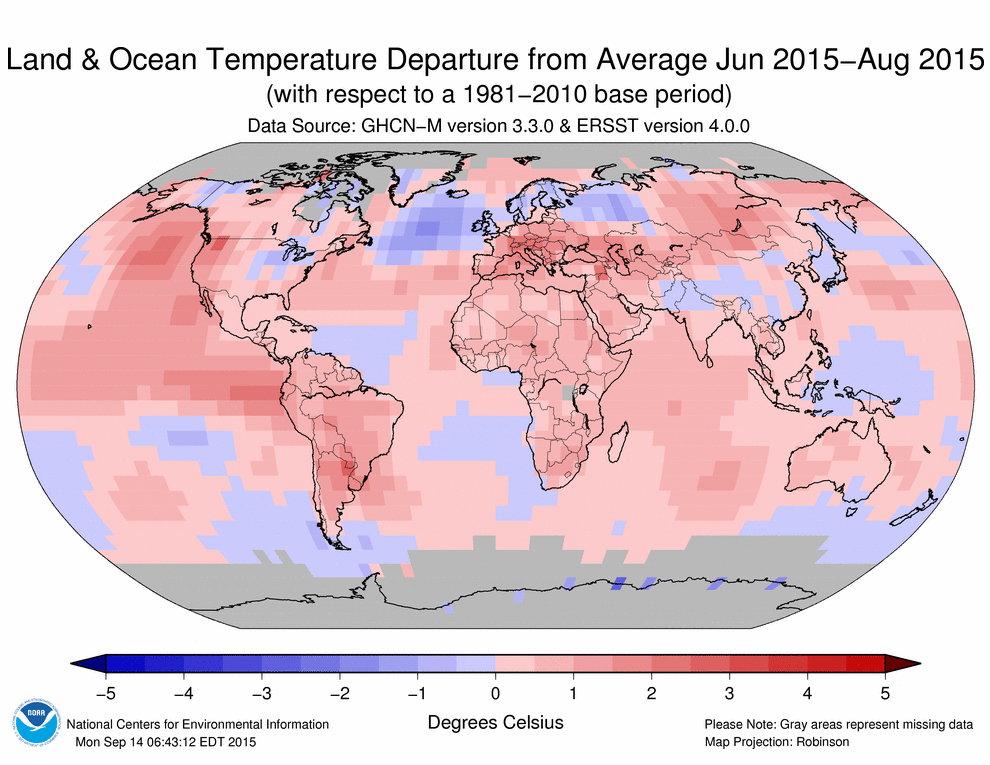
If you look at the NOAA map of temperature percentiles from January-August 2015, your eyes are immediately drawn to a world bathed in shades of red, indicating warmer-than-average conditions. But right in the middle of the North Atlantic, a large, stubborn patch of blue stands out—a cold spot in a warming world. This “warming hole,” as it has been called, quickly became a subject of intense scientific and public concern.
The most common and alarming theory linked this cold anomaly to a slowdown of the Atlantic Meridional Overturning Circulation (AMOC), the vast ocean current system that acts as a planetary “conveyor belt,” transporting warm water northward. The fear was that this could be a fingerprint of a long-predicted climate tipping point, where melting ice sheets flood the North Atlantic with fresh water, inhibiting the deep-water formation that drives the entire circulation.
But what if the most obvious suspect—the weakening AMOC—was the wrong one? On-the-ground data collected by instruments in the heart of this region, the storm-tossed Irminger Sea, pointed investigators in a completely different direction. Direct observations from before, during, and after the event reveal that the real cause was less about a slow, creeping collapse and more about a sudden, powerful, and localized event.
1. It Wasn’t a Climate Collapse, It Was an Incredibly Intense Winter
The primary reason for the shockingly low sea surface temperatures in 2015 wasn’t a failure of the AMOC to deliver heat from the south. Instead, the data points to a much simpler, more direct cause: “strong local atmospheric forcing.” In plain terms, the Irminger Sea experienced an exceptionally long and cold winter during 2014-2015.
This intense winter was driven by a strongly positive phase of the North Atlantic Oscillation (NAO), a major atmospheric pressure pattern. In this phase, stronger-than-usual winds whip across the Atlantic, carrying frigid, dry air over the Irminger Sea and aggressively pulling heat from the ocean. The persistent cold was both severe in its peak and unusually long, extending a month later than usual into April. This is a crucial distinction because it attributes the cooling to short-term, powerful atmospheric variability rather than a permanent weakening of a global ocean circulation system.
2. The Ocean’s ‘Engine’ Sped Up, It Didn’t Weaken
Contrary to the theory that the ocean’s circulation was stalling, the intense winter cooling caused the exact opposite to happen. The cold, dense surface water sank with unprecedented force, a process known as deep convection… which is the very engine that drives overturning circulation. By causing surface water to become incredibly dense and sink, it kickstarts the deep, cold return-flow of the ocean’s conveyor belt.
The cooling was so strong that it produced “record mixed layer depths” in the Irminger Sea. In the winter of 2014-2015, the ocean was churned by convection so violent that the water column was actively mixed down over 1200 meters. The process was so total that all layers of different temperatures and salinity were erased down to an astonishing depth of 1400 meters, completely ‘ventilating’ the basin to its middle depths, a process that infuses the deep ocean with oxygen and other atmospheric gases from the surface. This was not a gentle process; it was a wholesale replacement, a powerful reset button for the entire mid-level ocean in the region.
“…the strong local atmospheric forcing is predominantly responsible for the negative sea surface temperature anomalies observed in the subpolar North Atlantic in 2015 and that there is no evidence of permanently weakened deep convection.”
3. We’ve Seen This Movie Before: A Throwback to the 1990s
While the convection event of 2015 was the deepest observed in the modern instrumental record for the Irminger Sea (which began in 2003), the atmospheric conditions that caused it were not entirely new. The strong surface forcing from the atmosphere was comparable in strength to that seen in the winters of 1993 and 1994.
Crucially, just like in 2014-2015, the mid-1990s was a period dominated by that same positive NAO state, cementing the link between this atmospheric pattern and these powerful deep-ocean renewal events. This historical context highlights the powerful natural variability that occurs in the region on interannual and decadal scales, cautioning against interpreting a single dramatic event as a sign of permanent change.
4. Local Weather Is a Powerful Actor on the World Stage
To isolate the culprit, scientists built a simple simulation. The question was: could they recreate the dramatic 2015 temperature plunge using only the heat lost to the brutally cold atmosphere above? They ran the numbers, deliberately leaving out any changes to the ocean currents. The result was a near-perfect match, a smoking gun pointing directly at the atmosphere.
The model’s finding was clear: the temperature variability observed in the Irminger Sea could be explained almost entirely by the local cooling. The simulation did not need to include any slowdown or trend in the lateral heat transport (the heat brought in by currents like the AMOC) to accurately match the real-world observations. This reinforces a key lesson: on shorter timescales, the influence of local atmospheric forcing within the subpolar gyre (a vast, circular current system in the high-latitude North Atlantic) can be more relevant and dramatic than the slower processes associated with multi-decadal climate change.
5. It Takes Decades to See the True Climate Signal
The final and most sobering takeaway from the study is about the challenge of seeing the big picture. The natural variability in the subpolar gyre is so exceptionally large—with huge swings in temperature from year to year and decade to decade—that detecting a clear, statistically significant climate change trend requires an incredibly long time series of data.
The study estimates that in this specific region, a record on the order of 40 years is needed to distinguish a long-term climate trend from the noise of natural variability. This is a far longer period than in other ocean regions, where a trend might become clear in just 10 years. This serves as a powerful reminder of the danger of associating short-term observations, even dramatic ones like the 2015 “warming hole,” with long-term climate “fingerprints” without sufficient data and context.
Conclusion: Listening to the Ocean’s Complex Rhythms
The North Atlantic’s “warming hole” of 2015 was not the harbinger of a circulation collapse that many feared. Instead, it was a potent demonstration of the ocean’s immense natural variability, driven by powerful atmospheric forces that can temporarily overwhelm the slower, grinding trend of global warming. It was an act of weather, not a fundamental shift in climate.
In a moment of incredible scientific serendipity, this dramatic event occurred just as a major new international observation program, the Overturning of the Subpolar North Atlantic Program (OSNAP), was being installed. This new system of instruments will provide an unprecedented, continuous look at the circulation in this critical region, helping scientists better understand its complex rhythms. In a world of accelerating climate change, the great challenge is learning to distinguish the ocean’s short-term, violent shouts from the long, slow whisper of a changing world.
Figure: NOAA map of temperature percentiles from January to August 2015, obtained from https://www.ncei.noaa.gov/access/monitoring/monthly-report/global/201508.
de Jong, M. F., and L. de Steur (2016), Strong winter cooling over the Irminger Sea in winter 2014–2015, exceptional deep convection, and the emergence of anomalously low SST, Geophys. Res. Lett., 43, 7106–7113, doi:10.1002/2016GL069596.
 Ocean to Climate
Leave a comment