
This blog post and the “Deep Dive” podcast, created by NotebookLM, are based on “Surface warming over Greenland amplified by remote forcing from tropical Atlantic” by Zhang et al. (2025).
Recent research indicates that sea surface temperature variability in the tropical North Atlantic acts as a remote driver for the significant warming of the Greenland Ice Sheet. This phenomenon occurs through an atmospheric teleconnection known as a Rossby wave train, which migrates poleward to create high-pressure systems over Greenland. These circulation changes facilitate the advection of warm, moist air from lower latitudes, which is further amplified by increased downward long-wave radiation. While this warming is present year-round, its intensity exhibits strong seasonality, with the most prominent effects occurring during the winter and spring. These findings are essential for refining climate predictability and understanding the factors contributing to global sea-level rise. Observations and numerical simulations confirm that this tropical Atlantic influence is a critical, yet previously under-explored, component of Arctic climate change.
Greenland’s Rapid Warming Has a Surprising New Driver Thousands of Miles Away
Introduction: The Unraveling Climate Mystery
It is a well-established and deeply concerning fact of our time: the Arctic is warming faster than any other region on Earth. At the heart of this warming is the Greenland Ice Sheet, a vast body of ice whose accelerated melting poses a direct threat to global sea levels. For decades, scientists have worked like detectives, piecing together all the complex factors driving this change, from local atmospheric feedbacks to well-known climate patterns originating in the distant tropical Pacific.
This scientific detective story has a new chapter. A study from Zhang et al. (2025) has uncovered a surprising and powerful new clue in the case of Greenland’s warming. The research reveals a previously underappreciated connection between the warming waters of the tropical Atlantic Ocean and the air temperature over Greenland. This article breaks down the three most impactful takeaways from this critical discovery.
1. It’s Not Just the Pacific: A New Atlantic Connection is Accelerating Warming
For years, scientific investigations into the remote drivers of Greenland’s climate have largely focused on influences from the tropical Pacific and Indian Oceans. And even studies of the Atlantic’s role have largely concentrated on mid-latitude patterns, not on direct teleconnections from its tropical regions. While those connections are important, this new research highlights that a critical piece of the puzzle has been “less explored.”
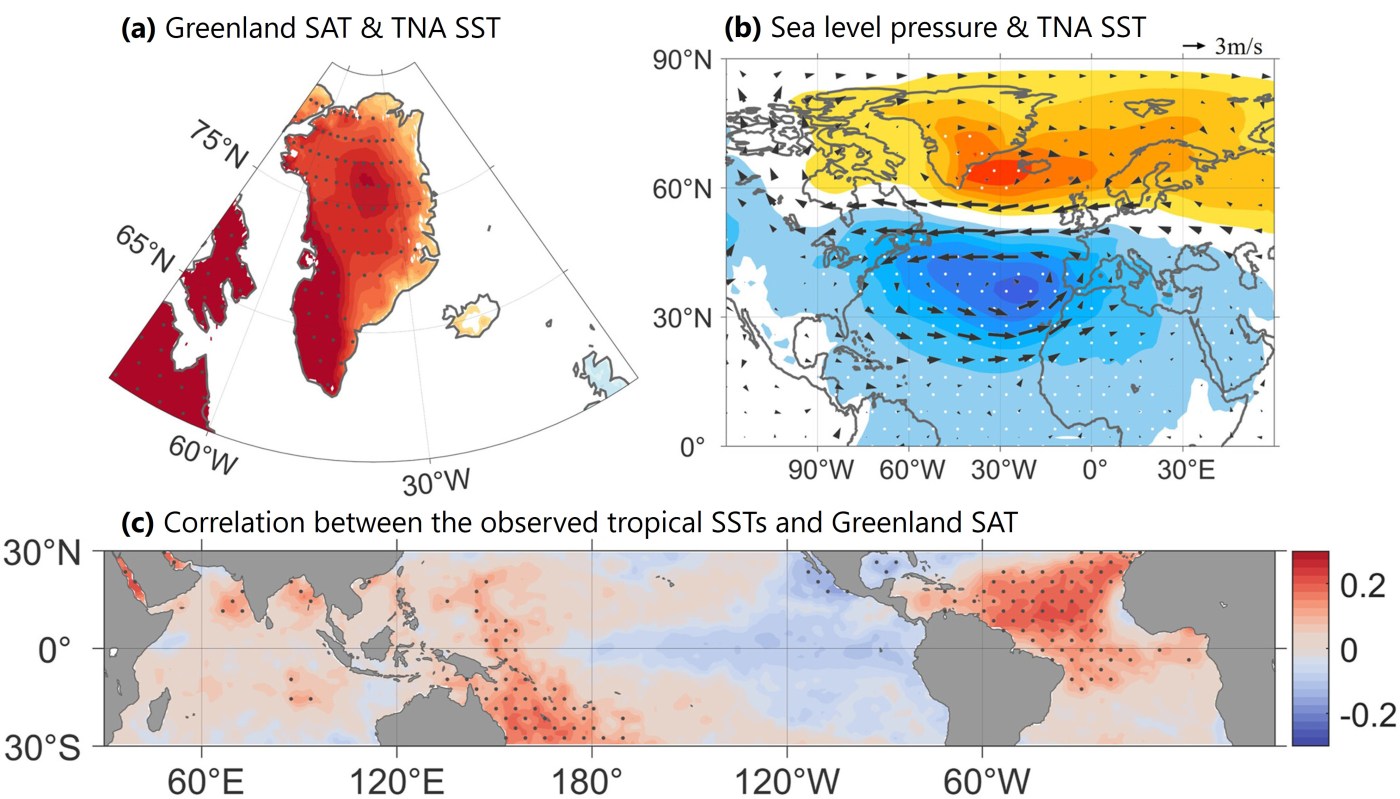
The study identifies a strong and significant link between the sea surface temperature (SST) in the Tropical North Atlantic (TNA) and Greenland’s surface air temperature. This connection is especially relevant today, as the TNA itself has experienced a significant warming trend of 0.14 K per decade between 1979 and 2023. This finding adds a crucial new dimension to our understanding of Arctic amplification, showing that a powerful driver of Arctic change originates not in the Pacific, but in the neighboring Atlantic basin.
2. An Atmospheric Chain Reaction Creates a “Moisture Blanket”
The study details a fascinating physical mechanism that links the warm tropical ocean to the frozen ice sheet—a kind of atmospheric chain reaction. It begins when anomalous warming in the Tropical North Atlantic triggers a large atmospheric wave, known as a Rossby wave train, which travels northward toward the pole.
This wave alters large-scale circulation patterns, culminating in the formation of an “abnormal high-pressure center around Greenland.” This system spins in a way that actively pulls or “advects” warm, moist air from the south, steering it directly over the ice sheet. But the warming doesn’t stop there. The increased atmospheric moisture has a powerful secondary effect: it enhances “downward long-wave radiation.” In simple terms, this extra water vapor acts like a “moisture blanket,” trapping heat and radiating it back down toward the ice, magnifying the initial warming effect from the transported air.
As the study’s authors summarize in their Plain Language Summary:
The resulting warm and moisture advection and the increased downward long‐wave radiation can magnify the warming. These findings are crucial for understanding the mechanism of the warming of Greenland and improving the prediction of the future climate of Greenland.
3. The Connection is Strongest in Winter, With Complex Consequences
Perhaps one of the most surprising findings is the timing of this teleconnection. The link between the Tropical North Atlantic and Greenland is most prominent in the boreal winter and spring, not during the summer melt season that typically dominates headlines. This counter-intuitive seasonality has complex and regionally-specific consequences for the ice sheet.
While summer melt is the most direct cause of ice loss, warming during other seasons can significantly alter the ice sheet’s annual mass balance. The study explains these potential effects:
- TNA-related winter warming is unlikely to cause significant melt but is associated with increased snowfall specifically over western Greenland, which could affect the ice sheet’s total mass accumulation.
- Warming in the “shoulder season” of late spring can prolong the duration of surface melt, potentially increasing the total amount of ice lost each year.
- The effect in autumn is more complex, creating an east-west dipole pattern: the connection leads to warming over western Greenland while simultaneously causing mild cooling over the eastern parts of the ice sheet.
Conclusion: A More Connected Climate
The research by Zhang et al. provides a clearer picture of the intricate forces acting on the Greenland Ice Sheet. The key takeaways are clear: a newly identified and powerful link connects the tropical Atlantic to Greenland, this connection operates through a dual mechanism of warm air transport and a “moisture blanket” effect, and its strongest influence is surprisingly felt in winter and spring.
These findings are not just academic; they have practical implications for our ability to forecast Arctic climate change. As the study notes, this teleconnection “may improve the predictability and future projections of Greenland’s climate.” This research also opens the door to new questions about potential climate feedback loops. The authors note that as TNA-driven warming accelerates Greenland’s melt, the resulting freshwater pouring into the ocean could itself influence the very Atlantic circulation patterns that started the process, underscoring the deeply interconnected nature of our planet’s systems.
As different parts of our global climate system become more interconnected, what other surprising long-distance relationships will we uncover, and how will they shape the future of our planet?
Figure modified from Figures 2, 3 & 5 in Zhang et al. (2025): (a) Partial regression pattern of Greenland surface air temperature (K/K) anomalies from the ERA5 data set against the tropical North Atlantic index in winter (DJF) during the period of 1979–2023, with the Niño 3.4 index removed. The stippling represents regression coefficients that reach the 95% significance level based on Student’s t-test. (b) Partial regression pattern of the sea level pressure (color shading, Pa/K) and 850-hPa wind (vectors, m s−1/K) anomalies from the ERA5 data set against the tropical North Atlantic index in winter (DJF) during the period of 1979–2023, with the Niño 3.4 index removed. The white stippling represents the statistically significant areas with regression coefficients at a level of <0.05 based on Student’s t-test. (c) Correlation between the observed tropical sea surface temperature (SSTs) and area-weighted annual mean surface air temperature over Greenland. The stippling represents correlation coefficients that reach the 95% significance level based on Student’s t-test.
Zhang, D., Holland, D. M., Zhou, Z.‐Q., Yao, Y., Hou, Y., & Li, X. (2025). Surface warming over Greenland amplified by remote forcing from tropical Atlantic. Journal of Geophysical Research: Atmospheres, 130, e2025JD044154. https://doi.org/10.1029/2025JD044154
 Ocean to Climate
As noted by the authors, it could be just (-) NAO with weakened Icelandic low and Azoles high, producing a warming of TNA and Greenland.