
The Labrador Sea is one of the main regions where the surface Atlantic water loses its heat to the atmosphere (thus gets heavier) and sinks into the deep ocean, producing what’s known as deep ocean convection that mainly drives the Atlantic Meridional Ocean Circulation (AMOC). It is also characterized by the Labrador Current, a strong cyclonic ocean circulation (i.e., anticlockwise) along the lateral boundaries. The Labrador Sea is constantly affected by Arctic freshwater (in both solid and liquid forms) from the north through Davis Strait and from the east by the West Greenland Current. The future projected increase in the Arctic freshwater flux should increase the buoyancy of the Labrador Sea (i.e., making the surface water less heavy), weakening the deep convection and thus the AMOC. However, a new study published in Nature Communications utilized a high-resolution (~10 km) climate model forced by increasing greenhouse gases (under RCP8.5 scenario) to show that the Labrador Current strongly restricts the spread of Arctic freshwater from Davis Strait to the interior Labrador Sea, by rapidly transporting the Arctic freshwater to the south; thus the freshening is mostly confined to the shelf close to Newfoundland and Labrador of Canada. This in turn limits the Arctic freshwater-induced weakening of the AMOC. This study also pointed out that the Labrador Current is not adequately resolved and thus much weaker than observed in low-resolution (~100 km) models typically used in the Coupled Model Intercomparison Project (CMIP) phase 5 and 6 protocols; thus, the role of the Labrador Current in limiting the Arctic freshwater-induced weakening of the AMOC is not properly represented in the CMIP5 and CMIP6 model projections for the future.
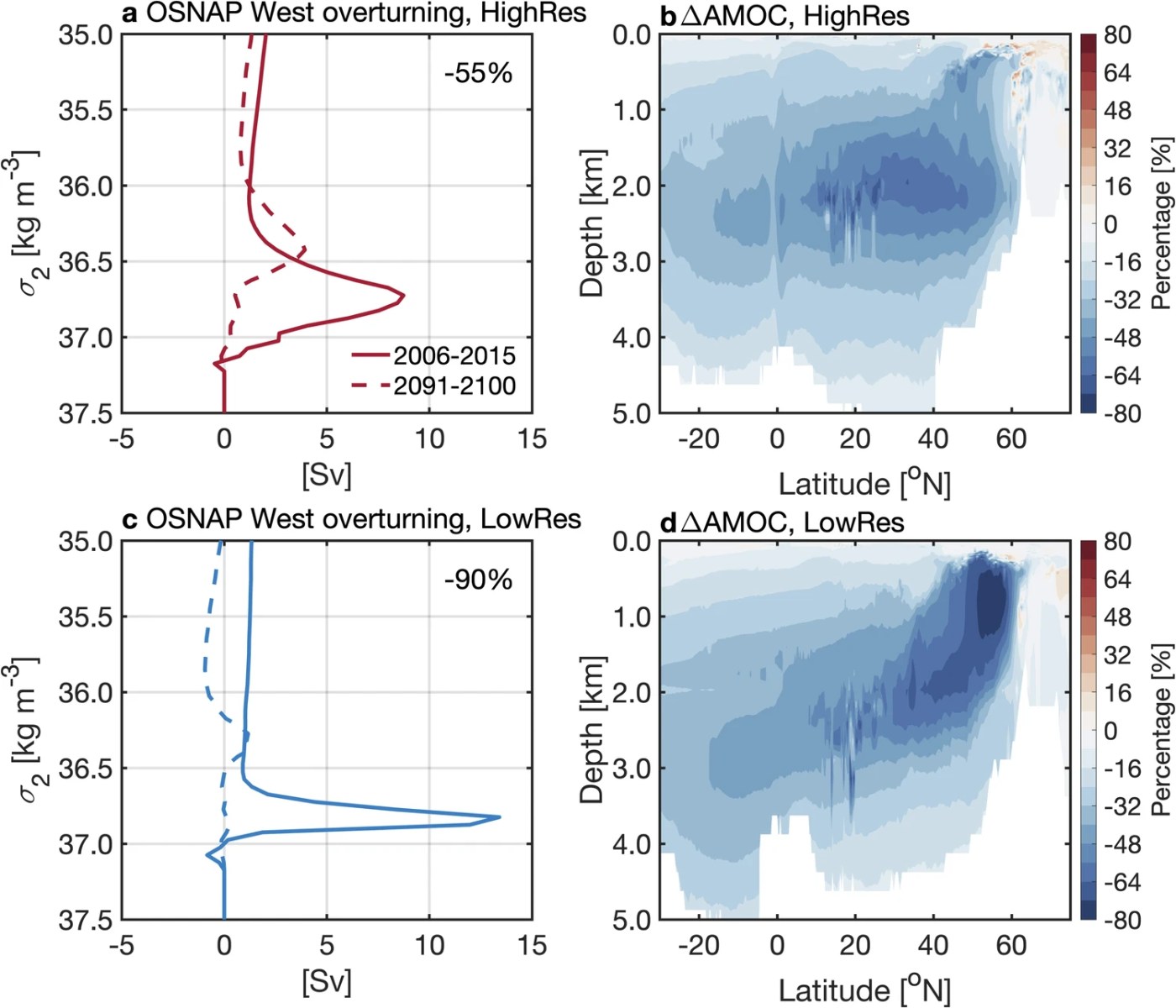
There are a couple of caveats to note. In the high-resolution model simulation (CESM1.3) used in this study, increasing snow & rainfall over land around the Arctic Circle and the associated increase in river runoff are resolved, as well as Arctic sea ice melting. However, no Greenland ice sheet melting or Arctic land ice melting was included in the high-resolution model simulation. It should be also noted that the projected weakening of the total AMOC in this high-resolution model is quite consistent with that in the low-resolution version of the same model, although its vertical structure differs between the high and low-resolution versions (Gou et al., 2024).
Figure 4 from Shan et al. (2024): Weakening of Labrador Sea overturning and the Atlantic Meridional overturning circulation (AMOC). (a, c) Changes of overturning across the west leg of Overturning in the Subpolar North Atlantic Program observing system (OSNAP West) in a High-Res and c Low-Res. Solid (dashed) lines indicate the mean in 2006–2015 (2091–2100). The percentage changes in the maximum overturning streamfunction between 2006–2015 and 2091–2100 is denoted on the upper-right corner in a and c. b, d Percentage changes in the AMOC from 2006–2015 to 2091–2100 in b High-Res and d Low-Res. The percentage changes are calculated as the AMOC streamfunction differences between 2091–2100 and 2006–2015, divided by the maximum AMOC at 40oN in 2006–2015 in each simulation. The AMOC is calculated in density space and then remapped into depth space using the time and zonal mean depth of each density layer.
Shan, X., Sun, S., Wu, L. & Spall, M. Role of the Labrador Current in the Atlantic Meridional Overturning Circulation response to greenhouse warming. Nature Communications, 15, 7361 (2024). https://doi.org/10.1038/s41467-024-51449-9
Gou, R. Lohmann, G. & Wu, L. Atlantic Meridional Overturning Circulation Decline: Tipping Small Scales under Global Warming. Physical Review Letters, 133, 034201. https://doi.org/10.1103/PhysRevLett.133.034201
 Ocean to Climate
A new study based on recent surface drifter deployments suggests that if an increasing amount of freshwater through the Davis Strait reaches the Labrador Sea in the future, it would largely circumnavigate the interior Labrador Sea following the Labrador shelf, not directly affecting the convection region. Obviously, this result has an important implication for the future of the AMOC in a positive way. The main conclusion is largely consistent with the high-resolution model-based study of Shan et al. (2024).
Duyck, E., Foukal, N. P., and Frajka-Williams, E.: Circulation of Baffin Bay and Hudson Bay waters on the Labrador shelf and into the subpolar North Atlantic, Ocean Sci., 21, 241–260, https://doi.org/10.5194/os-21-241-2025, 2025.