
This blog post and the “Deep Dive” podcast, created by NotebookLM, are based on “Imminent rapid decline of the Indonesian Throughflow after reaching a turning point of CO2 concentration” by Hu et al. (2025).
This research article analyzes how rising carbon dioxide levels affect the Indonesian Throughflow (ITF), a vital oceanic link between the Pacific and Indian Oceans. Using CMIP6 climate models, the study identifies a nonlinear response where the flow remains stable until reaching a specific turning point of atmospheric CO2. Beyond this threshold, the ITF undergoes an abrupt decline driven by shifting wind patterns and precipitation levels. The study warns that current CO2 concentrations have likely reached this first turning point, potentially triggering a rapid transition toward a more isolated Indo-Pacific system. Ultimately, the findings suggest that the weakening of this current could represent a significant climate tipping element with major consequences for global ocean circulation.
1. Introduction: The Planet’s Hidden Engine is Sputtering
Deep beneath the waves, the global ocean circulation system acts as the Earth’s climate engine, constantly moving vast quantities of heat and water around the globe. A critical component of this engine is the Indonesian Throughflow (ITF), the only tropical pathway connecting the massive Pacific and Indian Oceans. As a key part of the “Global Meridional Overturning Circulation,” the ITF helps regulate the climate for the entire planet.
For years, this current presented scientists with a major puzzle. Climate models consistently predicted that the ITF would weaken under the stress of global warming. Yet, historical observations showed no significant trend; some data even suggested it was strengthening. This glaring inconsistency left a critical question unanswered.
Now, a landmark study using advanced CMIP6 climate simulations has finally solved the mystery. The answer, however, is not reassuring. The research reveals that the apparent stability of the Indonesian Throughflow was a temporary illusion, and we are on the brink of a major, rapid change.
2. Four Surprising Takeaways from a Landmark Climate Study
2.1 Takeaway 1: The Mystery of the “Stable” Current is Solved—And It’s Not Good News
For decades, the apparent stability of the Indonesian Throughflow was a significant inconsistency between climate models and real-world observations. It seemed to defy the predicted effects of a warming world.
The new research resolves this by demonstrating that the ITF’s response to rising atmospheric CO2 is nonlinear. This means its behavior isn’t a straight line; instead, it changes dramatically once certain CO2 levels are reached.
The study shows that the previous stability was not a sign of resilience. It was simply because atmospheric CO2 levels had not yet reached a critical “turning point.” Before this threshold, the weakening trend caused by warming was too small to be distinguished from the current’s natural year-to-year variability.
2.2 Takeaway 2: We Have Just Crossed a Critical Climatic Threshold
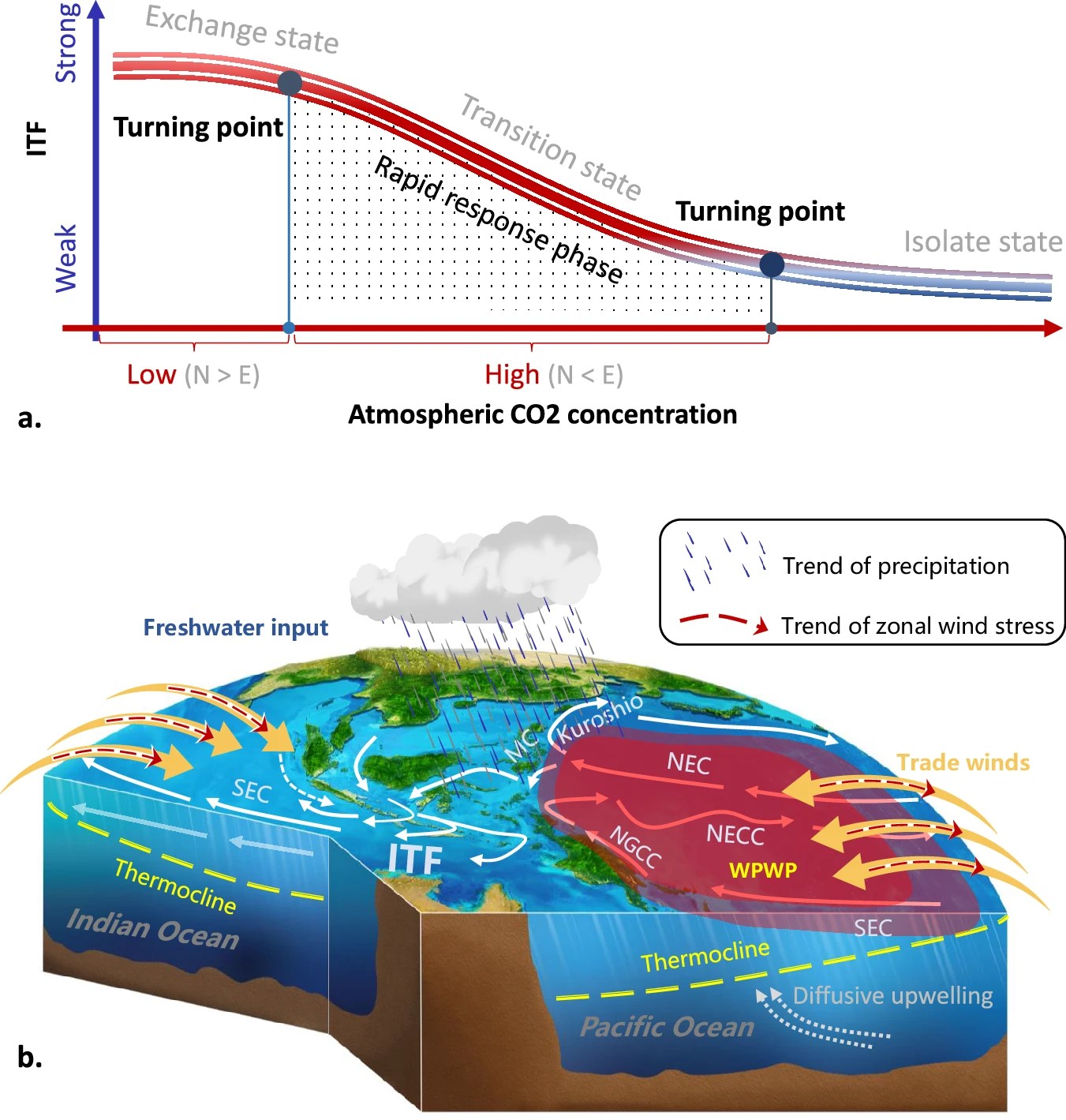
The study identifies a specific “turning point” for the ITF: an atmospheric CO2 mass of approximately 3 x 10¹⁵ kilograms.
The most alarming finding is that humanity has already passed this critical threshold. According to observational data cited in the study, atmospheric CO2 mass reached 3.10 x 10¹⁵ kg in 2014 and was approximately 3.30 x 10¹⁵ kg in 2023.
The direct consequence of crossing this line is stark. The study indicates we have now entered a “Transition state,” where a rapid decline of the Indonesian Throughflow is “imminent.” The authors of the paper underscore the gravity of this moment:
“Significantly, we note that the level of current CO2 mass has reached 3 × 10¹⁵Kg, i.e., the first turning point of ITF’s response to CO2, by the end of Hist run in 2014… suggesting that we may have recently entered a ‘Transition state’ when the ITF will begin to rapidly decrease.”
2.3 Takeaway 3: The Current’s Fate is a Tug-of-War Between Warming and Rainfall
The overall change in the Indonesian Throughflow is the net result of a tug-of-war between two opposing forces: one driven by temperature (the thermosteric component) and one by salinity (the halosteric component).
- The Thermosteric Effect (Temperature): As CO2 rises, it causes the Pacific trade winds to weaken. This reduces the westward flow of warm surface water, decreasing the pressure gradient that drives the current. This effect causes a significant weakening of the ITF and is the dominant force in the long run.
- The Halosteric Effect (Salinity): At the same time, rising CO2 alters global precipitation patterns. In the Western Pacific Ocean, this has led to increased rainfall, making the surface water fresher (less salty). This fresher water is less dense, causing the sea level in the Western Pacific to be slightly higher. This increases the sea-level height difference—and thus the pressure gradient—between the Pacific and Indian Oceans, giving the current a stronger push and causing it to strengthen.
Ultimately, this tug-of-war has a clear winner. The study shows that the weakening effect from temperature changes is more powerful than the strengthening effect from salinity changes, resulting in a net decline of the current. This strengthening “salinity effect” is the key to the puzzle outlined earlier: for decades, it was powerful enough to hide the underlying weakening from warming, tricking observers into seeing a stable or even strengthening current.
2.4 Takeaway 4: A New Potential “Tipping Element” for the Global Climate
The study’s findings place the Indonesian Throughflow in the broader context of major global climate risks. The potential for a severe weakening or collapse of the ITF means it could be a major “climate tipping element,” similar in significance to the potential collapse of the Atlantic Meridional Overturning Circulation (AMOC).
A much weaker ITF would cause the Indo-Pacific system to shift from its current “Exchange state” to a relatively “Isolate state.” This would dramatically reduce the transfer of heat and freshwater between the two largest oceans on Earth.
Such a transition would have far-reaching impacts on the global climate system, marine environments, and the ocean’s fundamental ability to absorb heat from the atmosphere. As the researchers conclude, the implications are profound:
“The collapse of the ITF might be also a potential climate tipping element.”
3. Conclusion: Beyond the Turning Point
The message of this research is clear and direct: the perceived stability of the Indonesian Throughflow was an illusion. We have now crossed a critical threshold, entering a period where this vital ocean current is set to undergo rapid and consequential change.
Looking ahead, the study projects that if CO2 levels continue to rise, the ITF could eventually stabilize at nearly half its present strength, fundamentally altering the exchange between the Pacific and Indian Oceans. This is not just an oceanic reshuffling; a collapsed ITF could alter marine ecosystems across the Indo-Pacific, accelerate warming in the North Pacific, and fundamentally impair the ocean’s ability to absorb heat, with consequences for the entire global climate system.
The science suggests one of the planet’s most important circulatory systems is now in rapid decline. What does it mean to live in a world that has passed such a critical turning point?
Fig. 4 in Hu et al. (2025): Schematic of the nonlinear response of the Indonesian Throughflow (ITF) to increasing CO2 concentration and map of the Indo-Pacific Ocean system in the “Exchange state”. Panel (a) presents the various phases of the ITF in response to increasing CO2. “N > E” denotes when the ITF’s natural variability is greater than the externally forced change. Panel (b) indicates the “exchange state” of the Indo-Pacific system before the first turning point is reached. Major ocean currents are depicted, including the South Equatorial Current (SEC), North Equatorial Current (NEC), the North Equatorial Countercurrent (NECC), the Mindanao Current (MC) and the New Guinea Coastal Current (NGCC). The Western Pacific Warm Pool (WPWP) is also marked. Note that not all known currents are displayed for brevity.
Hu, S., Lu, X., Sprintall, J. et al. Imminent rapid decline of the Indonesian Throughflow after reaching a turning point of CO2 concentration. Nat. Commun. 16, 11605 (2025). https://doi.org/10.1038/s41467-025-66746-0
 Ocean to Climate
Leave a comment