
Atlantic Niña is a natural climate pattern characterized by cooler-than-average sea surface temperatures in the eastern equatorial Atlantic Ocean. It’s considered the ‘cold phase’ of what oceanographers call the Atlantic Zonal Mode, similar to how La Niña is the cold phase of the El Niño-Southern Oscillation (ENSO) in the Pacific.
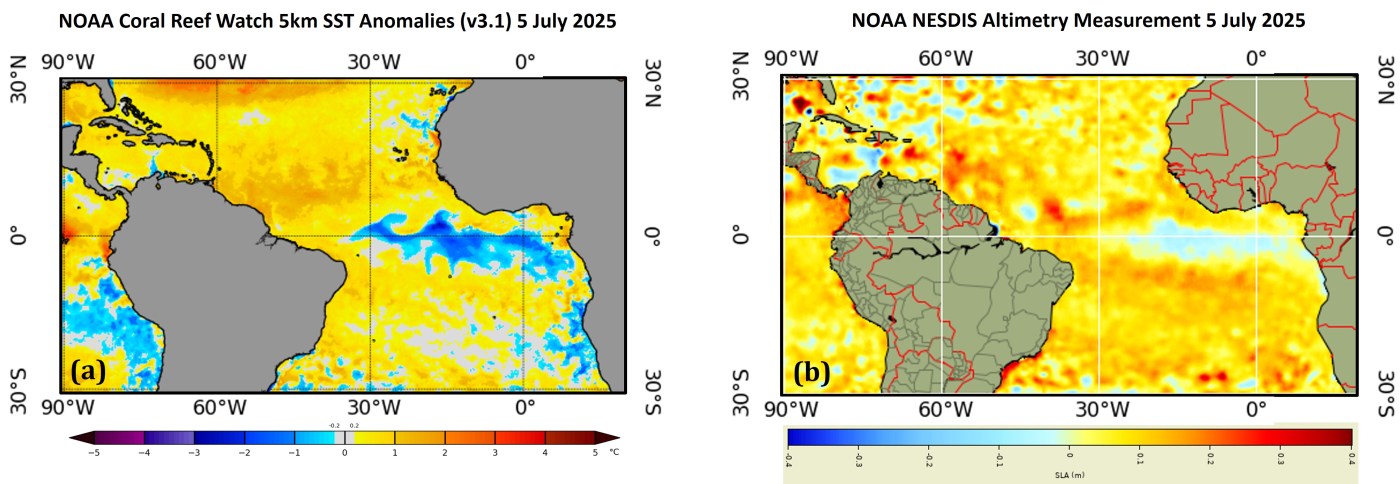
Looking at the latest NOAA satellite images (updated on July 6, 2025), the signs of 2025 Atlantic Niña onset are becoming clear. Figure 1a, which tracks sea surface temperature anomalies, shows a distinct cooling across the equatorial Atlantic. These cooler temperatures are further supported by depressed sea surface heights (Figure 1b), indicating an upward shift of the equatorial thermocline. This combination strongly suggests that enhanced equatorial upwelling is driving the cooling, signaling the likely onset of 2025 Atlantic Niña.
While not as globally impactful as its Pacific cousin, Atlantic Niña can significantly influence the Atlantic hurricane season (Kim et al. 2023; Wang et al. 2024). Specifically, cooler waters in the eastern equatorial Atlantic can weaken the Atlantic intertropical convergence zone (ITCZ) rain band. This weakening of the ITCZ can disrupt the atmospheric conditions necessary for hurricane development in the deep tropical eastern North Atlantic, such as African easterly wave activity and low-level cyclonic vorticity. This in turn decreases the likelihood of powerful hurricanes developing in the deep tropics near the Cape Verde islands, and thus the risk of major hurricanes impacting the Caribbean islands and the U.S. (Kim et al. 2023).
While other significant climate drivers like ENSO (El Niño-Southern Oscillation) and the Atlantic Meridional Mode (AMM) also influence hurricane activity, if the 2025 Atlantic Niña persists or strengthens in the coming months, it could play a significant role in shaping this Atlantic hurricane season.
Figure 1. NOAA satellite images of (a) July/05/2025 sea surface temperature anomalies and (b) July/05/2025 sea surface height anomalies from https://coralreefwatch.noaa.gov/product/5km/, and https://www.star.nesdis.noaa.gov/
Kim, D., Lee, SK., Lopez, H. Foltz, GR., Wen, C., West, R. & Dunion, J. (2023). Increase in Cape Verde hurricanes during Atlantic Niño. Nature Communications, 14, 3704. https://doi.org/10.1038/s41467-023-39467-5
Wang, H., Wang, C., & Zhang, L. (2024). Differentiated impacts of central and Eastern Atlantic Niño on Hurricane activity in the tropical North Atlantic. Geophysical Research Letters, 51, e2024GL112178. https://doi.org/10.1029/2024GL112178
 Ocean to Climate