More Pixels Solved the Pacific Ocean’s Cooling Mystery

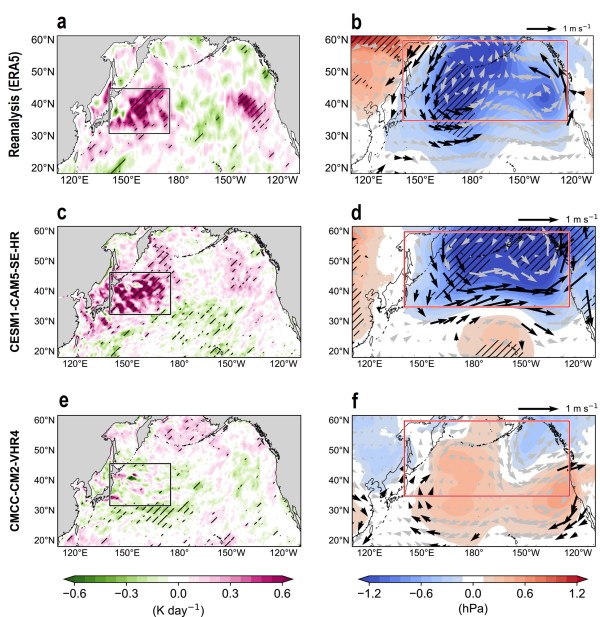
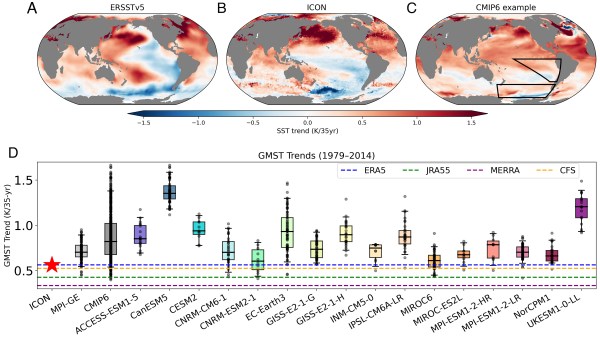
This blog post and the “Deep Dive” podcast, created by NotebookLM, are based on “Km-scale coupled simulation and model–observation SST trend discrepancy” by Kang et al. (2026). This research article investigates why traditional climate models fail to replicate the observed cooling in the Southern Ocean and southeastern tropical Pacific. By utilizing the ICON coupled model at a kilometer-scale resolution,... Continue Reading →

The Great Melt: Uncovering the Hidden Forces Reshaping Antarctica’s Underbelly

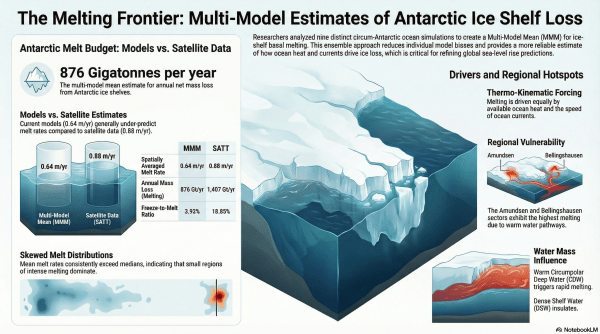
This blog post and the “Deep Dive” podcast, created by NotebookLM, are based on “Multi-model estimate of Antarctic ice-shelf basal mass budget and ocean drivers” by Galton-Fenzi et al. (2026). This research paper presents the Realistic Ice Shelf-Ocean Estimates (RISE) Project, which synthesizes nine different numerical simulations to establish a multi-model mean (MMM) of Antarctic... Continue Reading →

The Arctic’s New Engine: Why the Great Ocean Conveyor Belt is Defying the Warming Trend

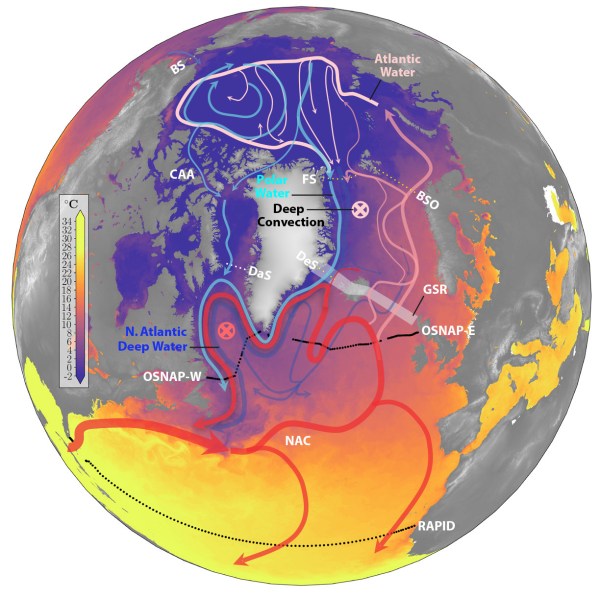
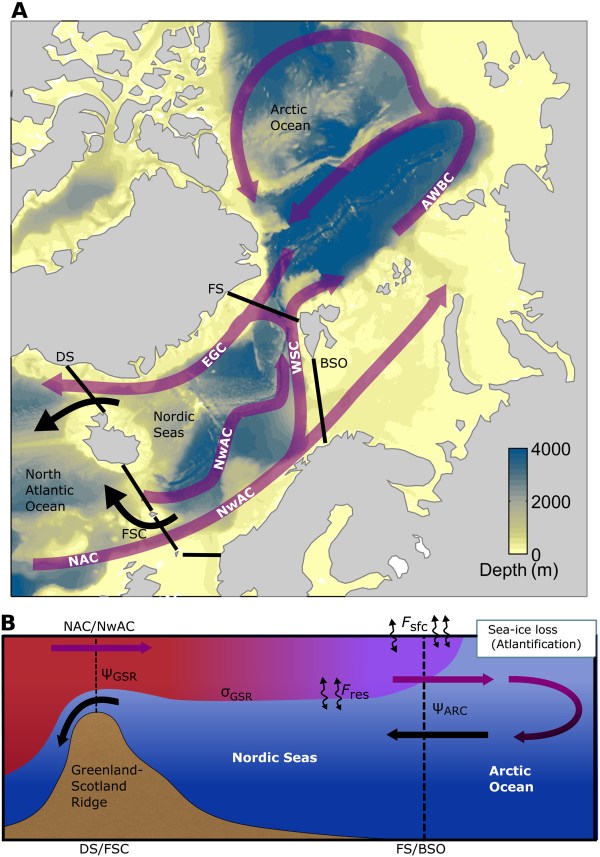
This blog post and the “Deep Dive” podcast, created by NotebookLM, are based on “Atlantification drives recent strengthening of the Arctic overturning circulation” by Årthun et al. (2025). A recent study examines how Atlantification, the northward expansion of warm Atlantic waters, is altering the Arctic overturning circulation. While traditional source regions for dense water in the Nordic Seas have... Continue Reading →

The Barents Sea – Arctic Engine Powering the Global Meridional Overturning Circulation

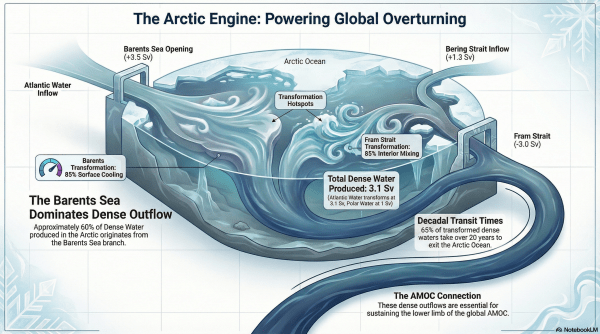
This blog post and the “Deep Dive” podcast, created by NotebookLM, are based on "The Arctic overturning circulation: transformations, pathways and timescales” by Dörr et al. (2026). Dörr et al. (2026) investigates the Arctic overturning circulation by analyzing how warm Atlantic Water is converted into Dense and Polar Waters. Utilizing a high-resolution ocean model and Lagrangian tracking, the authors... Continue Reading →

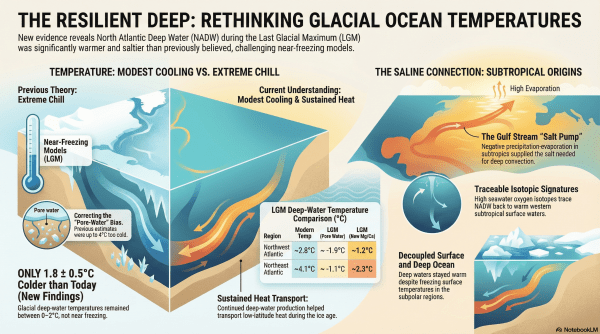
Salt Maintained Persistent Deep-Water Formation in the Glacial North Atlantic

This blog post and the “Deep Dive” podcast, created by NotebookLM, are based on a preprint article “Relatively warm deep-water formation persisted in the Last Glacial Maximum” by Wharton et al. (2026). This research investigates the state of the deep North Atlantic Ocean during the Last Glacial Maximum, challenging previous theories that the deep sea... Continue Reading →

Local Winds Shape the South Atlantic Bight Primary Productivity and Acidity

This blog post and the “Deep Dive” podcast, created by NotebookLM, are based on “Wind control of the interannual ocean-biogeochemical variability in the South Atlantic Bight.” by Gomez et al. (2026). This research investigates how alongshore wind variability and the Gulf Stream control interannual changes in the marine ecosystem of the South Atlantic Bight. By... Continue Reading →

Has A Vital Deep Ocean Current Weakened by 26% Since 2014? — Yes and No

This blog post and the “Deep Dive” podcast, created by NotebookLM, are based on “Observed decrease in Deep Western Boundary Current transport in subpolar North Atlantic” by Koman et al. (2024). Scientific analysis of the Deep Western Boundary Current (DWBC) off the southern tip of Greenland reveals a 26% decline in transport between 2014 and... Continue Reading →

The North Atlantic ‘Cold Blob’ of 2015: It Wasn’t Caused by a Collapsing Ocean Current

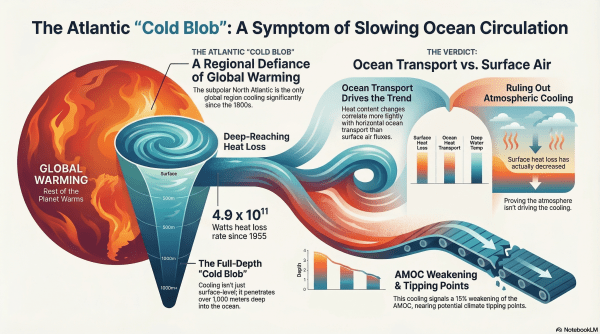
This blog post and the “Deep Dive” podcast, created by NotebookLM, are based on “Strong winter cooling over the Irminger Sea in winter 2014–2015, exceptional deep convection, and the emergence of anomalously low SST” by de Jong and de Steur. (2016). This research investigates the extraordinary deep convection observed in the Irminger Sea during the winter of 2014–2015. While... Continue Reading →

A Stalling Engine: How “Shoaling” of the Ocean’s Conveyor Belt Accelerates the Decline of Ocean Heat Transport

This blog post and the “Deep Dive” podcast, created by NotebookLM, are based on “Future Shoaling of the AMOC and Its Impact on Oceanic Heat Transport to the Subpolar North Atlantic” by Lee et al. (2026). Research by Lee et al. (2026) investigates how greenhouse gas emissions will alter the Atlantic Meridional Overturning Circulation (AMOC) and its ability to move heat... Continue Reading →

Nordic Seas are the Primary Driver of the AMOC

This blog post and the “Deep Dive” podcast, created by NotebookLM, are based on “Volume, Heat, and Freshwater Divergences in the Subpolar North Atlantic Suggest the Nordic Seas as Key to the State of the Meridional Overturning Circulation” by Chafik and Rossby (2019). Research by Chafik and Rossby identifies the Nordic Seas as the primary driver of... Continue Reading →

Website Powered by WordPress.com.

Up ↑