During the satellite era (1979-present), the tropical Pacific Ocean has warmed significantly less than the other tropical oceans in response to increasing greenhouse gases (GHGs). This La Niña-like warming trend in observations is in disagreement with the El Niño-like warming trend projected by the Coupled Model Intercomparison Project (CMIP) models for both the 20th and... Continue Reading →
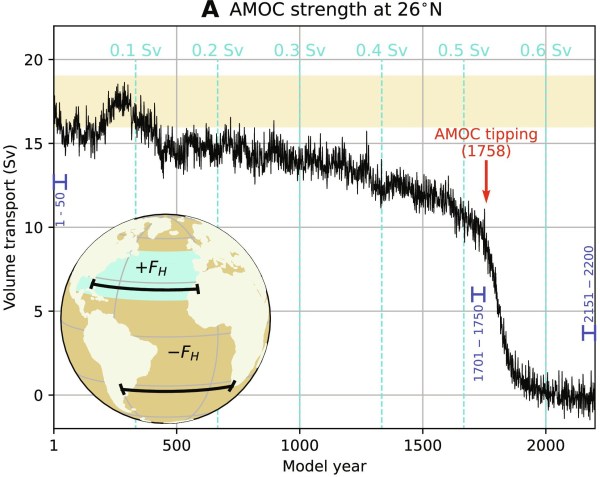
Sustained ocean measurements at 34°S crucial for estimating the distance to an AMOC collapse
The Atlantic Meridional Overturning Circulation (AMOC) transports warm and salty upper ocean water to the subpolar North Atlantic where the upper ocean releases some heat to the atmosphere. Due to the surface cooling and the high salinity (i.e., salty), the upper ocean water becomes heavier and thus sinks down to the deep ocean and then... Continue Reading →
Climate and weather scientists in the U.S. don’t talk to each other
As a climate scientist, I have worked and interacted with many weather scientists in the past 20 years or so. I am also currently in a task force team to advance subseasonal (2~4 weeks) forecasts of severe weather activity in the U.S. I have learned so much from weather scientists about how longer-term climate processes... Continue Reading →