TWISO is a tropics-wide 45-day pulse and does not requires MJO

This blog post and the “Deep Dive” podcast on a paper “Tropics-wide intraseasonal oscillations” by Bao et al. (2025) was created by NotebookLM. Deep Dive Podcast “Earth's Global Climate Heartbeat The TWISO Cycle” powered by NotebookLM: 1.0 Introduction: The Stable Tropics Aren't So Stable When we think about the climate of the tropics, we tend... Continue Reading →

The Atlantic’s Slowing “Heartbeat”: How a Fading Ocean Current Is Silencing a Major Climate Pattern

This blog post and the “Debate” podcast on a paper “Atlantic Meridional Overturning Circulation slowdown suppresses Atlantic Niño variability” by Freire-SouzaLi et al. (2025) was created by NotebookLM. Debate Podcast: This is different from Deep Dive Podcast. This is a debate between two hosts, illuminating different perspectives on the study, “Meltwater or Warming Drives Atlantic... Continue Reading →

The Atlantic’s ‘Warming Hole’ Isn’t What You Think: 5 Surprising Truths From New Climate Research

This blog post and the "Deep Drive" podcast on a new paper "Atmosphere-driven processes in shaping long-term climate variability in Greenland and the broader subpolar North Atlantic" by Li et al. (2025) was created by NotebookLM. Deep Dive Podcast "The Wind-Driven Mystery of the North Atlantic Warming Hole: How Atmospheric Swings Orchestrate Ocean Heat and... Continue Reading →

Synergy effect of warm Atlantic-Pacific on the longest-lasting 2023 western North American heat wave

The southwestern United States (US) and Northern Mexico experienced their longest stretch of record-breaking heat wave in the summer of 2023 from mid-June to early August, affecting over 100 million people, causing over 200 deaths, and $14.5 billion in economic loss. In Phoenix, Arizona, for example, the heat wave lasted for 31 days from 30... Continue Reading →

Future strengthening of the Antarctic Slope Current and its potential implications for global sea level rise

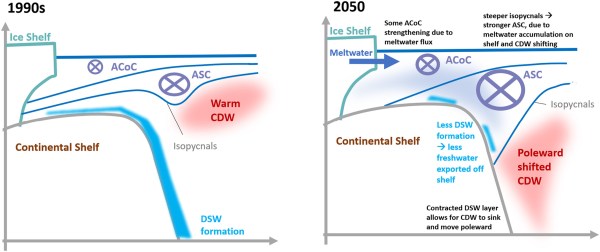
The Antarctic Slope Current (ASC) is the westward-flowing coastal current system around Antarctica, largely driven by easterly winds. It serves as a barrier to heat and salt exchanges between the cold, fresh Antarctic ice shelf region and the warm, salty Circumpolar Deep Water (CDW) in the Southern Ocean. A weakening of the ASC allows more... Continue Reading →

A note on the potential AMOC collapse for nonexperts

As the Earth warms due to anthropogenic climate change, sea- and land-based ice melts, adding buoyant freshwater to the surface of the high-latitude North Atlantic and thus decreasing salinity. This makes the surface water lighter reducing the sinking of the surface water and thus the AMOC. However, the amount of added freshwater is not enough... Continue Reading →

Papers that I enjoyed reading in January 2025

Adams, K. H., Reager, J. T., Buzzanga, B. A., David, C. H., Sawyer, A. H., & Hamlington, B. D. (2024). Climate-induced saltwater intrusion in 2100: Recharge-driven severity, sea level-driven prevalence. Geophysical Research Letters, 51, e2024GL110359. https://doi.org/10.1029/2024GL110359: The projected increase in regional saltwater intrusion to Aquafer (for drinking & etc) is driven not only (1) by... Continue Reading →

The annual mean AMOC in 2022 is the lowest after its biggest drop in 2009

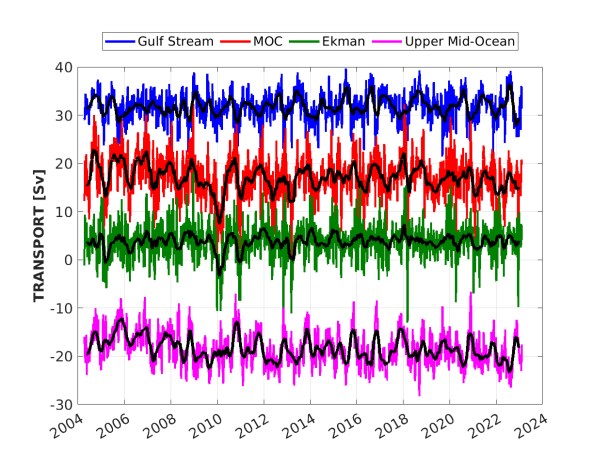
Scientists have been monitoring the Atlantic Meridional Overturning Circulation (AMOC) at around 26.5°N since April 2004 through the RAPID/Meridional Overturning Circulation and Heatflux Array/Western Boundary Time Series moored array (RAPID). The newly released RAPID dataset fully incorporated a recent geomagnetic correction of the submarine cable measurement of the Florida Current transport, a critical component of... Continue Reading →

France’s floating ocean laboratory is a future hub of international Arctic research collaboration

As of 2024, there are currently 70 permanent research stations from 29 countries scattered around the continent of Antarctica conducting important scientific research to better understand the Earth system and its changes due to human activity. In the Arctic, however, there are no such permanent research stations because there is no land in the Arctic.... Continue Reading →

Increasing frequency of “moist” heatwaves

Heatwaves usually come with dry conditions because the regions under the so-called heat dome, which is typically responsible for severe heatwave events, are deprived of moisture and rainfall. However, in the southern US states under semi-tropical environments, "moist" heatwave events may occur, causing both the temperature and humidity stresses on human physiology. But, you may... Continue Reading →

Website Powered by WordPress.com.

Up ↑