Emergence of a shallow aragonite-undersaturated layer in the Southern Ocean

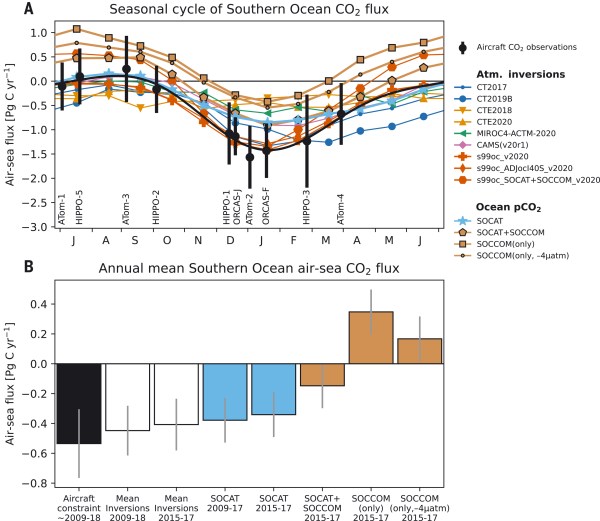
As the ocean absorbs anthropogenic CO2, its pH and carbonate ion concentration  decrease, thereby decreasing the ratio of the concentration of dissolved carbonate ions in the sea water to the concentration of dissolved ions in a saturated solution of aragonite (i.e., aragonite saturation state ΩAr). If ΩAr falls below the threshold ΩAr=1, ocean acidification makes it harder... Continue Reading →

Why does the upper atmosphere cool with increasing carbon dioxide?

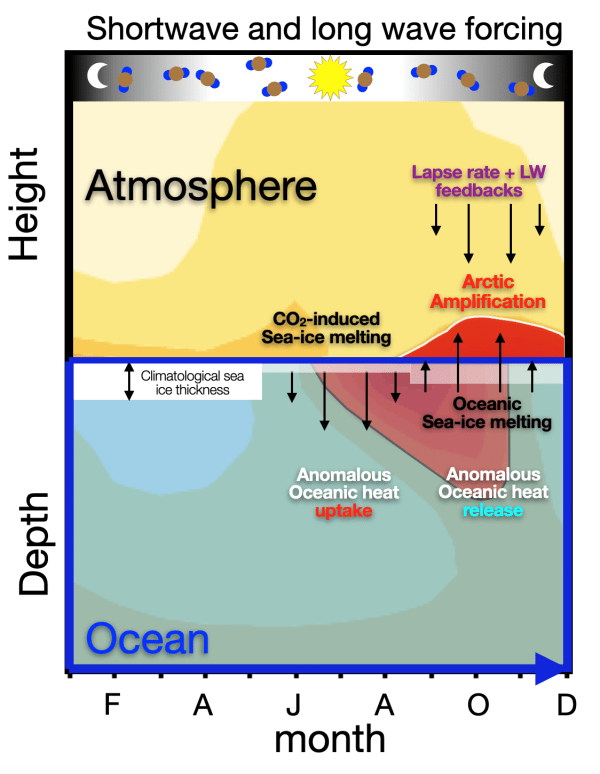
According to model simulations with increasing carbon dioxide in the atmosphere, the zonal mean temperature in the atmosphere get warmer in the troposphere (< 10km or > 100hPa) and colder in the stratosphere (10 ~ 50km or 100 ~ 1hPa). A simple explanation is that the amount of infrared heat radiated out to the space... Continue Reading →

Ocean-ice momentum flux reversal and the associated stabilization of the Beaufort Gyre and freshwater accumulation

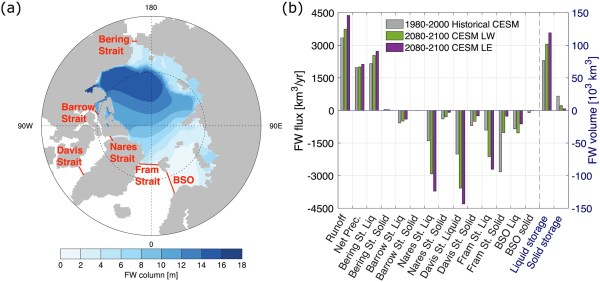
Driven by the Beaufort High and associated wind-stress curl, the anticyclonic ocean gyre over the Canada Basin, as known as the Beaufort Gyre, is a dominant feature of the Arctic Ocean circulation. The Beaufort Gyre is the largest freshwater reservoir in the Arctic Ocean  (Proshutinsky et al., 2009) and also is a region of the largest summer sea... Continue Reading →

Pantropical inter-ocean interactions & the rising influence of tropical Atlantic Ocean

Conventional view so far has been that El Nino - Southern Oscillation (ENSO) is largely responsible for energizing the dominant modes of SST variability  in the tropical Atlantic and Indian Oceans through changes in the Walker circulation and extratropical atmospheric waves. However, recent studies have shown that SST variability in the tropical Atlantic and Indian... Continue Reading →

New ocean observing system reveals a little contribution of the Labrador Sea Water production to the AMOC

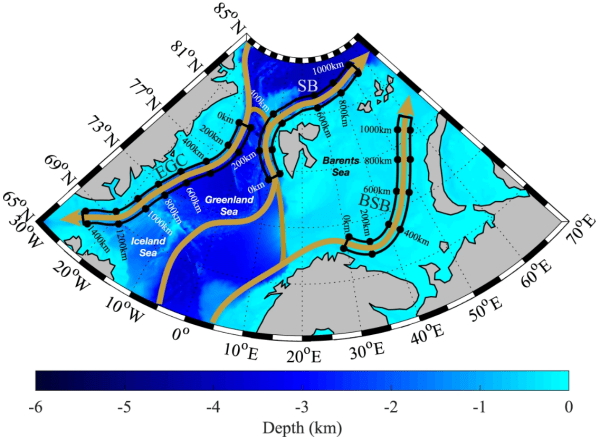
A new study published in Science analyzed the first 21-month record of the Overturning in the Subpolar North Atlantic Program (OSNAP) observing system, which was launched in the summer of 2014. The OSNAP observing system comprises an integrated coast-to-coast array of two sections: OSNAP West, extending from the southeastern Labrador shelf to the southwestern tip... Continue Reading →

Tropical ocean warming provides optimal growth condition for iron-limited cyanobacterium

Although the cyanobacterium (Trichodesmium) fixes as much as half of the nitrogen (N2) that supports tropical open-ocean ecosystem, its growth is limited by iron (Fe) availability. A study published in Nature Climate Change performed laboratory experiments to show that the optimum growth temperature of Fe-limited Trichodesmium is about 32°C, which is much higher than for Fe-replete cells (about... Continue Reading →

Global meridional overturning circulation revisited

Ocean tracers such as heat, salt and carbon are perpetually carried by the global meridional overturning circulation (GMOC) and redistributed between hemispheres and across ocean basins from their source regions. The GMOC is therefore a crucial component of the global heat, salt and carbon balances. In a new article accepted in Geophysical Research Letter, a... Continue Reading →

Recent warming of the Indian Ocean suppresses the Indian summer monsoon circulation

A recent article published in Science Advances analyzed an atmospheric reanalysis dataset (MERRA2) covering the 1980–2016 period to show that a significant warming occurred in the Indian Ocean over the study period, and thus reduced the temperature difference between the Indian subcontinent and Indian Ocean in boreal summer. The reduced land-ocean temperature difference in turn produced anomalous... Continue Reading →

Increasing water temperature tied to rapid sea level rise along the U.S. East Coast during 2010-2015

In a new article accepted for publication in the Geophysical Research Letters, Ricardo Domingues (CIMAS University of Miami & NOAA/AOML) and his coauthors explored  the observed rapid sea level rise along the U.S. East Coasts during 2010-2015, which is linked to extensive flooding and “sunny day” flooding (or nuisance flooding) events in large urban areas including... Continue Reading →

Natural variability in the Southern Ocean as a driver of the observed Antarctic sea-ice expansion trends

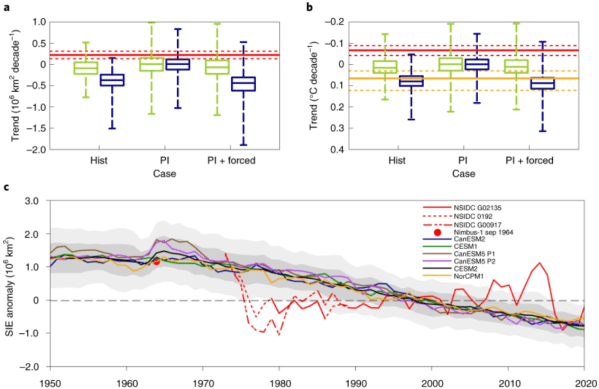
A team of scientists from Princeton University, NOAA-GFDL, and UCAR performed global climate model simulations, using a newly developed coupled ocean–atmosphere model SPEAR (Seamless System for Prediction and Earth System Research). When this model was driven with changes in past radiative forcing, the model simulation did not reproduce the observed increasing trends in sea-ice concentration around... Continue Reading →

Website Powered by WordPress.com.

Up ↑