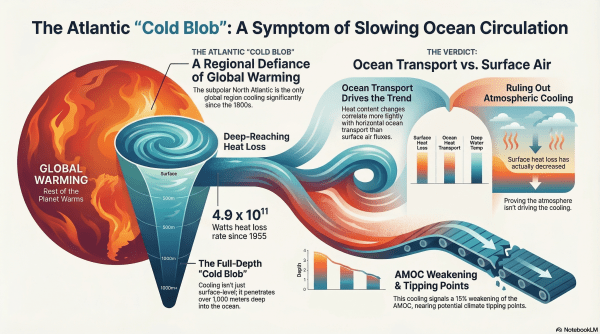
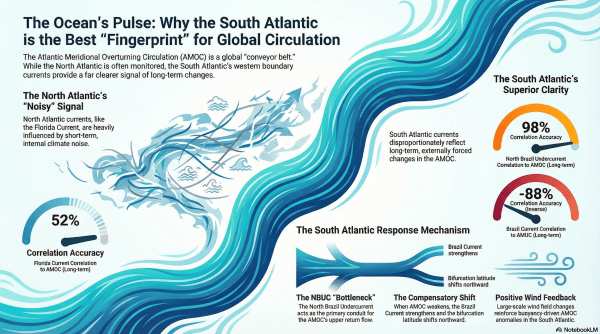
This blog post and the “Deep Dive” podcast, created by NotebookLM, are based on “Decadal changes in Atlantic overturning due to the excessive 1990s Labrador Sea convection” by Böning et al. (2023). Deep beneath the surface of the Atlantic, a colossal current system is constantly at work. Known as the Atlantic Meridional Overturning Circulation (AMOC),... Continue Reading →
While the Labrador Sea contributes little to the AMOC’s strength, it is still the express lane
The recent shift in understanding (the OSNAP results) doesn't mean the Labrador Sea is irrelevant; it just changes its job description. It is less of a "pump" and more of a "conduit" and a "collector." Here is the detailed breakdown of how it works. This blog post was generated by Google Gemini Pro and NotebookLM.... Continue Reading →
Convection ≠ Overturning: Why Labrador Sea Convection Doesn’t Drive The AMOC
The oceanography community is deeply engaged in a debate about how much weight the Labrador Sea actually carries in maintaining the Atlantic Overturning Circulation (AMOC) system. According to the OSNAP (Overturning in the Subpolar North Atlantic Program) data, the Labrador Sea's contribution to the AMOC is surprisingly small (around 3–4 Sv) while the eastern subpolar... Continue Reading →
Surge of Fresh Water Paradoxically Strengthened the Labrador Sea Overturning Circulation
This blog post and the “Deep Dive” podcast, created by NotebookLM, are based on “Strengthening of Labrador Sea Overturning Linked to Subsurface Freshening Over Recent Decades” by Li et al. (2026). Introduction: The Ocean's Engine and a Long-Standing Puzzle The Atlantic Ocean is home to a vast, powerful system of currents often called the "ocean's... Continue Reading →
A Highway of Heat to the Arctic: Why a Vital Ocean Current Is Losing Its Chill
This blog post and the “Deep Dive” podcast, created by NotebookLM, are based on “Reduced cooling in the Norwegian Atlantic Slope Current: investigating mechanisms of change from 30 years of observations” by Baumann et al. (2025). This research analyzes thirty years of hydrographic data to investigate why Atlantic Water in the Norwegian Atlantic Slope Current is cooling less as it travels... Continue Reading →
The Atlantic’s Long Reach: How tropical Ocean Warming Fuels Greenland’s Melt
This blog post and the “Deep Dive” podcast, created by NotebookLM, are based on “Surface warming over Greenland amplified by remote forcing from tropical Atlantic” by Zhang et al. (2025). Recent research indicates that sea surface temperature variability in the tropical North Atlantic acts as a remote driver for the significant warming of the Greenland... Continue Reading →
Increase in massive marine heat wave events since 2003 triggered a widespread ecological reorganization in the North Atlantic
This blog post and the “Deep Dive” podcast, created by NotebookLM, are based on “Major heat wave in the North Atlantic had widespread and lasting impacts on marine life” by Werner et al. (2026). Scientific analysis reveals that a massive marine heat wave beginning in 2003 triggered an abrupt and extensive ecological reorganization across the North Atlantic. Researchers utilized decades of... Continue Reading →
Beyond the AMOC: An Abrupt Decline of the Indonesian Throughflow (ITF) Is Already Underway
This blog post and the “Deep Dive” podcast, created by NotebookLM, are based on “Imminent rapid decline of the Indonesian Throughflow after reaching a turning point of CO2 concentration" by Hu et al. (2025). This research article analyzes how rising carbon dioxide levels affect the Indonesian Throughflow (ITF), a vital oceanic link between the Pacific... Continue Reading →
Fingerprint Of Global Warming On Tropical Oceans Has Emerged In The Atlantic—While the Pacific Stays Cool
This blog post and the “Deep Dive” podcast, created by NotebookLM, are based on “Emergence of the enhanced equatorial Atlantic warming as a fingerprint of global warming” by Dong et al. (2025). Summary: This research identifies enhanced equatorial warming (EEW)—a pattern where sea surface temperatures near the equator rise faster than the surrounding tropics—as a... Continue Reading →
Rethinking the AMOC Variability: Why the Irminger Sea—Not the Labrador Sea—Is the True Center of Action
This blog post and the “Deep Dive” podcast, created by NotebookLM, are based on “Irminger Sea Is the Center of Action for Subpolar AMOC Variability” by Chafik et al. (2022). Summary: Chafik et al. (2022) identified the Irminger Sea as the primary "center of action" for driving fluctuations in the subpolar Atlantic Meridional Overturning Circulation... Continue Reading →