Seasonal hurricane outlooks, such as those issued by NOAA's Climate Prediction Center, Colorado State University (Klotzbach et al., 2017), European Center for Medium-Range Weather Forecasts, and University of Arizona (Davis and Zeng, 2019), produce skillful (i.e.,. better than climatology) seasonal forecasts of overall North Atlantic tropical cyclone (TC) activity. Such forecasts are possible because seasonal... Continue Reading →
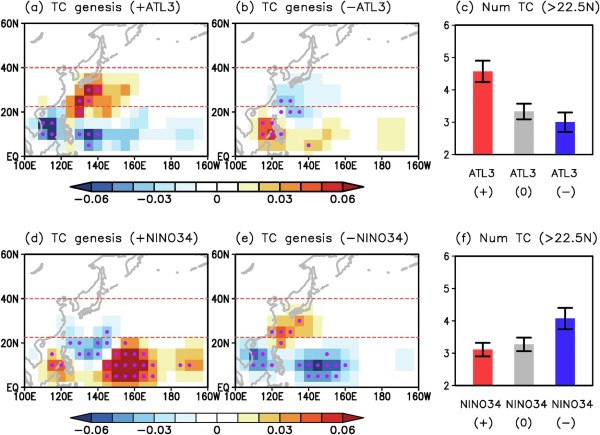
Onset of 2025 Atlantic Niña and its implication for typhoon landfalling risks in East and Southeast Asian countries
Atlantic Niña is a natural climate pattern characterized by cooler-than-average sea surface temperatures in the eastern equatorial Atlantic Ocean, appearing predominantly in June-August. It is considered the 'cold phase' of the Atlantic Zonal Mode, the leading mode of tropical Atlantic sea surface temperature variability in June-August, similar to how La Niña is the cold phase... Continue Reading →
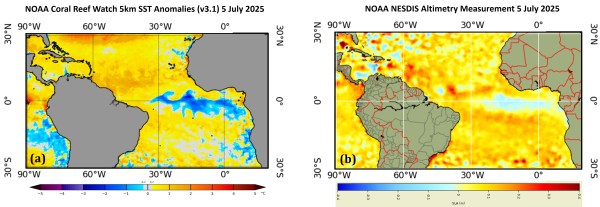
Onset of 2025 Atlantic Niña: What it means for the Atlantic hurricane season (updated)
Atlantic Niña is a natural climate pattern characterized by cooler-than-average sea surface temperatures in the eastern equatorial Atlantic Ocean. It’s considered the 'cold phase' of what oceanographers call the Atlantic Zonal Mode, similar to how La Niña is the cold phase of the El Niño-Southern Oscillation (ENSO) in the Pacific. Looking at the latest NOAA... Continue Reading →
Human-induced ozone depletion has acted to enhance the La Niña-like SST trend pattern
During the satellite era (1979-present), the tropical Pacific Ocean has warmed significantly less than the other tropical oceans in response to increasing greenhouse gases (GHGs). This La Niña-like warming trend in observations is in disagreement with the El Niño-like warming trend projected by the Coupled Model Intercomparison Project (CMIP) models for both the 20th and... Continue Reading →
ENSO forecasts extended to 18 months?
According to the recharge-discharge oscillator theory (Jin, 1997), the leading mode of tropical Pacific upper ocean heat content anomalies is a predictor (or a precursor) for the onset of El Niño - Southern Oscillation (ENSO) at the interannual time scale. A new study published in Nature (Zhao et al., 2024) utilized multiple global sea surface... Continue Reading →
Atlantic Niña brewing: An implication for the 2024 hurricane season
Currently (as of June 22, 2024), a phenomenon known as Atlantic Niña is brewing in the tropical Atlantic Ocean. As the Atlantic counterpart of La Niña in the Pacific, Atlantic Niña is characterized by the appearance of cold sea surface temperature anomalies (SSTAs) in the eastern equatorial Atlantic. It is known to reduce rainfall and... Continue Reading →
Why is it hard to identify the subpolar and subtropical jets from zonal-mean zonal wind profiles?
Two important atmospheric jet streams that shape the extratropical zonal wind field in both hemispheres are the subtropical jet and the subpolar jet. The subtropical jet is located around 30° latitude line at the boundary between the Hadley cell and the Ferrel cell, and is predominantly a high-altitude feature. Since it is largely in thermal-wind... Continue Reading →