
A team of scientists from Princeton University, NOAA-GFDL, and UCAR performed global climate model simulations, using a newly developed coupled ocean–atmosphere model SPEAR (Seamless System for Prediction and Earth System Research). When this model was driven with changes in past radiative forcing, the model simulation did not reproduce the observed increasing trends in sea-ice concentration around... Continue Reading →
Ocean acidification may induce toxic algal bloom and disrupt the pelagic food web
A field experiment led by a team of scientists from GEOMAR Helmholtz Centre for Ocean Research Kiel and others (Riebesell et al., 2018) showed that the toxic microalga Vicicitus globosus, known for its wide geographical distribution and confirmed role in fish kills, has an advantage under ocean acidification, increasing its abundance in natural plankton communities at CO2 levels higher... Continue Reading →
Antarctic meltwater slows down global warming by more than a decade
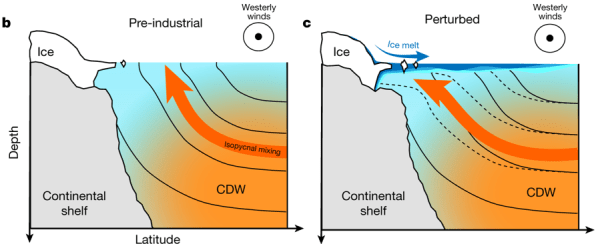
A new study published in Nature used climate models to explore the effects of meltwater from the Antarctic ice sheets and ice shelves on global surface temperature under a warming climate. The study found that the increasing meltwater decreases the surface salinity of the Southern Ocean and thus increases the near-surface stratification, which in turn... Continue Reading →
Deep convection that feeds the AMOC may occur in Arctic Sea under a warming climate
The Atlantic Meridional Overturning Circulation (AMOC) is a key ocean circulation system that carries heat, salt, carbon and other biogeochemical elements along its paths, redistributing them between hemispheres and across ocean basins, and thus is a crucial component of the global heat, salt and carbon balances. At present, the subduction of dense water (i.e., deep convection) that... Continue Reading →
Antarctic Ice Sheet retreat in the Amundsen Sea driven by central tropical Pacific SST variability
A new study appeared in Nature Geoscience (Jenkins et al., 2018) analyzed ocean temperature, salinity, dissolved-oxygen and current measurements from 2000 to 2016 near the Dotson Ice Shelf in the Amundsen Sea to determine temporal changes in net basal melting. The study showed that a decadal cycle dominates the ocean record, which is highly correlates with... Continue Reading →
Satellite-derived Antarctic ice loss over the past decade is 80% higher than IPCC projections
A short article appeared in Nature Climate Change compared Antarctic ice-sheet mass balance between satellite-derived observations and IPCC-AR5 model-based projections. Satellite-derived observations show that Antarctic ice-sheet has decreased since 1992 contributing around 0.27 mm-per-yr sea level rise. During the last decade (2007-2017), the contribution from Antarctica increased to around 0.55 mm-per-yr . This value is around 30... Continue Reading →
Ocean carbon sink is dictated by natural variability on decadal time scales
Data-based estimates show that the global oceanic carbon flux has increased rapidly since around 2000 with little decadal variability during 1992-1999 (Rödenbeck et al., 2015). An article published in Geophysical Research Letters (Li and Ilyina, 2017) used large ensemble climate model simulations to show that the observed increase is much faster than simulated by their biogeochemical process model. By... Continue Reading →
Deglacial atmospheric CO2 increase caused by enhanced abyssal circulations in the Pacific Ocean
Paleo records indicate that during the last deglaciation period (19,000–9,000 years ago) atmospheric CO2 level increased by about 80 ppm. A new study published in Nature Geoscience analysed neodymium (Nd) isotope data in North Pacific sediment cores to find an increase in 14C age of North Pacific subsurface waters sourced from Antarctica indicating an enhanced abyssal overturning... Continue Reading →
Increasing role of the North Atlantic in anthropogenic ocean heat uptake
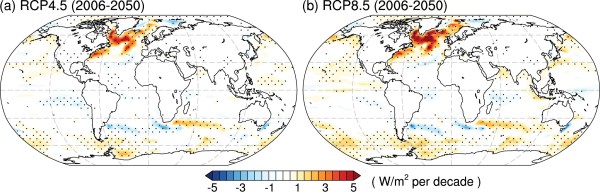
Anthropogenic aerosols preferentially cool the Northern Hemisphere, and the effect on surface heat flux into the North Atlantic opposes the greenhouse gas (GHG) effect. However, aerosols are projected to decline in the near future, reinforcing the greenhouse effect on the North Atlantic heat uptake. As a result, the surface uptake of anthropogenic heat by the... Continue Reading →
Ship-based observations significantly underestimate carbon dioxide outgassing in the high-latitude Southern Ocean
It is widely believed that the Southern Ocean accounts for a significant portion of the oceanic uptake of anthropogenic carbon dioxide (CO2). However, flux estimates in this region are based on sparse ship-based observations that are strongly biased towards summer. A new study published in Geophysical Research Letters presented new estimates of Southern Ocean air‐sea CO2 fluxes based... Continue Reading →
 Ocean to Climate