Online document-sharing service has revolutionized the way scientists share documents and interact with collaborators. Google Docs is probably the most widely used online document-sharing service. I use it almost every day for work and to share scientific paper drafts with coauthors. It is very convenient and facilitates collaboration between co-authors. For instance, a co-author can... Continue Reading →
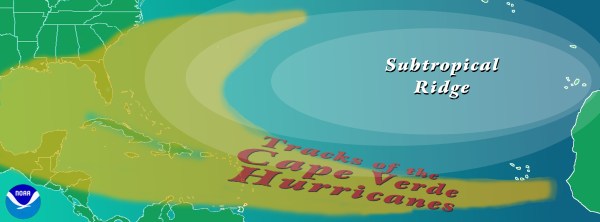
El Niño’s little brother in the Atlantic may not be so little when it comes to its impact on hurricanes
Atlantic Niño, characterized by warm sea surface temperature (SST) anomalies in the eastern equatorial Atlantic, is the Atlantic counterpart of the Pacific El Niño. Due to its smaller size in zonal extent, it is often referred to as El Niño’s little brother. It was previously thought to have a limited regional influence on rainfall variability... Continue Reading →
Atlantic deep water is now warm enough to melt previously stable Greenland glacier
Ice sheet melting from Greenland's glaciers accounts for an increasing proportion of global sea level rise, losing ~330 billion tonnes of ice per year during 2006-2018 (compared to ~120 billion tonnes of ice per year during 1901-1990). A new study published in Nature Communications examined recent changes at K.I.V Steenstrups Nordre Bræ (66.53°N, 34.57°W), a... Continue Reading →
The Global Ocean Conveyor Belt is Reshaping from the Southern Ocean
As the surface ocean warms and polar ice sheets melt due to increasing anthropogenic greenhouse gases in the atmosphere, near-surface stratification is increasing almost everywhere, including the major deep water formation regions in the high-latitude North Atlantic and around Antarctica. As a result, the global Meridional Overturning Circulation (MOC), also known as the global ocean... Continue Reading →
Papers that I enjoyed reading in February 2023
Zhang, R., Sun, S., Chen, Z., Yang, H., & Wu, L. (2023). Rapid 21st century weakening of the Agulhas current in a warming climate. Geophys. Res. Lett., 50, e2022GL102070. https://doi.org/10.1029/2022GL102070: The Agulhas current is projected to slow down and become shallower during the rest of the 21st century, partly in response to the slowdown of... Continue Reading →
Antarctic Bottom Water (AABW) export pathways across the Southern Ocean
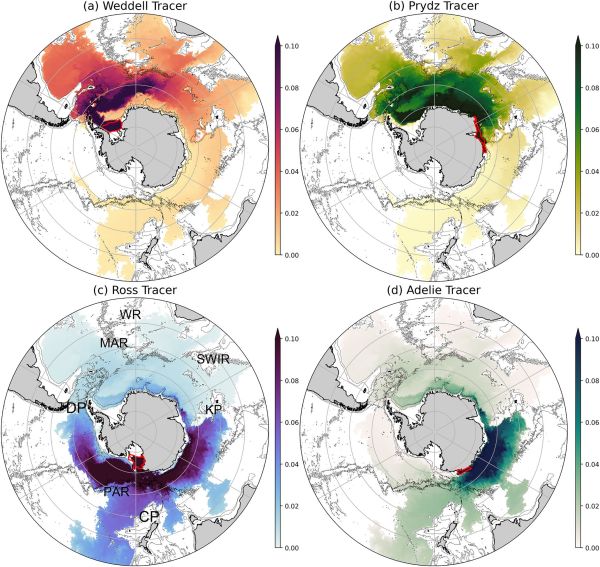
The Antarctic Bottom Water (AABW) is the densest water mass of the global ocean that covers about 30 ~ 40% of the global ocean volume with temperatures ranging from -0.8 to 2°C and salinities from 34.6 to 34.7 psu. It forms around Antarctica and spreads into the Southern Ocean and then into the Atlantic, Indian,... Continue Reading →
How I review a scientific paper
As a career scientist, I review scientific papers regularly, at least once every month. For instance, I reviewed a total of 18 papers in 2021, and many of them 2 ~ 3 times for revisions. I think I can speak for almost everyone that nobody really enjoys reviewing papers. We do it because it is... Continue Reading →
Java-Sumatra Niño/Niña: two long-lost siblings of El Niño
There are many siblings, cousins, and distant relatives of El Niño spanning the Pacific, Atlantic, and Indian Oceans who share a feature in common: ocean surface temperature anomalies along eastern boundaries linked to changes in the upwelling of cooler water from below. So far, climate scientists have identified a total of 14 members of this... Continue Reading →
Nearshore sea ice shield Antarctic ice shelves from the damaging impact of ocean waves
The Larsen ice shelves extend along the east coast of the Antarctic Peninsula over the northwest part of the Weddell Sea. From north to south, these segments are called the Larsen A, B, C, and D, bordered by Filchner–Ronne Ice Shelf south of the Weddell Sea. In 1995, the Larsen A ice shelf completely disintegrated,... Continue Reading →
North Atlantic zonal winds will shift northward and become more extreme in the future
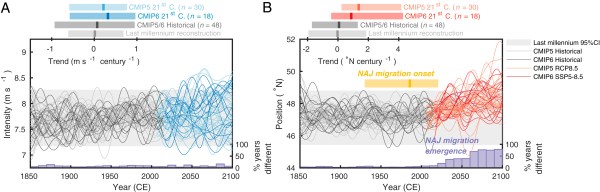
The warming response of the upper atmosphere is much stronger in the tropics due to higher water vapor content and frequent deep tropical convection that maintains the atmosphere column well-mixed. As a result, the zonal jet strength, which is largely proportional to the meridional gradient of atmosphere temperature via "thermal wind relationship" is projected to... Continue Reading →