Recent news articles from the Washington Post "Why hurricane season is suddenly quiet — and what’s in store" and "A rare deluge could hit parts of the Sahara that almost never get rain this time of year" discussed two seemingly unconnected climate conditions around the tropical North Atlantic and West Africa. For the former, some... Continue Reading →
Atlantic Niña brewing: An implication for the 2024 hurricane season
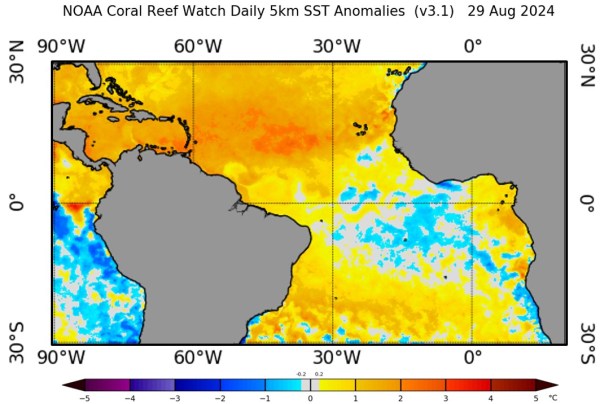
Currently (as of June 22, 2024), a phenomenon known as Atlantic Niña is brewing in the tropical Atlantic Ocean. As the Atlantic counterpart of La Niña in the Pacific, Atlantic Niña is characterized by the appearance of cold sea surface temperature anomalies (SSTAs) in the eastern equatorial Atlantic. It is known to reduce rainfall and... Continue Reading →
Letter to a Young Ecologist
This short essay by Daniel C. Laughlin is beneficial not only for young ecologists but also for all scientists both young and old. The author spoke of three elements of ecology: natural history, quantitative reasoning, and communication. If you are an oceanographer or climate scientist, you may want to substitute "natural history" with "observational data" for... Continue Reading →
Sustained ocean measurements at 34°S crucial for estimating the distance to an AMOC collapse
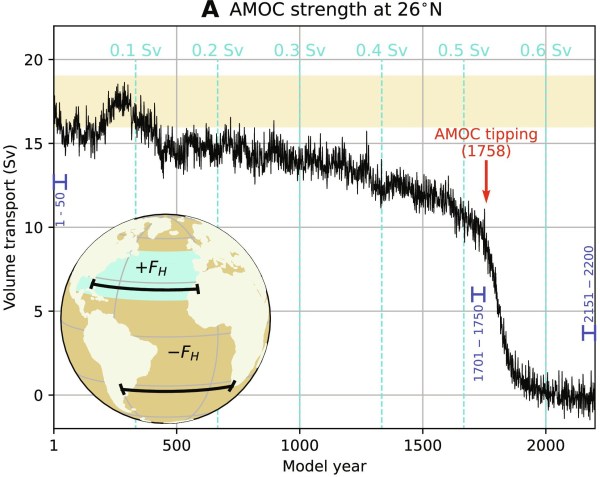
The Atlantic Meridional Overturning Circulation (AMOC) transports warm and salty upper ocean water to the subpolar North Atlantic where the upper ocean releases some heat to the atmosphere. Due to the surface cooling and the high salinity (i.e., salty), the upper ocean water becomes heavier and thus sinks down to the deep ocean and then... Continue Reading →
Useful editing tips from climate science editor
Michael White is a climate science editor for Nature. He posted on Twitter a list of useful tips for climate scientists to consider before they submit their work to Nature or other journals. Personally, I would like to stress his suggestion to avoid subjective wording like “unprecedented”, “dramatic”, and “remarkable”. Such a subjective word gives... Continue Reading →
3 most memorable reviews … so far
Throughout my career, I have published many scientific papers and reviewed even more papers. So, I have received or encountered many interesting reviews. Here are the 3 most memorable comments that I have received so far. #3) "The paper is very poorly written, lacks objective detail, and makes fatal flaw assumptions about the role of... Continue Reading →
Your suggestion “rejected” in a shared online document?
Online document-sharing service has revolutionized the way scientists share documents and interact with collaborators. Google Docs is probably the most widely used online document-sharing service. I use it almost every day for work and to share scientific paper drafts with coauthors. It is very convenient and facilitates collaboration between co-authors. For instance, a co-author can... Continue Reading →
Atlantic deep water is now warm enough to melt previously stable Greenland glacier
Ice sheet melting from Greenland's glaciers accounts for an increasing proportion of global sea level rise, losing ~330 billion tonnes of ice per year during 2006-2018 (compared to ~120 billion tonnes of ice per year during 1901-1990). A new study published in Nature Communications examined recent changes at K.I.V Steenstrups Nordre Bræ (66.53°N, 34.57°W), a... Continue Reading →
The Global Ocean Conveyor Belt is Reshaping from the Southern Ocean
As the surface ocean warms and polar ice sheets melt due to increasing anthropogenic greenhouse gases in the atmosphere, near-surface stratification is increasing almost everywhere, including the major deep water formation regions in the high-latitude North Atlantic and around Antarctica. As a result, the global Meridional Overturning Circulation (MOC), also known as the global ocean... Continue Reading →
Arctic Ocean is experiencing dramatic weight loss due to increasing freshwater storage
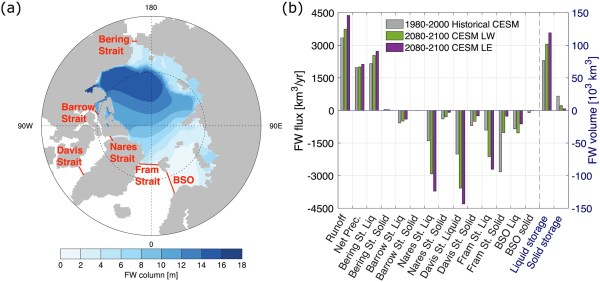
The freshwater cycle in the Earth System is a delicate balance between the net loss (i.e., evaporation > precipitation) in the warm tropical-subtropical oceans, the net gain (i.e., precipitation > evaporation) in the cold polar oceans, and the net poleward transport by the atmosphere. These processes maintain the tropical-subtropical oceans salty and the polar oceans... Continue Reading →