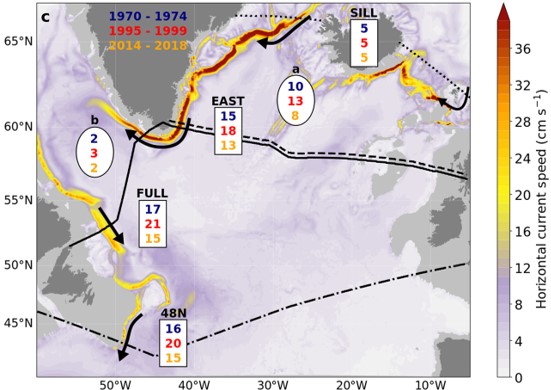
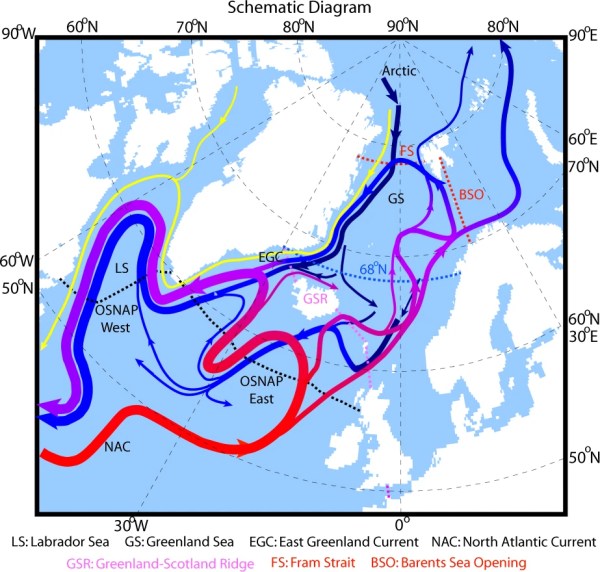
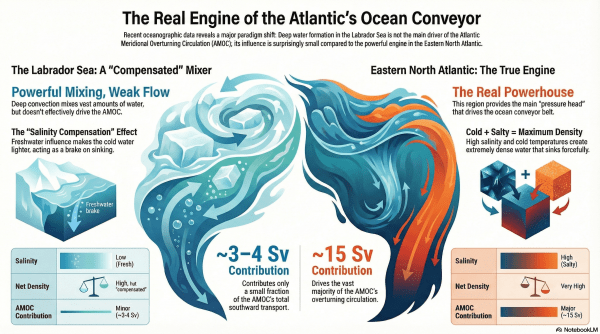
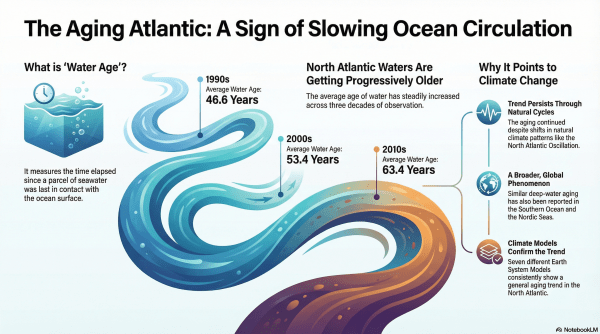
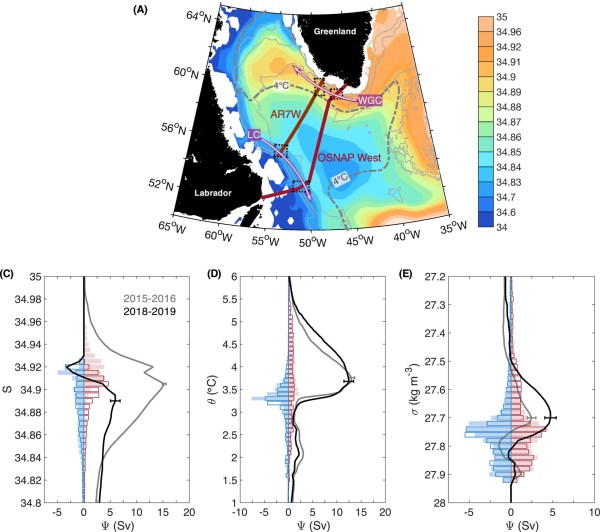
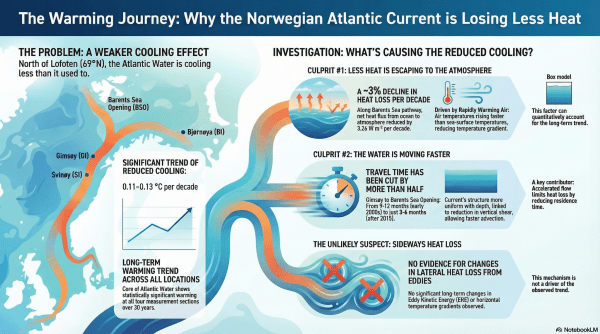
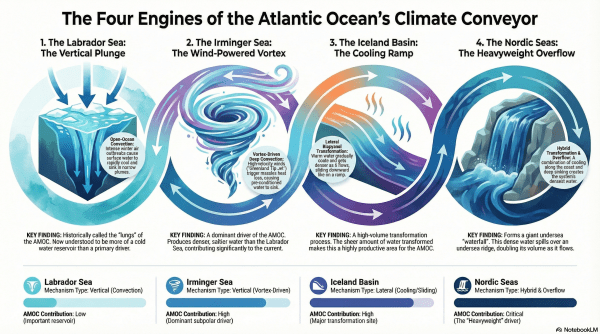
The current state-of-the-art climate models suggest that the human-induced weakening of the Atlantic Meridional Overturning Circulation (AMOC) has already begun since the mid-1980s. However, continuous direct observational records during the past two decades have shown no clear sign of a slowing down of the AMOC. To shed light on this apparent contradiction, a new study... Continue Reading →
Storm-resolving climate models project a 36% increase in the year-to-year variability of Atlantic hurricane activity by the 2050s
Tropical cyclone (TC) activity results in substantial loss of life and property damage. While the Atlantic basin has experienced a pronounced increase in accumulated cyclone energy (ACE) and the number of TCs over the past 50 years, TC-resolving climate models project a slight decrease in TC frequency throughout the 21st century (e.g., Roberts et al.,... Continue Reading →
The annual mean AMOC in 2022 is the lowest after its biggest drop in 2009
Scientists have been monitoring the Atlantic Meridional Overturning Circulation (AMOC) at around 26.5°N since April 2004 through the RAPID/Meridional Overturning Circulation and Heatflux Array/Western Boundary Time Series moored array (RAPID). The newly released RAPID dataset fully incorporated a recent geomagnetic correction of the submarine cable measurement of the Florida Current transport, a critical component of... Continue Reading →
France’s floating ocean laboratory is a future hub of international Arctic research collaboration
As of 2024, there are currently 70 permanent research stations from 29 countries scattered around the continent of Antarctica conducting important scientific research to better understand the Earth system and its changes due to human activity. In the Arctic, however, there are no such permanent research stations because there is no land in the Arctic.... Continue Reading →
The Labrador Current restricts the Arctic freshwater-induced weakening of the AMOC
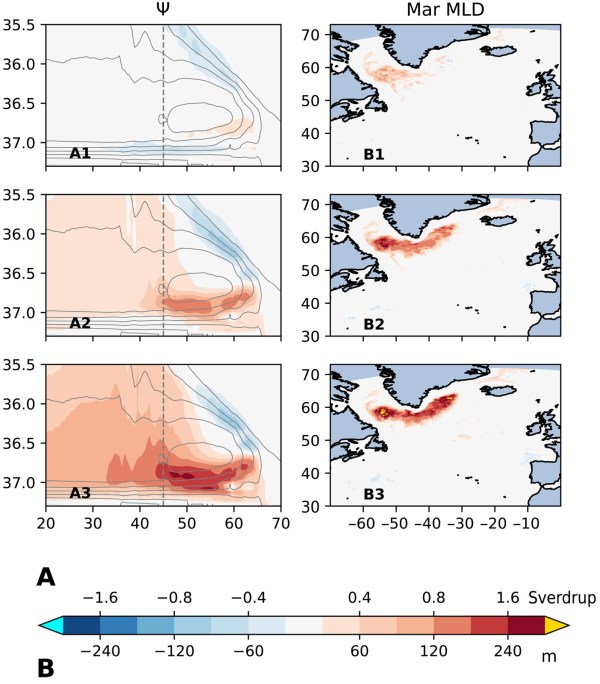
The Labrador Sea is one of the main regions where the surface Atlantic water loses its heat to the atmosphere (thus gets heavier) and sinks into the deep ocean, producing what's known as deep ocean convection that mainly drives the Atlantic Meridional Ocean Circulation (AMOC). It is also characterized by the Labrador Current, a strong... Continue Reading →
Geomagnetic correction of submarine cable measurement revealed no significant trend in the Gulf Stream transport since 1982
The Florida Current (FC) refers to the Gulf Stream across the Florida Straits between Florida and the Bahamas. Its volume transport has been measured continuously since 1982 using submarine cables across the Florida Straits at 27°N by NOAA's Atlantic Oceanographic and Meteorological Laboratory (AOML). A previous study (Piecuch and Beal, 2023) reported that the FC... Continue Reading →
Increasing ocean stratification intensifies sea surface temperature variability
As the surface ocean warms and polar ice sheets melt due to increasing anthropogenic greenhouse gases in the atmosphere, near-surface ocean stratification is increasing almost everywhere. In tropical and subtropical oceans, in particular, enhanced near-surface stratification inhibits the mixing between warmer surface water and cooler subsurface water, leading to a shallower surface mixed layer. In... Continue Reading →
Increasing frequency of “moist” heatwaves
Heatwaves usually come with dry conditions because the regions under the so-called heat dome, which is typically responsible for severe heatwave events, are deprived of moisture and rainfall. However, in the southern US states under semi-tropical environments, "moist" heatwave events may occur, causing both the temperature and humidity stresses on human physiology. But, you may... Continue Reading →
Human-induced ozone depletion has acted to enhance the La Niña-like SST trend pattern
During the satellite era (1979-present), the tropical Pacific Ocean has warmed significantly less than the other tropical oceans in response to increasing greenhouse gases (GHGs). This La Niña-like warming trend in observations is in disagreement with the El Niño-like warming trend projected by the Coupled Model Intercomparison Project (CMIP) models for both the 20th and... Continue Reading →
Quad-State Tornado Outbreaks promoted by a long-lived PNA
On December 10, 2021, one of the most destructive winter tornado outbreaks developed in northeastern Arkansas. This tornado outbreak, later coined as the Quad-State Tornado Outbreaks by the news media, struck portions of the Ohio Valley, including Missouri, Illinois, Tennessee, and Kentucky, from December 10 to 11, 2021. According to the National Oceanic and Atmospheric... Continue Reading →