
Mass loss from the West Antarctic ice shelves and glaciers has been linked to basal melt by ocean heat flux. The Totten Ice Shelf in East Antarctica, which buttresses a marine-based ice sheet with a volume equivalent to at least 3.5 m of global sea-level rise, also experiences rapid basal melt, but the role of... Continue Reading →
Arctic sea-ice decline weakens the Atlantic Meridional Overturning Circulation
The ongoing decline of Arctic sea ice exposes the ocean to anomalous surface heat and freshwater fluxes, resulting in positive buoyancy anomalies that can affect ocean circulation. In this study, we use an optimal flux perturbation framework and comprehensive climate model simulations to estimate the sensitivity of the Atlantic Meridional Overturning Circulation (AMOC) to such... Continue Reading →
The North Atlantic Oscillation as a driver of rapid climate change in the Northern Hemisphere
Pronounced climate changes have occurred since the 1970s, including rapid loss of Arctic sea ice, large-scale warming and increased tropical storm activity in the Atlantic. Anthropogenic radiative forcing is likely to have played a major role in these changes, but the relative influence of anthropogenic forcing and natural variability is not well established. The above... Continue Reading →
The influence of environmental variability on the biogeography of coccolithophores and diatoms in the Great Calcite Belt
The Great Calcite Belt (GCB), a region of high calcite concentration from coccolithophores, covers 60 % of the Southern Ocean area. We examined the influence of temperature, macronutrients, and carbonate chemistry on the distribution of mineralizing phytoplankton in the GCB. Coccolithophores occupy a niche in the Southern Ocean after the diatom spring bloom depletes silicic acid.... Continue Reading →
The role of Atlantic overturning circulation in the recent decline of Atlantic major hurricane frequency
Observed Atlantic major hurricane frequency has exhibited pronounced multidecadal variability since the 1940s. However, the cause of this variability is debated. Using observations and a coupled earth system model (GFDL-ESM2G), here we show that the decline of the Atlantic major hurricane frequency during 2005–2015 is associated with a weakening of the Atlantic Meridional Overturning Circulation... Continue Reading →
Carbon uptake and biogeochemical change in the Southern Ocean, south of Tasmania
The carbon content of the water masses of the Southern Ocean south of Tasmania has increased over the period 1995–2011, leading to a general decrease in pH. An enhancement in the upwelling of DIC-rich deep waters is the main plausible cause of the increase in carbon in surface waters south of the Polar Front. North... Continue Reading →
Pacific origin of the abrupt increase in Indian Ocean heat content during the warming hiatus

Global mean surface warming has stalled since the end of the 20th century, but the net radiation imbalance at the top of the atmosphere continues to suggest an increasingly warming planet. This apparent contradiction has been reconciled by an anomalous heat flux into the Pacific Ocean, induced by a shift toward a La Nina-like state... Continue Reading →
Wind-driven ocean dynamics impact on the contrasting sea-ice trends around West Antarctic
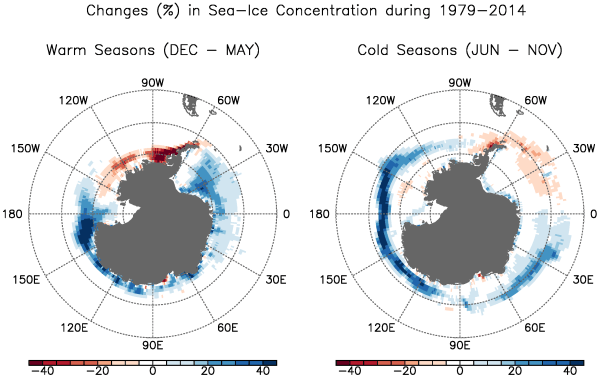
Since late 1978, Antarctic sea-ice extent has overall expanded in all seasons in stark contrast to the retreating Arctic sea-ice extent. However, while the sea-ice extent around East Antarctica has increased monotonically, the sea-ice around West Antarctica exhibits regionally and seasonally inhomogeneous trends. For instance, Antarctic sea-ice extent in the East Pacific has decreased substantially... Continue Reading →
The defining characteristics of ENSO extremes and the strong 2015/16 El Niño
The El Niño Southern Oscillation (ENSO) continues to boast its prominence as Earth's strongest source of year-to-year climate variability with the appearance of a remarkable El Niño event in the boreal winter of 2015. The 2015/16 El Niño was indeed a strong event with dramatic impact on a global scale. However, it exhibited distinct characteristics... Continue Reading →
 Ocean to Climate