Carbon uptake and biogeochemical change in the Southern Ocean, south of Tasmania

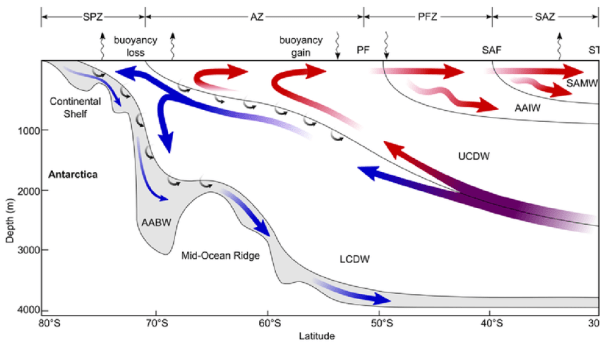
The carbon content of the water masses of the Southern Ocean south of Tasmania has increased over the period 1995–2011, leading to a general decrease in pH. An enhancement in the upwelling of DIC-rich deep waters is the main plausible cause of the increase in carbon in surface waters south of the Polar Front. North... Continue Reading →

Pacific origin of the abrupt increase in Indian Ocean heat content during the warming hiatus

Global mean surface warming has stalled since the end of the 20th century, but the net radiation imbalance at the top of the atmosphere continues to suggest an increasingly warming planet. This apparent contradiction has been reconciled by an anomalous heat flux into the Pacific Ocean, induced by a shift toward a La Nina-like state... Continue Reading →

Wind-driven ocean dynamics impact on the contrasting sea-ice trends around West Antarctic

Since late 1978, Antarctic sea-ice extent has overall expanded in all seasons in stark contrast to the retreating Arctic sea-ice extent. However, while the sea-ice extent around East Antarctica has increased monotonically, the sea-ice around West Antarctica exhibits regionally and seasonally inhomogeneous trends. For instance, Antarctic sea-ice extent in the East Pacific has decreased substantially... Continue Reading →

The defining characteristics of ENSO extremes and the strong 2015/16 El Niño

The El Niño Southern Oscillation (ENSO) continues to boast its prominence as Earth's strongest source of year-to-year climate variability with the appearance of a remarkable El Niño event in the boreal winter of 2015. The 2015/16 El Niño was indeed a strong event with dramatic impact on a global scale. However, it exhibited distinct characteristics... Continue Reading →

Website Powered by WordPress.com.

Up ↑