More Than an Emission: How Rising Waste Heat Are Cooking North America

This blog post and the “Deep Dive” podcast, created by NotebookLM, are based on “Energy‐Consumption‐Induced Anthropogenic Heat Release Intensifies Heatwaves and Wildfire Threats in North America: A CESM2‐Based Projection for the Late 21st Century” by Wang et al. (2025). When we talk about climate change, the conversation almost invariably turns to greenhouse gases. Carbon dioxide,... Continue Reading →

Why Rising Seas Could Lower a Hurricane’s Peak Surge—But Drown a Wider Area

This blog post and the “Deep Dive” podcast, created by NotebookLM, are based on “Combined impacts of hurricane strengthening and global mean sea level rise on future Atlantic storm surge events” by Danso et al. (2025). It’s a scenario that seems frighteningly straightforward: as climate change causes sea levels to rise and hurricanes to strengthen,... Continue Reading →

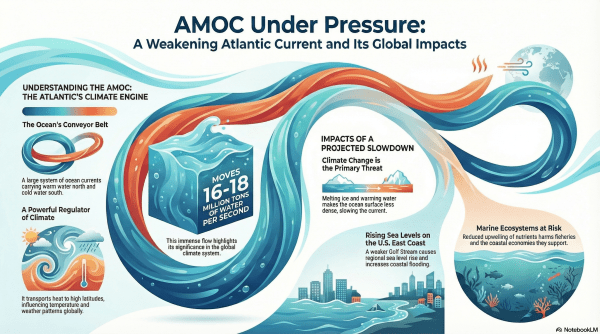
The Atlantic’s Weakening Pulse: How a Slowing Ocean Current Could Reshape Our Climate and Coasts

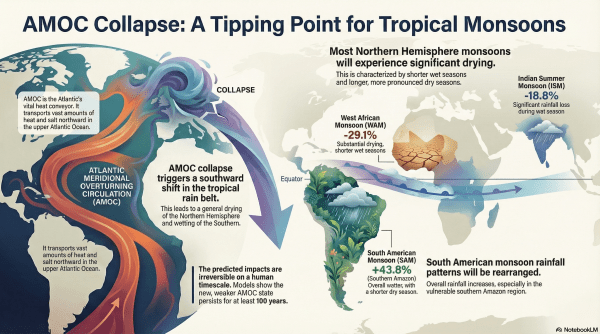
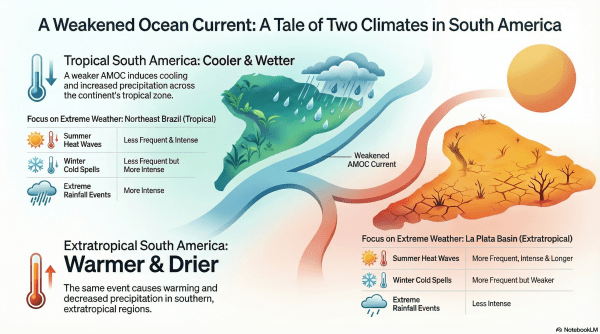
This blog post and the “Deep Dive” podcast, created by NotebookLM, are based on "State of the Science Fact Sheet: Atlantic Meridional Overturning Circulation (AMOC)" by NOAA Science Council. This NOAA fact sheet briefly explains the Atlantic Meridional Overturning Circulation (AMOC), defining it as a critical ocean current that transports heat, salt, and carbon by... Continue Reading →

TWISO is a tropics-wide 45-day pulse and does not requires MJO

This blog post and the “Deep Dive” podcast on a paper “Tropics-wide intraseasonal oscillations” by Bao et al. (2025) was created by NotebookLM. Deep Dive Podcast “Earth's Global Climate Heartbeat The TWISO Cycle” powered by NotebookLM: 1.0 Introduction: The Stable Tropics Aren't So Stable When we think about the climate of the tropics, we tend... Continue Reading →

The Atlantic’s Slowing “Heartbeat”: How a Fading Ocean Current Is Silencing a Major Climate Pattern

This blog post and the “Debate” podcast on a paper “Atlantic Meridional Overturning Circulation slowdown suppresses Atlantic Niño variability” by Freire-SouzaLi et al. (2025) was created by NotebookLM. Debate Podcast: This is different from Deep Dive Podcast. This is a debate between two hosts, illuminating different perspectives on the study, “Meltwater or Warming Drives Atlantic... Continue Reading →

Seasonal outlook of hurricane activity for five North Atlantic sub-basins

Seasonal hurricane outlooks, such as those issued by NOAA's Climate Prediction Center, Colorado State University (Klotzbach et al., 2017), European Center for Medium-Range Weather Forecasts, and University of Arizona (Davis and Zeng, 2019), produce skillful (i.e.,. better than climatology) seasonal forecasts of overall North Atlantic tropical cyclone (TC) activity. Such forecasts are possible because seasonal... Continue Reading →

Synergy effect of warm Atlantic-Pacific on the longest-lasting 2023 western North American heat wave

The southwestern United States (US) and Northern Mexico experienced their longest stretch of record-breaking heat wave in the summer of 2023 from mid-June to early August, affecting over 100 million people, causing over 200 deaths, and $14.5 billion in economic loss. In Phoenix, Arizona, for example, the heat wave lasted for 31 days from 30... Continue Reading →

Onset of 2025 Atlantic Niña and its implication for typhoon landfalling risks in East and Southeast Asian countries

Atlantic Niña is a natural climate pattern characterized by cooler-than-average sea surface temperatures in the eastern equatorial Atlantic Ocean, appearing predominantly in June-August. It is considered the 'cold phase' of the Atlantic Zonal Mode, the leading mode of tropical Atlantic sea surface temperature variability in June-August, similar to how La Niña is the cold phase... Continue Reading →

Onset of 2025 Atlantic Niña: What it means for the Atlantic hurricane season (updated)

Atlantic Niña is a natural climate pattern characterized by cooler-than-average sea surface temperatures in the eastern equatorial Atlantic Ocean. It’s considered the 'cold phase' of what oceanographers call the Atlantic Zonal Mode, similar to how La Niña is the cold phase of the El Niño-Southern Oscillation (ENSO) in the Pacific. Looking at the latest NOAA... Continue Reading →

Storm-resolving climate models project a 36% increase in the year-to-year variability of Atlantic hurricane activity by the 2050s

Tropical cyclone (TC) activity results in substantial loss of life and property damage. While the Atlantic basin has experienced a pronounced increase in accumulated cyclone energy (ACE) and the number of TCs over the past 50 years, TC-resolving climate models project a slight decrease in TC frequency throughout the 21st century (e.g., Roberts et al.,... Continue Reading →

Website Powered by WordPress.com.

Up ↑