Quad-State Tornado Outbreaks promoted by a long-lived PNA

On December 10, 2021, one of the most destructive winter tornado outbreaks developed in northeastern Arkansas. This tornado outbreak, later coined as the Quad-State Tornado Outbreaks by the news media, struck portions of the Ohio Valley, including Missouri, Illinois, Tennessee, and Kentucky, from December 10 to 11, 2021. According to the National Oceanic and Atmospheric... Continue Reading →

MJO-driven onset of the 2021 Atlantic Niño

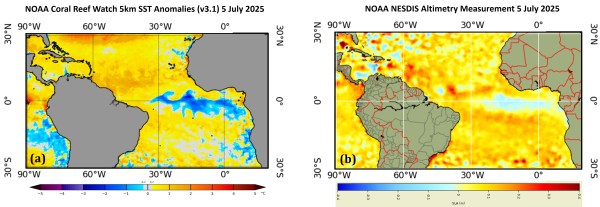
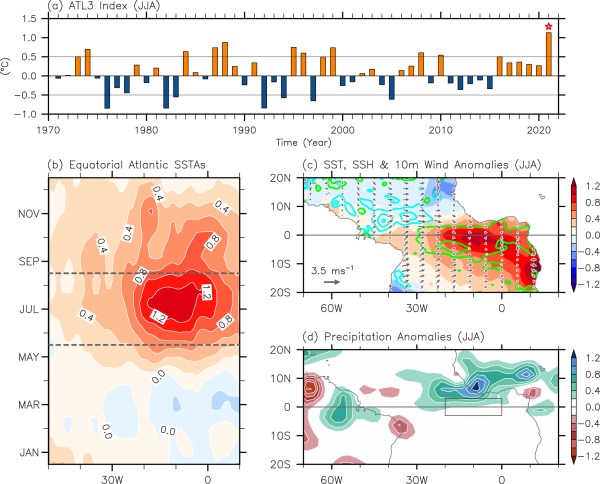
Atlantic Niño is the Atlantic counterpart of El Niño in the Pacific, often referred to as El Niño's little brother. It was previously thought to have only regional influence on rainfall variability in West Africa, but a growing number of studies have shown that Atlantic Niño also plays an important role in the development of... Continue Reading →

El Niño’s little brother in the Atlantic may not be so little when it comes to its impact on hurricanes

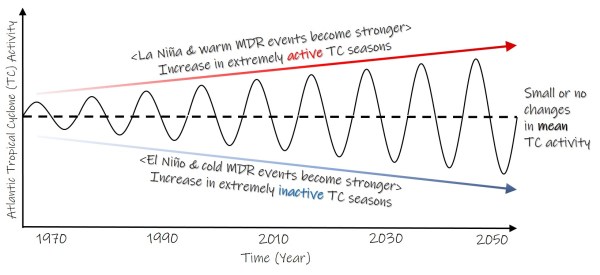
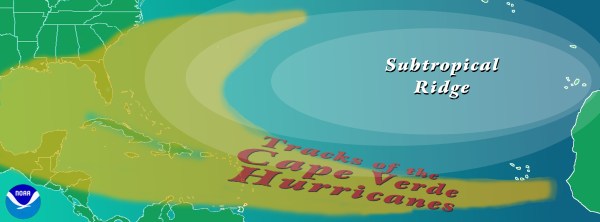
Atlantic Niño, characterized by warm sea surface temperature (SST) anomalies in the eastern equatorial Atlantic, is the Atlantic counterpart of the Pacific El Niño. Due to its smaller size in zonal extent, it is often referred to as El Niño’s little brother. It was previously thought to have a limited regional influence on rainfall variability... Continue Reading →

Java-Sumatra Niño/Niña: two long-lost siblings of El Niño

There are many siblings, cousins, and distant relatives of El Niño spanning the Pacific, Atlantic, and Indian Oceans who share a feature in common: ocean surface temperature anomalies along eastern boundaries linked to changes in the upwelling of cooler water from below. So far, climate scientists have identified a total of 14 members of this... Continue Reading →

Future El Niño events will develop faster and persist longer

Previous studies based on the climate models participating in the Coupled Model Intercomparison Project (CMIP) have suggested an increase in the frequency of extreme El Niño events in the 21st Century in response to increasing greenhouse gases. Several studies have attributed these shifts in El Niño frequency and amplitude to the projected changes in the... Continue Reading →

ENSO plays little role in early-season Atlantic hurricane activity

This is a guest blog by Robert West. Robert is a postdoctoral research associate in the Northern Gulf Institute (NGI) at the Mississippi State University and is also affiliated with NOAA's Atlantic Oceanographic and Meteorological Laboratory. Differences in sea surface temperature anomalies (SSTAs) between the tropical Atlantic and Pacific oceans are known to influence atmospheric... Continue Reading →

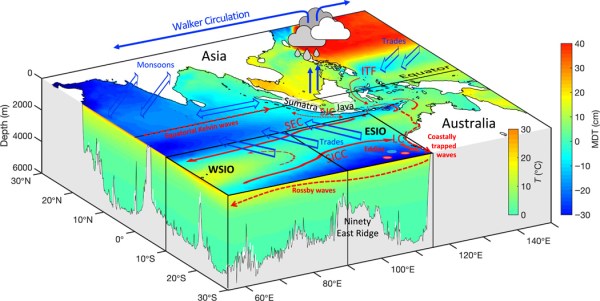
What caused the abrupt reduction of the South Indian Ocean heat & sea level in 2014–2016 and the ensuing quick recovery?

A decade-long increase of the basin-wide sea level and heat content in the subtropical southern Indian Ocean (SIO) during 2004–2013 ended abruptly, immediately following the onset of the strong 2014–2016 El Niño. Interestingly, this unprecedented drop of the SIO heat quickly recovered during the weak 2017–2018 La Niña. A study recently published in Science Advances... Continue Reading →

Co-variability of Pacific‐Atlantic SST contrast, Caribbean Sea tropical rainfall and U.S. summer to fall rainfall variability

In the U.S., peak summer (June-July) rainfall variability, especially east of the Rockies, is largely linked to North Atlantic sea surface temperature (SST) anomalies and associated variations in the Bermuda High. However, these well-established relationships almost completely break down in late summer to mid fall (August-October). Thus, operational seasonal forecast models have generally low skill... Continue Reading →

MJO-induced drying air across Central America may be a precursor to active weeks of U.S. tornadoes

The National Oceanic and Atmospheric Administration’s Storm Prediction Center (NOAA SPC) provides one- to eight-day severe weather forecast for the U.S. that includes tornado watch. To extend the current severe weather forecast beyond eight days to 2 - 4 weeks (i.e., subseasonal time scale), many studies have looked into the Madden-Julian Oscillation (MJO), a patch... Continue Reading →

Atlantic Multidecadal Oscillation (AMO) modulates North Atlantic atmospheric blocking

Atmospheric blocking over the high-latitude North Atlantic blocks the westerly jet stream, causing the eastward propagation of weather systems to stall for 7 days or so. An earlier study  by Häkkinen et al. (2011) used the 20th century atmospheric reanalysis product of NOAA (20CR) to show that the wintertime blocking frequency over high latitude North Atlantic covaries... Continue Reading →

Website Powered by WordPress.com.

Up ↑