TWISO is a tropics-wide 45-day pulse and does not requires MJO

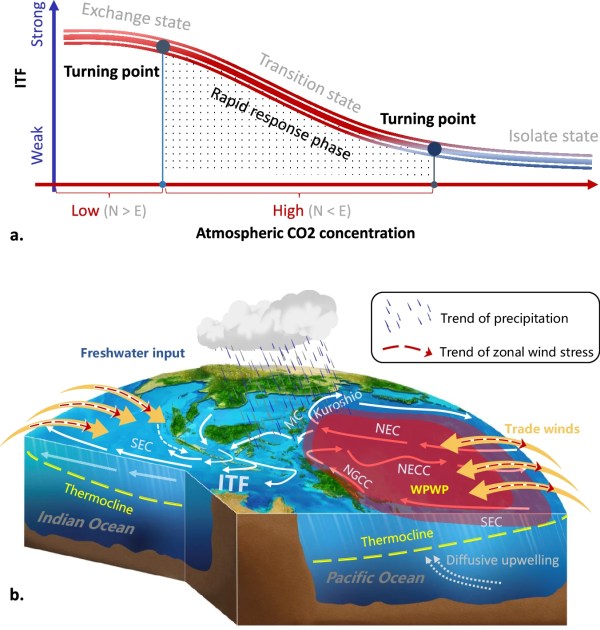
This blog post and the “Deep Dive” podcast on a paper “Tropics-wide intraseasonal oscillations” by Bao et al. (2025) was created by NotebookLM. Deep Dive Podcast “Earth's Global Climate Heartbeat The TWISO Cycle” powered by NotebookLM: 1.0 Introduction: The Stable Tropics Aren't So Stable When we think about the climate of the tropics, we tend... Continue Reading →

The Atlantic’s ‘Warming Hole’ Isn’t What You Think: 5 Surprising Truths From New Climate Research

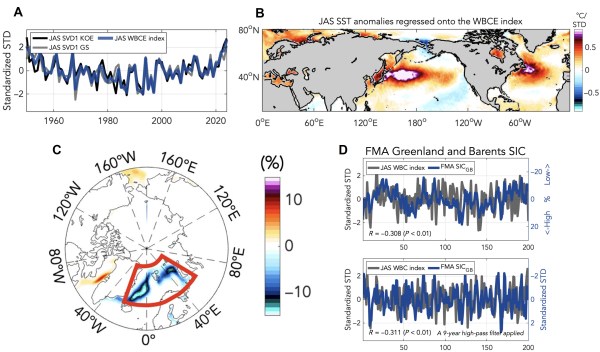
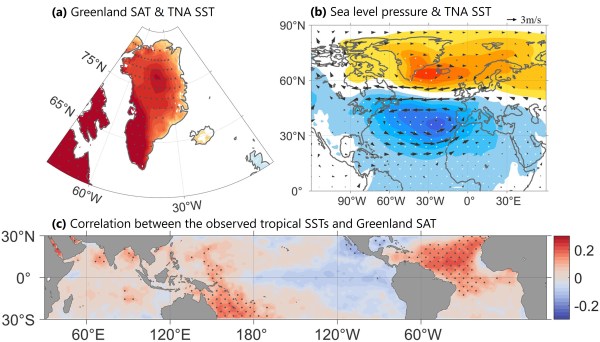
This blog post and the "Deep Drive" podcast on a new paper "Atmosphere-driven processes in shaping long-term climate variability in Greenland and the broader subpolar North Atlantic" by Li et al. (2025) was created by NotebookLM. Deep Dive Podcast "The Wind-Driven Mystery of the North Atlantic Warming Hole: How Atmospheric Swings Orchestrate Ocean Heat and... Continue Reading →

Seasonal outlook of hurricane activity for five North Atlantic sub-basins

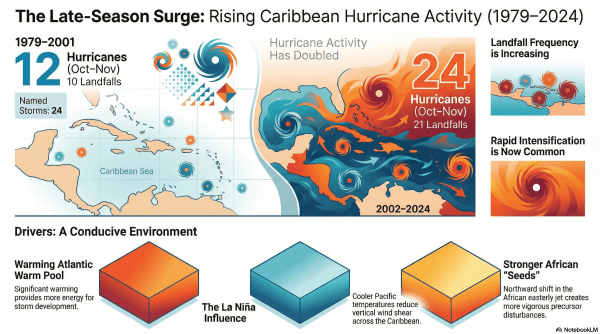
Seasonal hurricane outlooks, such as those issued by NOAA's Climate Prediction Center, Colorado State University (Klotzbach et al., 2017), European Center for Medium-Range Weather Forecasts, and University of Arizona (Davis and Zeng, 2019), produce skillful (i.e.,. better than climatology) seasonal forecasts of overall North Atlantic tropical cyclone (TC) activity. Such forecasts are possible because seasonal... Continue Reading →

Synergy effect of warm Atlantic-Pacific on the longest-lasting 2023 western North American heat wave

The southwestern United States (US) and Northern Mexico experienced their longest stretch of record-breaking heat wave in the summer of 2023 from mid-June to early August, affecting over 100 million people, causing over 200 deaths, and $14.5 billion in economic loss. In Phoenix, Arizona, for example, the heat wave lasted for 31 days from 30... Continue Reading →

Onset of 2025 Atlantic Niña and its implication for typhoon landfalling risks in East and Southeast Asian countries

Atlantic Niña is a natural climate pattern characterized by cooler-than-average sea surface temperatures in the eastern equatorial Atlantic Ocean, appearing predominantly in June-August. It is considered the 'cold phase' of the Atlantic Zonal Mode, the leading mode of tropical Atlantic sea surface temperature variability in June-August, similar to how La Niña is the cold phase... Continue Reading →

Onset of 2025 Atlantic Niña: What it means for the Atlantic hurricane season (updated)

Atlantic Niña is a natural climate pattern characterized by cooler-than-average sea surface temperatures in the eastern equatorial Atlantic Ocean. It’s considered the 'cold phase' of what oceanographers call the Atlantic Zonal Mode, similar to how La Niña is the cold phase of the El Niño-Southern Oscillation (ENSO) in the Pacific. Looking at the latest NOAA... Continue Reading →

AI’s summary of the signal-to-noise paradox related to the NAO

I asked Gemini (Flash 2.5) about the signal-to-noise paradox regarding the North Atlantic Oscillation, which is one of the emerging new ideas (or concepts) in climate research. Here is the reply. Yes, I am familiar with the signal-to-noise paradox, especially as it relates to the North Atlantic Oscillation (NAO). It's a significant and intriguing challenge... Continue Reading →

Increasing ocean stratification intensifies sea surface temperature variability

As the surface ocean warms and polar ice sheets melt due to increasing anthropogenic greenhouse gases in the atmosphere, near-surface ocean stratification is increasing almost everywhere. In tropical and subtropical oceans, in particular, enhanced near-surface stratification inhibits the mixing between warmer surface water and cooler subsurface water, leading to a shallower surface mixed layer. In... Continue Reading →

Human-induced ozone depletion has acted to enhance the La Niña-like SST trend pattern

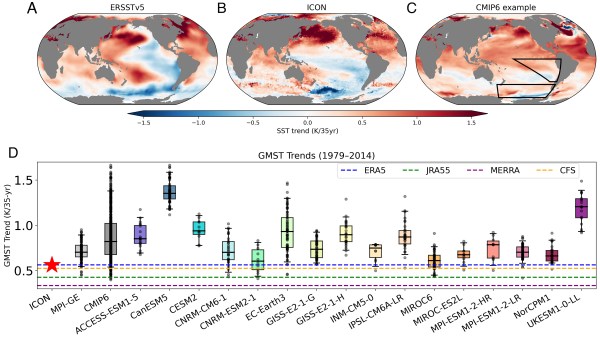
During the satellite era (1979-present), the tropical Pacific Ocean has warmed significantly less than the other tropical oceans in response to increasing greenhouse gases (GHGs). This La Niña-like warming trend in observations is in disagreement with the El Niño-like warming trend projected by the Coupled Model Intercomparison Project (CMIP) models for both the 20th and... Continue Reading →

ENSO forecasts extended to 18 months?

According to the recharge-discharge oscillator theory (Jin, 1997), the leading mode of tropical Pacific upper ocean heat content anomalies is a predictor (or a precursor) for the onset of El Niño - Southern Oscillation (ENSO) at the interannual time scale. A new study published in Nature (Zhao et al., 2024) utilized multiple global sea surface... Continue Reading →

Website Powered by WordPress.com.

Up ↑