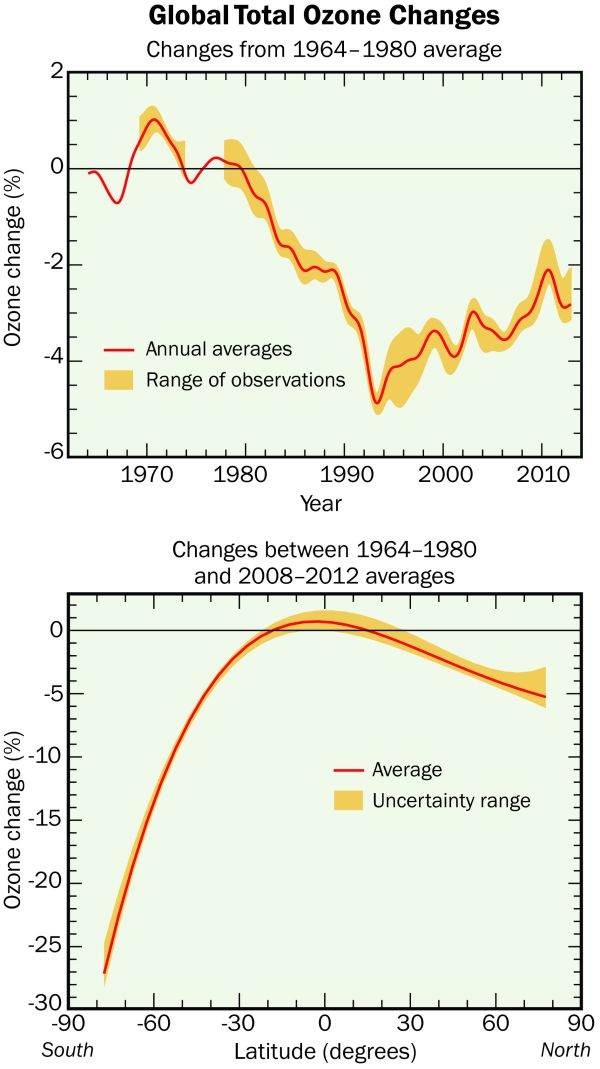
This new paper published in Science suggests that as the tropical oceans get warmer, ocean emissions of methyl bromide (CH3Br) and other short-lived ozone-depleting substances will increase, slowing down the ongoing ozone recovery. Image credit: Scientific assessment of ozone depletion 2014 http://science.sciencemag.org/content/358/6368/1257 https://www.esrl.noaa.gov/research/themes/o3/ http://science.sciencemag.org/content/353/6296/269
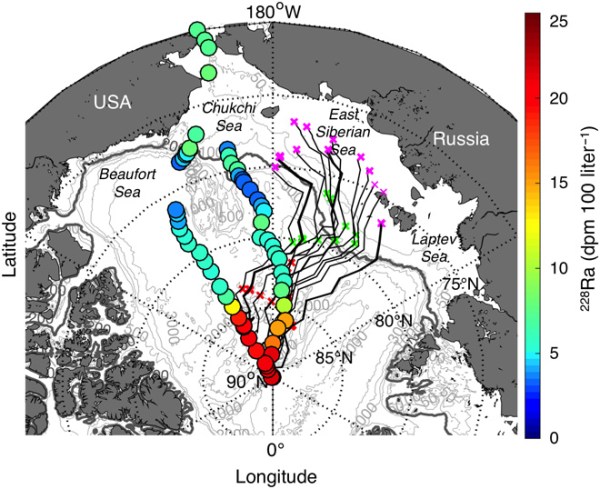
Arctic report card: update for 2017
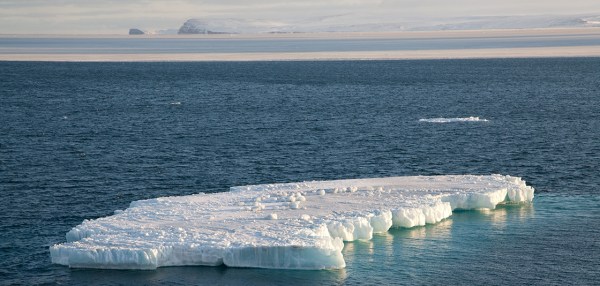
NOAA's Arctic program released Arctic Report Card Update for 2017. The report finds "Arctic shows no sign of returning to reliably frozen region of recent past decades", "The sea ice cover continues to be relatively young and thin with older, thicker ice comprising only 21% of the ice cover in 2017 compared to 45% in 1985.", and... Continue Reading →
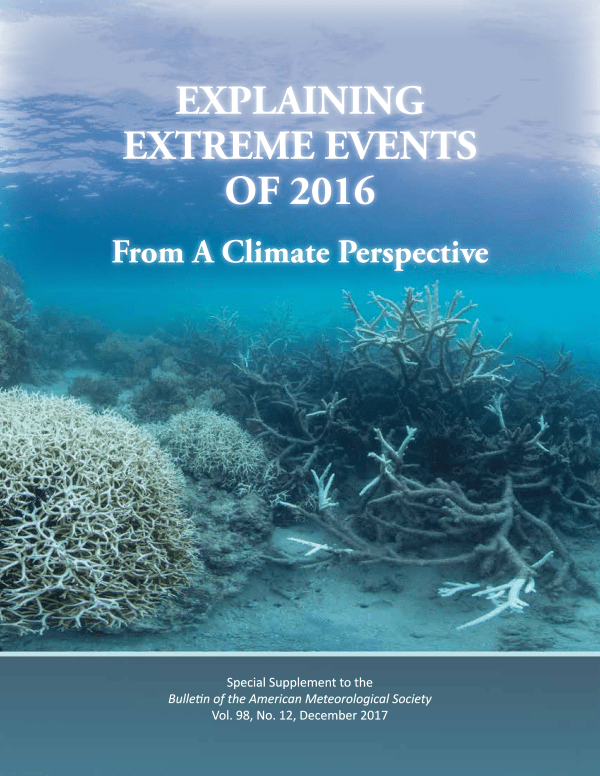
Explaining extreme events from a climate perspective
This special report of the Bulletin of the American Meteorological Society (BAMS) presents some extreme events in 2016, such as the record global heat, the heat across Asia, the 2015-16 El Niño and a marine heat wave off the coast of Alaska, and discusses how human-caused climate change may have affected the strength and likelihood of these extreme events.... Continue Reading →
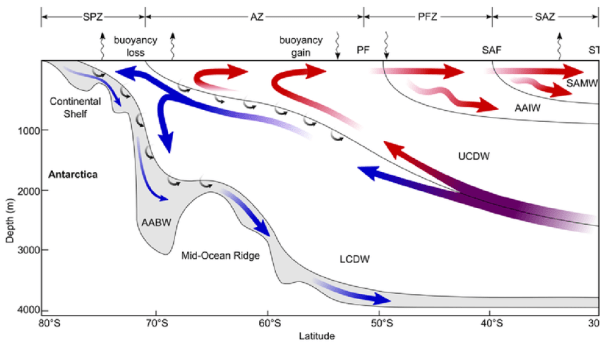
Global atmospheric teleconnections and multidecadal climate oscillations driven by Southern Ocean convection
A 1000-yr control simulation in a low-resolution coupled atmosphere–ocean model from the Geophysical Fluid Dynamics Laboratory (GFDL) family of climate models shows a natural, highly regular multidecadal oscillation between periods of Southern Ocean (SO) open-ocean convection and nonconvective periods. It is shown here that convective periods are associated with warming of the SO sea surface... Continue Reading →
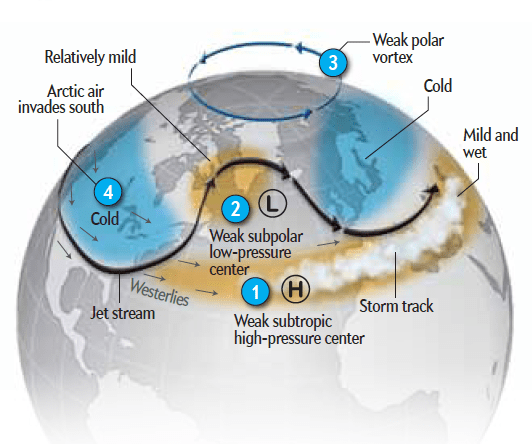
Future loss of Arctic sea-ice cover could drive a substantial decrease in California’s rainfall
From 2012 to 2016, California experienced one of the worst droughts since the start of observational records. As in previous dry periods, precipitation-inducing winter storms were steered away from California by a persistent atmospheric ridging system in the North Pacific. Here we identify a new link between Arctic sea-ice loss and the North Pacific geopotential... Continue Reading →
Deep oceans may acidify faster than anticipated due to global warming
Oceans worldwide are undergoing acidification due to the penetration of anthropogenic CO2 from the atmosphere. The rate of acidification generally diminishes with increasing depth. Yet, slowing down of the thermohaline circulation due to global warming could reduce the pH in the deep oceans, as more organic material would decompose with a longer residence time. To... Continue Reading →
Highlights of the findings of the U.S. global change research program climate science special report
This executive summary presents the Fourth National Climate Assessment (NCA4), an authoritative assessment of the science of climate change, with a focus on the United States. This represents the first of two volumes of the Fourth National Climate Assessment, mandated by the Global Change Research Act of 1990. https://science2017.globalchange.gov/chapter/executive-summary/
The reinvigoration of the Southern Ocean carbon sink
Several studies have suggested that the carbon sink in the Southern Ocean—the ocean’s strongest region for the uptake of anthropogenic CO2 —has weakened in recent decades. We demonstrated, on the basis of multidecadal analyses of surface ocean CO2 observations, that this weakening trend stopped around 2002, and by 2012, the Southern Ocean had regained its... Continue Reading →
Ocean heat drives rapid basal melt of the Totten Ice Shelf
Mass loss from the West Antarctic ice shelves and glaciers has been linked to basal melt by ocean heat flux. The Totten Ice Shelf in East Antarctica, which buttresses a marine-based ice sheet with a volume equivalent to at least 3.5 m of global sea-level rise, also experiences rapid basal melt, but the role of... Continue Reading →
Arctic sea-ice decline weakens the Atlantic Meridional Overturning Circulation
The ongoing decline of Arctic sea ice exposes the ocean to anomalous surface heat and freshwater fluxes, resulting in positive buoyancy anomalies that can affect ocean circulation. In this study, we use an optimal flux perturbation framework and comprehensive climate model simulations to estimate the sensitivity of the Atlantic Meridional Overturning Circulation (AMOC) to such... Continue Reading →