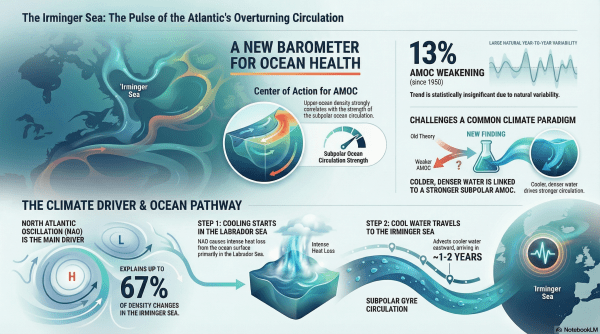
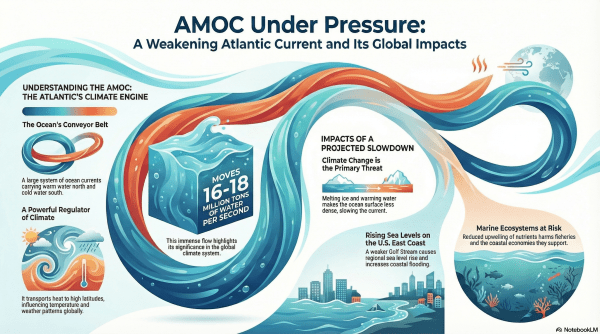
This blog post and the “Deep Dive” podcast on a paper “A pause in the weakening of the Atlantic meridional overturning circulation since the early 2010s” by Lee et al. (2024) was created by NotebookLM. Deep Dive Podcast “Atlantic Current Stability Is Borrowed Time” powered by NotebookLM: Introduction: The Ocean's Alarming Story Just Got More... Continue Reading →
AI’s summary of the signal-to-noise paradox related to the NAO
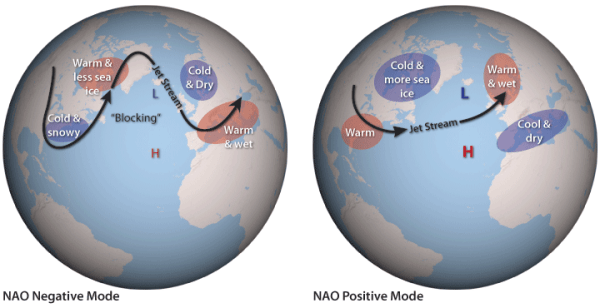
I asked Gemini (Flash 2.5) about the signal-to-noise paradox regarding the North Atlantic Oscillation, which is one of the emerging new ideas (or concepts) in climate research. Here is the reply. Yes, I am familiar with the signal-to-noise paradox, especially as it relates to the North Atlantic Oscillation (NAO). It's a significant and intriguing challenge... Continue Reading →
Future strengthening of the Antarctic Slope Current and its potential implications for global sea level rise
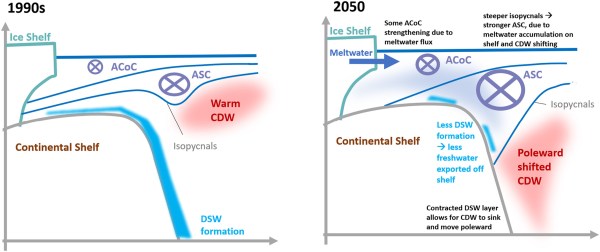
The Antarctic Slope Current (ASC) is the westward-flowing coastal current system around Antarctica, largely driven by easterly winds. It serves as a barrier to heat and salt exchanges between the cold, fresh Antarctic ice shelf region and the warm, salty Circumpolar Deep Water (CDW) in the Southern Ocean. A weakening of the ASC allows more... Continue Reading →
A note on the potential AMOC collapse for nonexperts
As the Earth warms due to anthropogenic climate change, sea- and land-based ice melts, adding buoyant freshwater to the surface of the high-latitude North Atlantic and thus decreasing salinity. This makes the surface water lighter reducing the sinking of the surface water and thus the AMOC. However, the amount of added freshwater is not enough... Continue Reading →
The annual mean AMOC in 2022 is the lowest after its biggest drop in 2009
Scientists have been monitoring the Atlantic Meridional Overturning Circulation (AMOC) at around 26.5°N since April 2004 through the RAPID/Meridional Overturning Circulation and Heatflux Array/Western Boundary Time Series moored array (RAPID). The newly released RAPID dataset fully incorporated a recent geomagnetic correction of the submarine cable measurement of the Florida Current transport, a critical component of... Continue Reading →
France’s floating ocean laboratory is a future hub of international Arctic research collaboration
As of 2024, there are currently 70 permanent research stations from 29 countries scattered around the continent of Antarctica conducting important scientific research to better understand the Earth system and its changes due to human activity. In the Arctic, however, there are no such permanent research stations because there is no land in the Arctic.... Continue Reading →
The Labrador Current restricts the Arctic freshwater-induced weakening of the AMOC
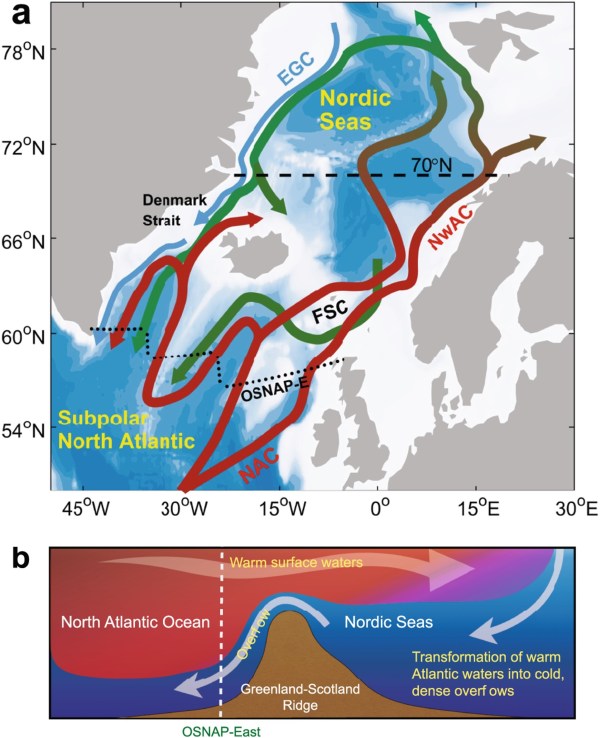
The Labrador Sea is one of the main regions where the surface Atlantic water loses its heat to the atmosphere (thus gets heavier) and sinks into the deep ocean, producing what's known as deep ocean convection that mainly drives the Atlantic Meridional Ocean Circulation (AMOC). It is also characterized by the Labrador Current, a strong... Continue Reading →
Human-induced ozone depletion has acted to enhance the La Niña-like SST trend pattern
During the satellite era (1979-present), the tropical Pacific Ocean has warmed significantly less than the other tropical oceans in response to increasing greenhouse gases (GHGs). This La Niña-like warming trend in observations is in disagreement with the El Niño-like warming trend projected by the Coupled Model Intercomparison Project (CMIP) models for both the 20th and... Continue Reading →
AMOC collapse is unlikely in the near future
A new study published in Science (Zhou and McManus, 2024) reconstructed the land ice melting (or discharge) rate during the intermittent events of ice melting in the last glacial period (i.e., Heinrich events). The study showed that the present-day Greenland Ice Sheet melting rate (since the 1980s) is comparable to that during weak-to-moderate strength Heinrich events. This... Continue Reading →
Sustained ocean measurements at 34°S crucial for estimating the distance to an AMOC collapse
The Atlantic Meridional Overturning Circulation (AMOC) transports warm and salty upper ocean water to the subpolar North Atlantic where the upper ocean releases some heat to the atmosphere. Due to the surface cooling and the high salinity (i.e., salty), the upper ocean water becomes heavier and thus sinks down to the deep ocean and then... Continue Reading →